




China Clothing OEM Supplier: How to Choose the Right Manufacturing Partner
Datum zveřejnění:2026-09-28 Kategorie:NOVINKY Počet zobrazení:576
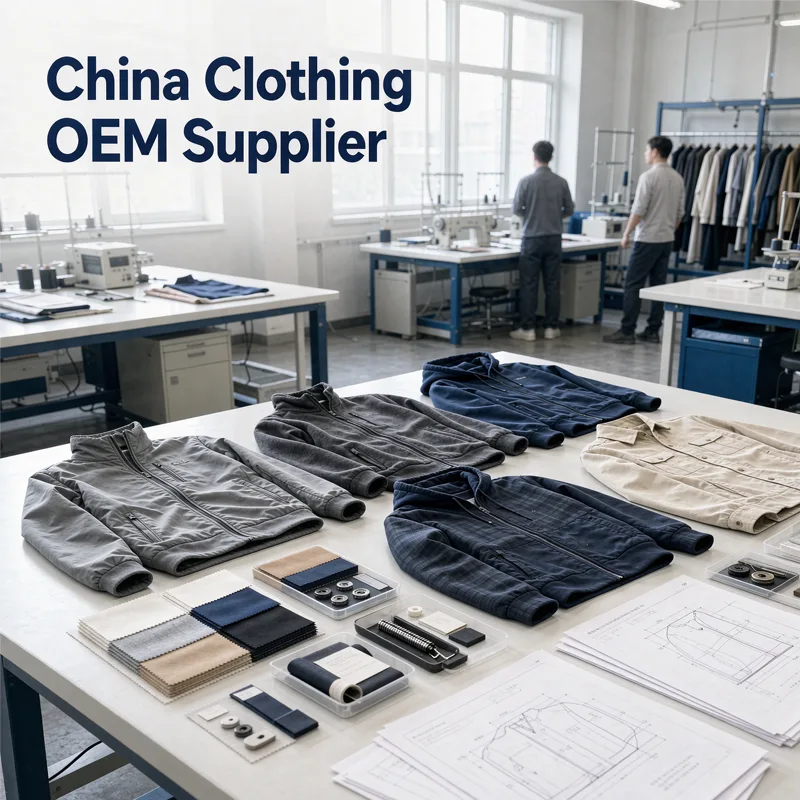
Choosing the right China clothing OEM supplier can affect your product quality, production cost, delivery schedule, and long-term brand growth.
The right supplier should do more than manufacture garments. It should understand your specifications, develop accurate samples, control bulk production, communicate clearly, and scale with your order requirements.
For international clothing brands, retailers, wholesalers, and private-label businesses, the key is not finding the supplier with the lowest quote.
It is finding an OEM partner that can consistently turn your specifications into production-ready clothing.
This guide explains how to evaluate a China clothing OEM supplier, compare factories, understand MOQ and pricing, manage samples, reduce production risks, and prepare a better inquiry.
1. What Is a China Clothing OEM Supplier?
A China clothing OEM supplier manufactures apparel according to a buyer's own designs, specifications, samples, or technical requirements.
OEM stands for Original Equipment Manufacturing.
Instead of buying ready-made clothing from a wholesaler, the buyer works with a manufacturer to produce garments for its own brand or business.
Typical OEM requirements include:
- Tech packs
- Technical drawings
- Existing garment samples
- Measurement charts
- Fabric specifications
- Color references
- Trim specifications
- Size requirements
- Label artwork
- Požadavky na balení
The manufacturer converts these requirements into finished garments.
1.1 OEM Supplier vs Clothing Wholesaler
These two business models are different.
| Factor | OEM Supplier | Wholesale Supplier |
|---|---|---|
| Product design | Buyer-defined | Usually supplier-defined |
| Přizpůsobení | High | Limited |
| Budování značky | Custom | Often standard |
| Látka | Can be specified | Usually predetermined |
| Rozměry | Custom possible | Standard sizes |
| Výroba | Made to order | Often ready stock |
| Nejvhodnější pro | Brands and private label | Resellers and retailers |
For example, a brand launching its own fleece jacket collection may need custom fabric, fit, labels, and packaging.
A wholesale supplier may not provide that level of control.
An OEM supplier can.
2. Why Do Brands Work With a China Clothing OEM Supplier?
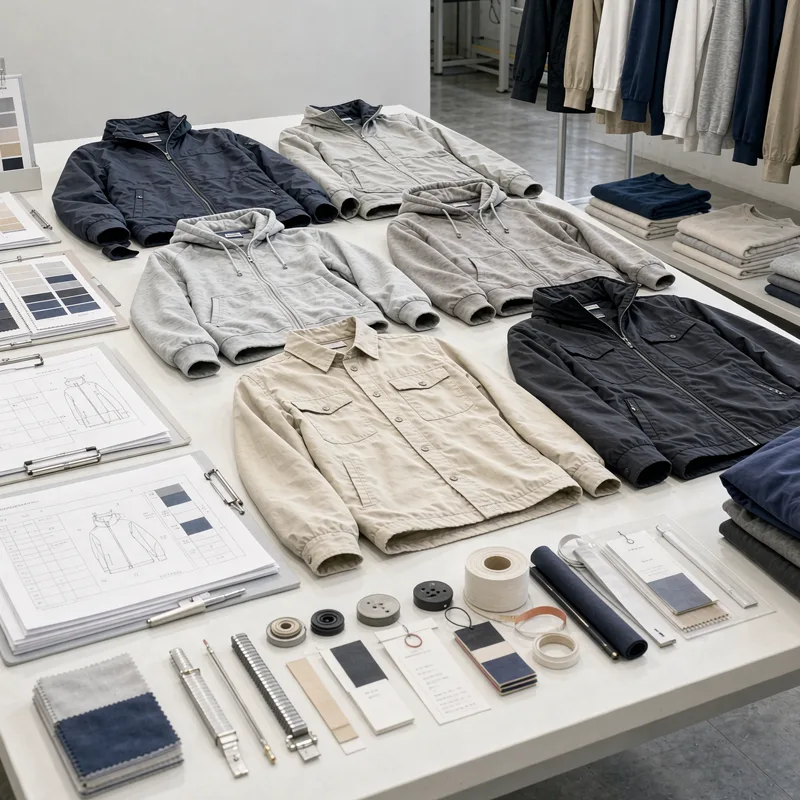
China has a large and established apparel manufacturing ecosystem.
According to the China National Garment Association, China's apparel and clothing accessory exports reached approximately US$159.15 billion in 2024. Knitwear exports also increased in physical volume during the year.
For buyers, the value of a China clothing OEM supplier is not simply manufacturing cost.
It can also come from access to:
- Fabric suppliers
- Trim suppliers
- Pattern development
- Sample rooms
- Cutting facilities
- Sewing production
- Dokončovací práce
- Quality inspection
- Balení
- Export experience
2.1 Access to a Complete Production Ecosystem
A clothing product rarely depends on sewing alone.
A jacket, for example, may require:
- Shell fabric
- Lining
- Zippers
- Snaps
- Štítky
- Interlining
- Drawcords
- Šití
- Dokončovací práce
- Balení
A supplier with stronger production coordination can simplify this process.
2.2 Flexible Product Development
Some buyers already have complete tech packs.
Others only have a product concept.
A capable supplier should be able to tell you which information is required before production.
That distinction becomes especially important when comparing OEM suppliers and ODM manufacturers.
3. OEM vs ODM: Which Supplier Should You Choose?
OEM and ODM are often used together, but they are not the same.
3.1 OEM Clothing Manufacturing
With OEM manufacturing, the buyer usually controls the product specifications.
The manufacturer follows the approved requirements.
This model works well when you already have:
- A complete tech pack
- Approved measurements
- Fabric specifications
- Construction details
- Existing samples
- Branding requirements
3.2 ODM Clothing Manufacturing
ODM stands for Original Design Manufacturing.
The manufacturer takes a more active role in product development.
Kupující může poskytnout:
- A product idea
- Reference photos
- Sketches
- Existing samples
- Market requirements
- Functional requirements
The manufacturer may then assist with:
- Výběr látky
- Pattern development
- Sample making
- Fit adjustment
- Stavebnictví
- Production preparation
3.3 OEM vs ODM Comparison
| Requirement | OEM | ODM |
|---|---|---|
| Buyer has complete design | ✓ | Optional |
| Tech pack available | ✓ | Optional |
| Pattern development | Based on specifications | Manufacturer can assist |
| Product development support | Limited | Higher |
| Sample development | Specification-driven | Collaborative |
| Nejvhodnější pro | Established products | New product development |
Example:
A sportswear brand already has a finished tech pack for a jacket.
OEM manufacturing may be the logical model.
A startup only has reference photos and a target price.
ODM support may be more useful.
The important question is not which model sounds better.
It is how much technical support your project actually requires.
4. How to Find a Reliable China Clothing OEM Supplier
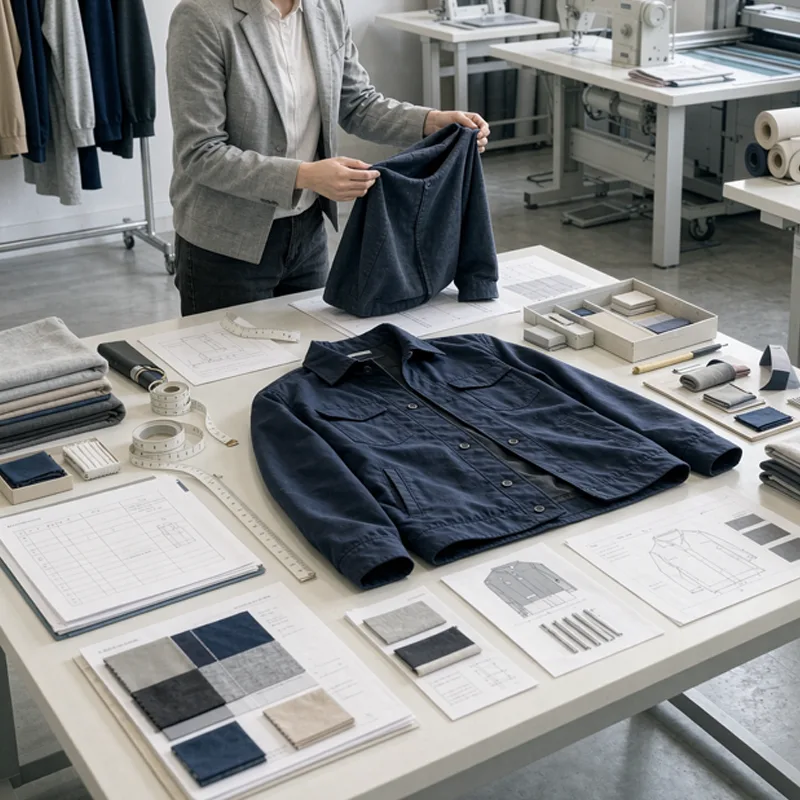
Searching for suppliers is easy.
Finding one that fits your project is harder.
Start with a structured evaluation.
4.1 Check Product Experience
Ask whether the supplier regularly produces your product category.
Relevant experience may include:
- Trička
- Mikiny s kapucí
- Mikiny
- Jackets
- Gilets
- Sportovní oblečení
- Activewear
- Outdoorwear
- Ležérní oblečení
- Children's apparel
- Tkané oděvy
- Knitwear
A supplier that understands your construction can identify problems earlier.
Example:
Suppose you need a fleece jacket with multiple panels, contrast trims, and functional pockets.
A factory that mainly produces simple promotional T-shirts may not have the same technical experience as a manufacturer regularly producing structured outerwear.
4.2 Check Manufacturing Scope
Ask what the supplier actually handles.
Questions should include:
- Where are samples developed?
- Where is cutting performed?
- Where is sewing performed?
- Which processes are outsourced?
- Who manages quality control?
- Who manages production scheduling?
- Where is final inspection completed?
Outsourcing is not automatically a problem.
The important issue is whether the production structure is transparent and properly managed.
4.3 Review Previous Product Examples
Do not only look at attractive product photography.
Look for evidence of:
- Construction quality
- Consistent stitching
- Fabric understanding
- Different product categories
- Customization experience
- Technical development
Product relevance matters more than the number of photos on a website.
5. What Should You Check Before Choosing a Clothing OEM Supplier?
A professional supplier evaluation should cover more than factory size.
5.1 Manufacturing Capability
Check:
- Production equipment
- Kategorie produktů
- Production processes
- Sample development
- Kontrola kvality
- Production planning
5.2 Technical Capability
Ask whether the supplier can work with:
- Tech packs
- CAD files
- Measurement charts
- Existing samples
- Fabric specifications
- Construction drawings
- Reference photographs
5.3 Customization Capability
Confirm whether the supplier can handle:
- Custom fabrics
- Custom colors
- Custom sizing
- Custom trims
- Štítky
- Hangtags
- Balení
- Private-label requirements
5.4 Communication Capability
A good supplier should be able to explain:
- What information is missing
- What production problems may occur
- What affects cost
- What affects lead time
- What needs sample approval
This is one of the easiest ways to distinguish a production partner from a simple quotation provider.
6. What MOQ Should You Expect From a China Clothing OEM Supplier?
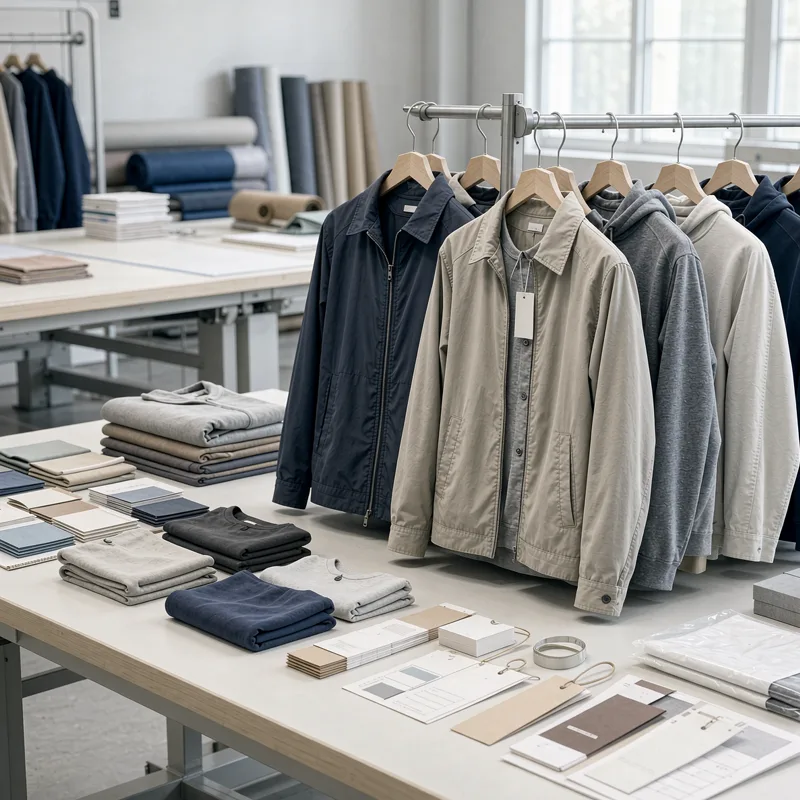
There is no universal MOQ for OEM clothing production.
Minimální objednávkové množství (MOQ) může záviset na:
- Product category
- Látka
- Barva
- Styl
- Construction complexity
- Přizpůsobení
- Fabric supplier requirements
- Výrobní proces
Some supplier marketplaces advertise very low MOQs, but buyers should not assume that one published MOQ applies to every custom product. Current marketplace listings show that advertised MOQs can vary significantly between suppliers and product types.
6.1 Ask the Right MOQ Question
Instead of asking:
“What is your MOQ?”
Ask:
“What is your MOQ per style, color, and fabric?”
Then ask whether there is a separate minimum for:
- Látka
- Custom color
- Custom trim
- Special finishing
- Balení
6.2 Example
Imagine a buyer wants:
- 2 jacket styles
- 3 colors per style
- Custom fabric
- Custom labels
- Custom packaging
A supplier may calculate MOQ at the style level, color level, or material level.
These differences can have a major effect on the final order structure.
Always get the MOQ definition in writing.
7. How Does the Clothing OEM Production Process Work?
A professional OEM project should follow a clear sequence.
7.1 Step 1: Product Brief
The buyer sends the available product information.
This may include:
- Product photos
- Sketches
- Tech packs
- Existing samples
- Rozměry
- Požadavky na látku
- Barvy
- Množství
- Branding requirements
7.2 Step 2: Technical Review
The supplier reviews the product.
The factory may identify:
- Difficult construction
- Material availability
- Measurement issues
- Production risks
- Cost drivers
- Sampling requirements
This stage is important because problems are cheaper to solve before production.
7.3 Step 3: Quotation
The supplier provides pricing based on the agreed specifications.
The quote should clarify:
- Unit price
- Minimální objednávkové množství
- Sample cost
- Material basis
- Přizpůsobení
- Balení
- Lead time
- Payment terms
- Shipping terms, where applicable
7.4 Step 4: Sample Development
The factory produces a sample.
The buyer checks:
- Vhodné
- Rozměry
- Látka
- Barva
- Stavebnictví
- Ozdobné lišty
- Budování značky
7.5 Step 5: Sample Approval
Do not move directly from an unapproved sample into bulk production.
Confirm the final specifications.
7.6 Step 6: Bulk Production
Once specifications are approved, production begins.
A typical workflow may include:
Material preparation → Cutting → Sewing → Finishing → Inspection → Packing
7.7 Step 7: Final Inspection
The finished garments are checked against the approved requirements.
This creates a traceable connection between:
Original specification → Approved sample → Bulk production
That connection is critical for quality consistency.
8. Why Is the Sample So Important in OEM Clothing Production?
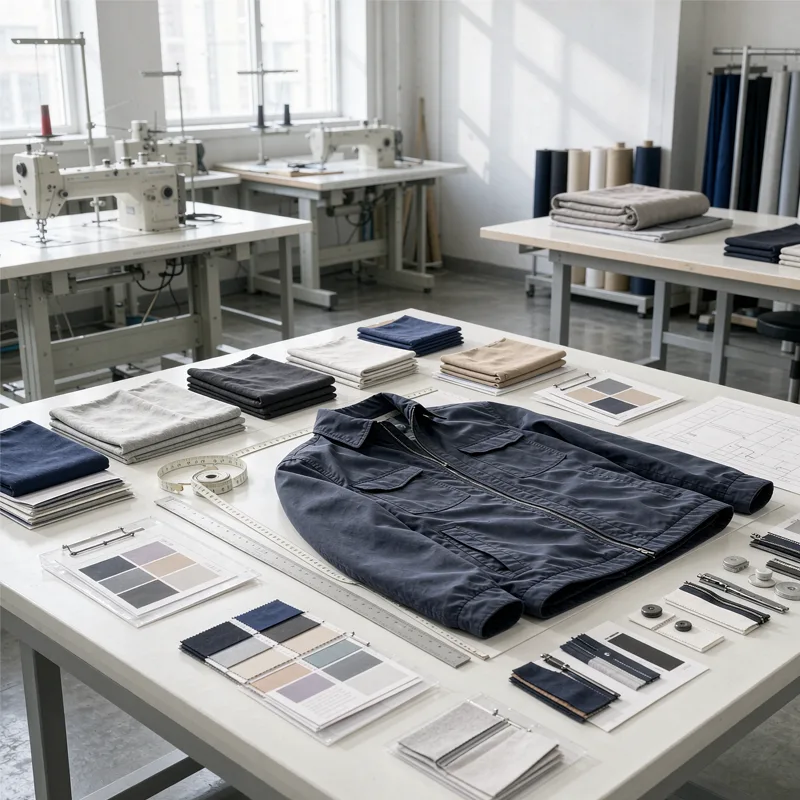
The sample is more than a visual preview.
It is a manufacturing reference.
A good sample can reveal problems before they affect thousands of garments.
8.1 What Should You Check?
Review:
- Chest measurement
- Body length
- Sleeve length
- Shoulder width
- Vhodné
- Gramáž látky
- Barva
- Šití
- Seam construction
- Zippers
- Buttons
- Štítky
- Balení
8.2 Example: A Small Measurement Problem
Imagine a jacket sample has a sleeve length that is 1.5 cm longer than expected.
That may seem minor.
But if the measurement is repeated across a large production run, the same issue can appear across the entire order.
The sample stage is therefore the right time to identify and correct it.
8.3 Create a Clear Approval Reference
Keep:
- Approved sample
- Final measurement chart
- Fabric information
- Color reference
- Trim specifications
- Label artwork
These documents create a shared production reference for both sides.
9. How to Compare China Clothing OEM Supplier Quotes
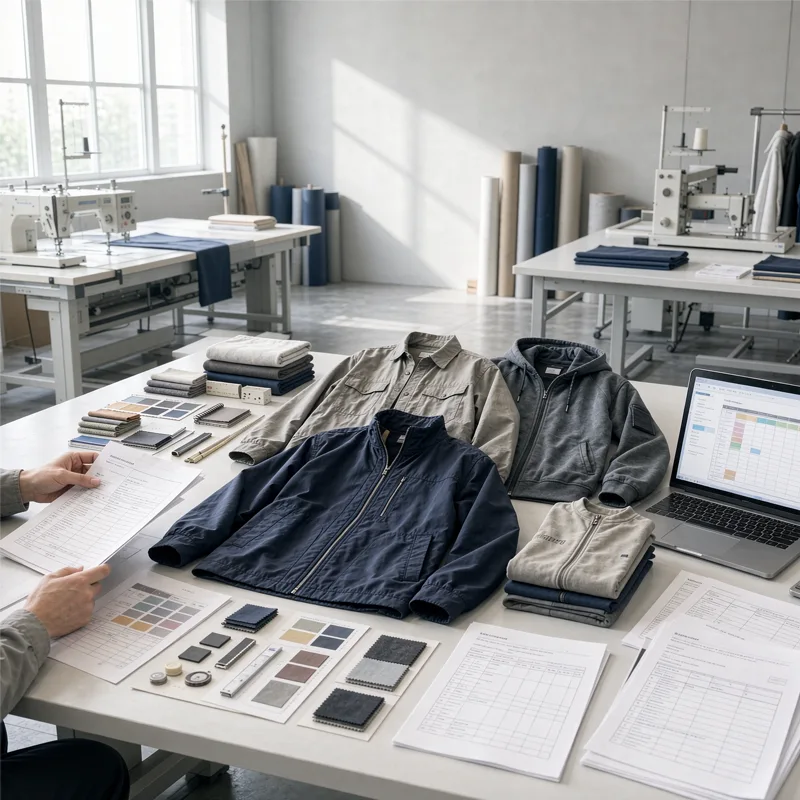
Never compare supplier quotes by unit price alone.
Two suppliers can quote different prices because they are quoting different products.
9.1 Compare Like With Like
Check the same:
- Složení látky
- Fabric GSM
- Stavebnictví
- Množství
- Color count
- Size range
- Ozdobné lišty
- Štítky
- Balení
- Inspection requirements
- Delivery terms
9.2 Example of a Quote Difference
Supplier A quotes $12.
Supplier B quotes $13.20.
At first glance, Supplier A looks cheaper.
But suppose Supplier A uses:
- Lower fabric GSM
- Standard packaging
- Different zipper
- Fewer customization details
while Supplier B includes your exact specifications.
The $1.20 difference is no longer a simple price comparison.
9.3 Use a Supplier Comparison Sheet
| Item | Supplier A | Supplier B | Supplier C |
|---|---|---|---|
| OEM production | Confirm | Confirm | Confirm |
| ODM support | Confirm | — | Confirm |
| Sample development | ✓ | ✓ | ✓ |
| Fabric sourcing | ✓ | Confirm | ✓ |
| Custom labels | ✓ | ✓ | ✓ |
| Balení | Confirm | ✓ | Confirm |
| Minimální objednávkové množství | Ask | Ask | Ask |
| Lead time | Confirm | Confirm | Confirm |
| QC process | Confirm | Confirm | Confirm |
This table should help you identify differences in the offer rather than simply select the lowest number.
10. How to Verify a China Clothing OEM Supplier
One of the biggest risks in international sourcing is assuming that every supplier describing itself as a “factory” operates the same way.
Verification should happen before a large order.
10.1 Ask About the Production Structure
Ask:
- Is the factory privately owned?
- Where is the production facility?
- Which processes are in-house?
- Which processes are outsourced?
- Where are samples developed?
- Who performs quality inspections?
- Who manages production?
10.2 Evaluate Technical Answers
Ask a technical question about your actual product.
Například:
“We need a 180 GSM polyester fleece jacket with a custom zipper and two-panel sleeve construction. What production issues should we consider?”
A knowledgeable supplier should be able to discuss the practical implications.
This is more useful than receiving a generic message saying:
“We are professional manufacturer with good quality and competitive price.”
10.3 Check Production Capacity Against Your Order
Annual capacity is only one part of the picture.
You also need to understand:
- Current production load
- Seasonal peaks
- Available production windows
- Number of styles
- Order complexity
- Required delivery date
A factory can have large annual capacity and still have limited availability for a specific month.
11. What Services Should a China Clothing OEM Supplier Offer?
Service scope differs between manufacturers.
However, many B2B buyers need more than basic sewing.
11.1 Material Sourcing
A supplier may help source:
- Knit fabrics
- Woven fabrics
- Fleece
- Linings
- Zippers
- Buttons
- Elastic
- Štítky
- Other trims
Material decisions affect both product performance and cost.
11.2 Pattern Development
Pattern development influences:
- Vhodné
- Garment appearance
- Fabric consumption
- Sewing efficiency
- Production consistency
11.3 Sample Development
A sample room should be able to translate your specifications into a physical garment.
11.4 Bulk Manufacturing
The supplier should have a clear process for:
- Material preparation
- Řezání
- Šití
- Dokončovací práce
- Kontrola
- Balení
11.5 Private Label
If you operate your own clothing brand, confirm whether the supplier supports:
- Woven labels
- Care labels
- Hangtags
- Printed labels
- Custom packaging
- Barcodes
- Cartons
Not every OEM supplier offers the same level of private-label support.
12. China OEM Factory vs Trading Company: What Is the Difference?
Not every supplier relationship is the same.
A factory generally focuses on manufacturing.
A trading company may coordinate manufacturing through one or more external factories.
Neither structure should be judged only by its label.
The key question is:
Who is responsible for your production, quality, communication, and delivery?
12.1 Factory Relationship
Potential advantages include:
- Direct technical communication
- Direct production coordination
- Better visibility into manufacturing
- Potentially simpler problem-solving
12.2 Trading Company Relationship
A trading company may provide:
- Supplier coordination
- Product sourcing
- Multi-factory access
- Consolidated communication
This can be useful when a buyer needs multiple product categories.
12.3 Questions to Ask
Before placing an order, clarify:
- Who manufactures the product?
- Who approves materials?
- Who controls production?
- Who performs QC?
- Who is responsible if specifications are not met?
The production structure should be transparent.
13. What Should You Send to a China Clothing OEM Supplier?
A detailed inquiry can save several rounds of questions.
13.1 Product Information
Send:
- Product category
- Reference photos
- Technical drawings
- Tech pack
- Existing sample
- Measurement chart
- Fabric specification
- Color reference
- Size range
13.2 Order Information
Include:
- Estimated quantity
- Number of styles
- Number of colors
- Expected delivery date
- Expected repeat order
13.3 Branding Information
Include:
- Logo artwork
- Štítky
- Hangtags
- Balení
- Carton requirements
13.4 Commercial Information
If possible, provide:
- Target market
- Target price range
- Shipping destination
- Required compliance or testing requirements
The goal is to give the supplier enough information to evaluate the project accurately.
14. Common Mistakes When Choosing a China Clothing OEM Supplier
14.1 Choosing Only the Lowest Price
Low pricing may reflect different assumptions.
Always compare specifications first.
14.2 Asking Only About MOQ
MOQ without context is not very useful.
Ask about:
- MOQ per style
- MOQ per color
- MOQ per fabric
- Fabric minimums
- Repeat-order requirements
14.3 Skipping Sample Approval
A sample is one of the most important risk-control stages.
Do not treat it as optional when product specifications are important.
14.4 Giving Vague Quality Requirements
Avoid:
“We need premium quality.”
Use measurable requirements instead.
Například:
- Složení látky
- GSM
- Measurement tolerance
- Stitching construction
- Trim specification
- Color reference
- Požadavky na balení
14.5 Ignoring Lead Time
Lead time depends on more than sewing.
It can include:
Material sourcing → Development → Sampling → Approval → Production → Inspection → Packing
A supplier should provide a realistic schedule based on your actual product.
15. How to Reduce Risk When Working With a New OEM Supplier
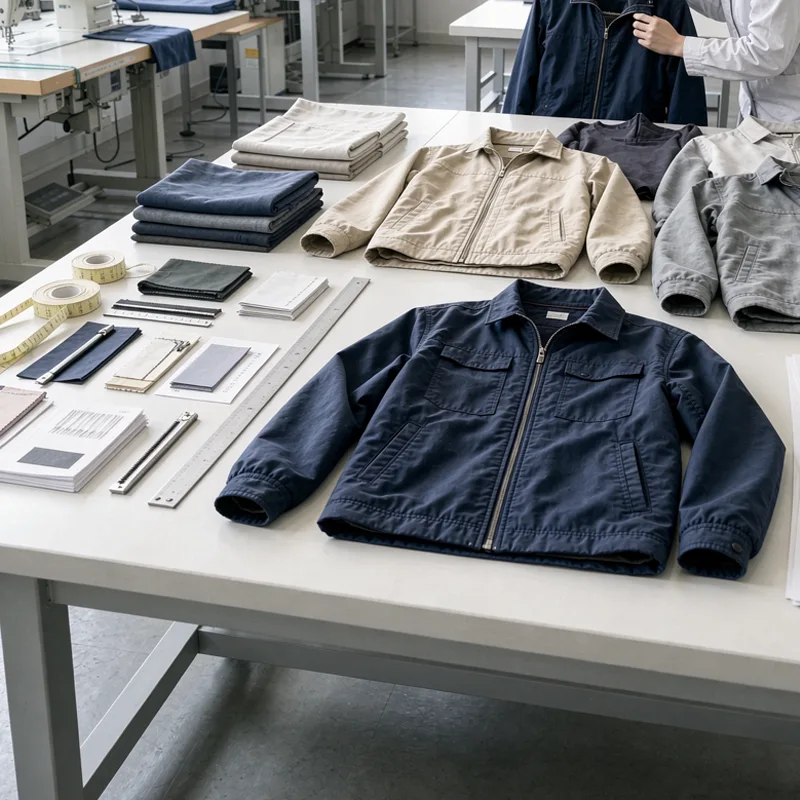
A first order should be treated as a validation stage.
15.1 Start With a Controlled Project
Before committing to a very large production program, evaluate:
- Sample quality
- Komunikace
- Production consistency
- Kontrola kvality
- Delivery performance
15.2 Document Everything
Keep a record of:
- Approved sample
- Tech pack
- Measurement chart
- Fabric specification
- Color approval
- Label artwork
- Požadavky na balení
- Final quotation
15.3 Define What “Approved” Means
An approved sample should not simply mean:
“Looks good.”
Define what has been approved.
Například:
| Area | Approval Reference |
|---|---|
| Látka | Composition + GSM |
| Vhodné | Measurement chart |
| Barva | Approved standard |
| Stavebnictví | Approved sample |
| Ozdobné lišty | Specified components |
| Budování značky | Final artwork |
| Balení | Final packing instructions |
This makes production expectations much clearer.
16. What Makes a Good China Clothing OEM Supplier?
A strong OEM supplier should be evaluated as a complete production partner.
16.1 Technical Understanding
Can the supplier understand your product specifications?
16.2 Sample Accuracy
Can it turn specifications into an accurate sample?
16.3 Production Consistency
Can the factory reproduce the approved sample during bulk production?
16.4 Quality Management
Does it have a defined quality-control process?
16.5 Communication
Can it identify problems and explain solutions clearly?
16.6 Production Planning
Can it provide a realistic schedule based on your order?
16.7 Customization
Can it support the fabrics, trims, labels, and packaging your brand requires?
A supplier does not need to be perfect in every category.
But the closer the manufacturing capabilities match your actual requirements, the easier the project becomes to manage.
17. What About KALAIBEN as a China Clothing OEM Supplier?
KALAIBEN is one example of a China-based apparel manufacturer providing OEM and ODM services.
According to its official company information, KALAIBEN specializes in knitted and woven apparel, including casualwear, sportswear, outdoorwear, children's apparel, travelwear, and lifestyle clothing. It states that its manufacturing operation includes approximately 6,000㎡ of facilities, more than 700 specialized machines, nearly 700 employees, and approximately 600,000 pieces or sets of annual production capacity.
Its official FAQ also states that buyers can provide technical drawings, tech packs, sketches, reference photographs, or existing samples, with support for pattern development and sample production. It also offers private-label options such as custom labels, hangtags, logos, and packaging.
For buyers evaluating an OEM supplier, these capabilities are useful to compare against their own product requirements rather than treating factory size alone as the deciding factor.
18. China Clothing OEM Supplier: Buyer Checklist
Before placing an order, review the following checklist.
| Area | Questions |
|---|---|
| Produkt | Does the supplier make similar garments? |
| OEM | Can it follow your specifications? |
| ODM | Can it assist if your design is incomplete? |
| Materials | Can it source the required fabric? |
| Odběr vzorků | How does sample approval work? |
| Minimální objednávkové množství | Is MOQ per style, color, or fabric? |
| Kvalita | How is bulk production inspected? |
| Capacity | Is production capacity available when needed? |
| Přizpůsobení | Can it provide labels and packaging? |
| Komunikace | Are technical details confirmed in writing? |
| Lead time | Is the schedule based on your actual product? |
| Výroba | Is the manufacturing structure transparent? |
| Pricing | Are all quote assumptions clearly defined? |
If the supplier cannot answer these questions clearly, ask for clarification before moving to bulk production.
19. How to Choose the Right China Clothing OEM Supplier
The right China clothing OEM supplier is not necessarily the cheapest supplier or the largest factory.
It is the supplier whose manufacturing system fits your product.
Before choosing a partner, verify five things:
- Can it make your product correctly?
- Can it develop an accurate sample?
- Can it maintain quality during bulk production?
- Can it meet your required production schedule?
- Can it communicate and solve problems effectively?
Then compare the commercial details:
- Minimální objednávkové množství
- Unit price
- Sample cost
- Požadavky na látku
- Přizpůsobení
- Balení
- Lead time
- Payment terms
- Podmínky dodání
The strongest sourcing process is not:
Find supplier → Get price → Place order.
A safer process is:
Define product → Shortlist suppliers → Verify capabilities → Develop sample → Approve specifications → Confirm quotation → Produce bulk order → Inspect → Review supplier performance
That process gives both the buyer and the manufacturer a clearer path from product idea to finished apparel.
For brands looking for a long-term China clothing OEM supplier, the goal should be more than completing one order.
The goal is to build a production relationship that can support better products, repeat orders, stable quality, and controlled growth.











