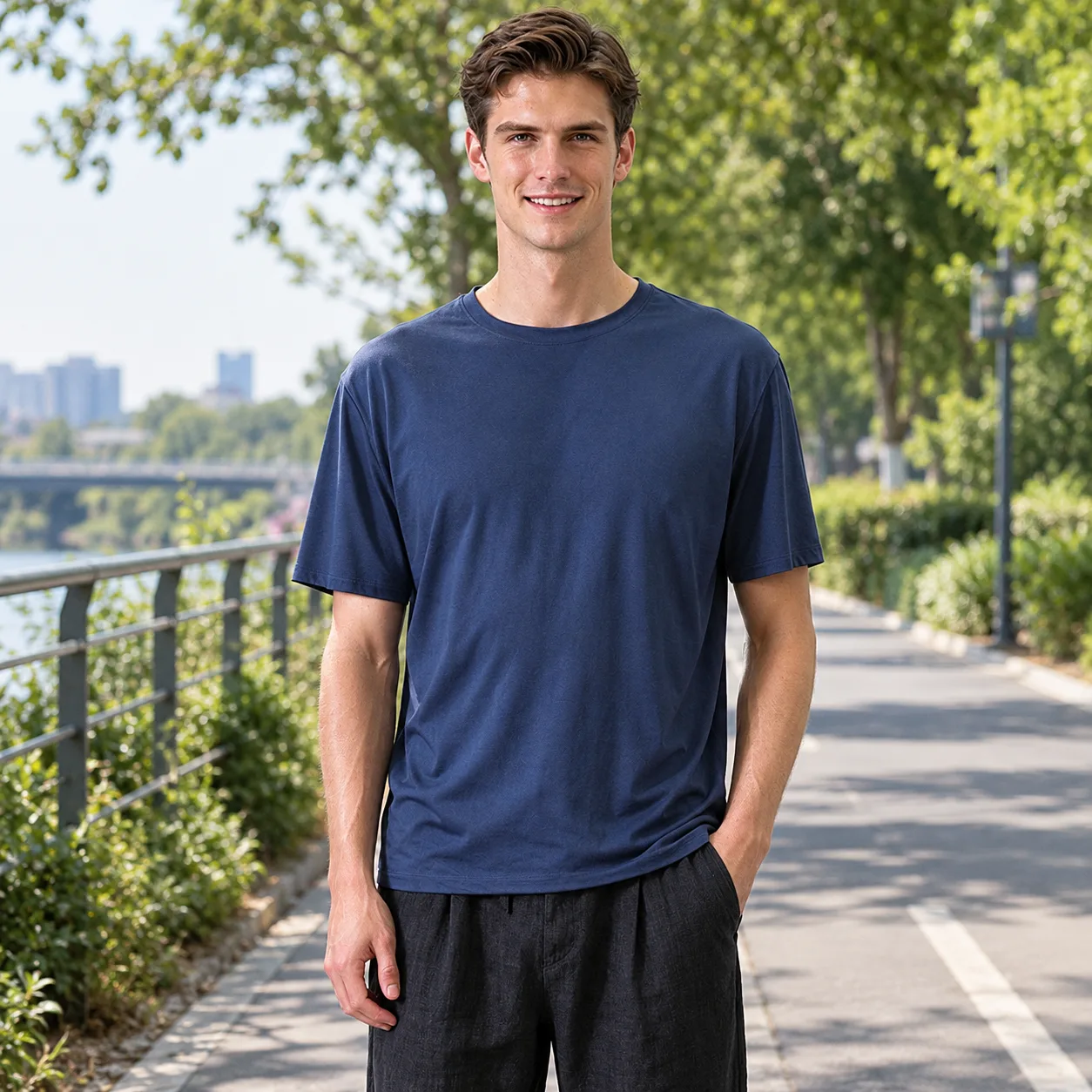
UPF 50+ Men's Short Sleeve T-Shirt: 100% Polyester Interlock at 120 GSM Explained
Julkaisupäivä:2026-10-08 Luokka:UUTISET Katselukerrat:392
If you're sourcing a men's short sleeve t-shirt that delivers UPF 50+ sun protection alongside moisture-wicking and quick-dry performance, a 100% polyester interlock knit at 120 GSM may be the most cost-effective solution on the B2B market. This article breaks down the fabric engineering behind this configuration and explains why it strikes the optimal balance between UV protection durability and wearing comfort.
What Is a UPF 50+ Men's Short Sleeve T-Shirt?
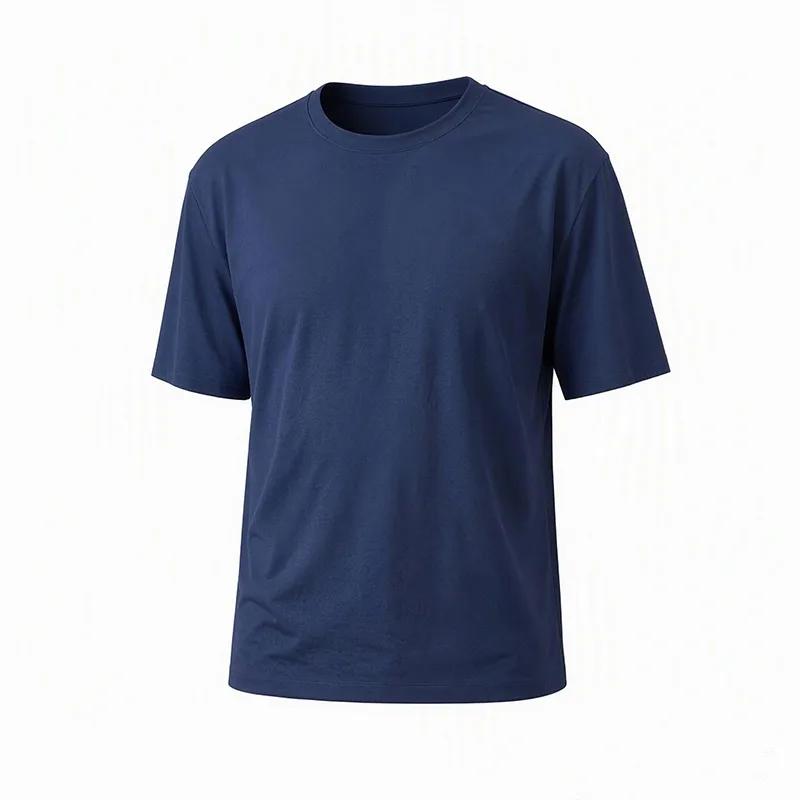
A UPF 50+ short sleeve t-shirt is a top made from fabric engineered to block ultraviolet radiation. UPF (Ultraviolet Protection Factor) is the international standard for measuring a textile's ability to block UV rays. UPF 50+ means the fabric blocks over 98% of UV radiation — the highest protection rating in international standards.
Unlike garments that rely on topical coatings for UV protection, high-quality UPF 50+ polyester t-shirts embed the UV-blocking function directly into the fiber itself. This means the protection does not significantly degrade with washing or normal wear.
Why 100% Polyester Interlock Outperforms Other Knit Structures
Interlock is a double-knit structure in which loops from both faces interlock, creating a denser, more stable fabric than single jersey. In sun-protective apparel, this structural advantage directly impacts protection performance.
Interlock vs. Single Jersey
| Dimension | Interlock | Single Jersey |
|---|---|---|
| Structure density | Denser, double-face interlocking | Looser, single-face structure |
| UV blocking | Stronger due to higher density | Requires higher GSM for equivalent UPF |
| Dimensional stability | Stable in both directions, no curling | Curls easily, stretches lengthwise |
| Pilling resistance | Uniform on both faces, durable | Prone to pilling on face side |
| Drape | Structured, holds shape | Soft but thin |
| Best use | Outdoor workwear, sportswear, sun protection | Everyday basics, layering |
The denser structure of interlock means fewer opportunities for light to penetrate the fabric. For a UPF 50+ men's short sleeve t-shirt, this means higher UV blocking at the same GSM — or the ability to maintain UPF 50+ at a lower weight.
UPF 50+ Protection: Embedded, Not Coated
This is the most overlooked yet most critical difference in B2B sourcing. Some sun-protective garments achieve their UPF rating through topical finishes — applying UV absorbers or titanium dioxide coatings to the fabric surface. The drawback: coatings gradually wash out, and protection diminishes with each laundry cycle.
High-quality 100% polyester fabric achieves UPF 50+ through the fiber itself. Polyester's molecular structure contains benzene rings that naturally absorb UV radiation. By adjusting fiber cross-section and weave density, the fabric achieves UPF 50+ without relying on chemical coatings. According to third-party testing data, this embedded protection maintains stable UPF values after repeated washing.
The AS/NZS 4399 Testing Standard
Globally, the most widely referenced standard for textile UPF rating is the Australia/New Zealand standard AS/NZS 4399. This standard tests fabric in a new, unstretched, and dry state under a solar spectrum simulating Melbourne summer conditions, classifying protection into UPF 15, 30, 50, and 50+ levels.
China's national standard GB/T 18830-2009 similarly specifies UPF 40+ and UPF 50+ as the standard labeling levels, with UPF 50+ being the highest grade. China Consumers Association has warned that some merchants advertise "UPF 200+," "UPF 500+," or even "UPF 2000+" — these are non-standard claims, as UPF 50+ is already the highest level in internationally recognized standards.
For B2B buyers, request third-party test reports from your supplier confirming the fabric's actual UPF value under AS/NZS 4399 or GB/T 18830-2009.
120 GSM: The Sweet Spot for Sun Protection T-Shirts
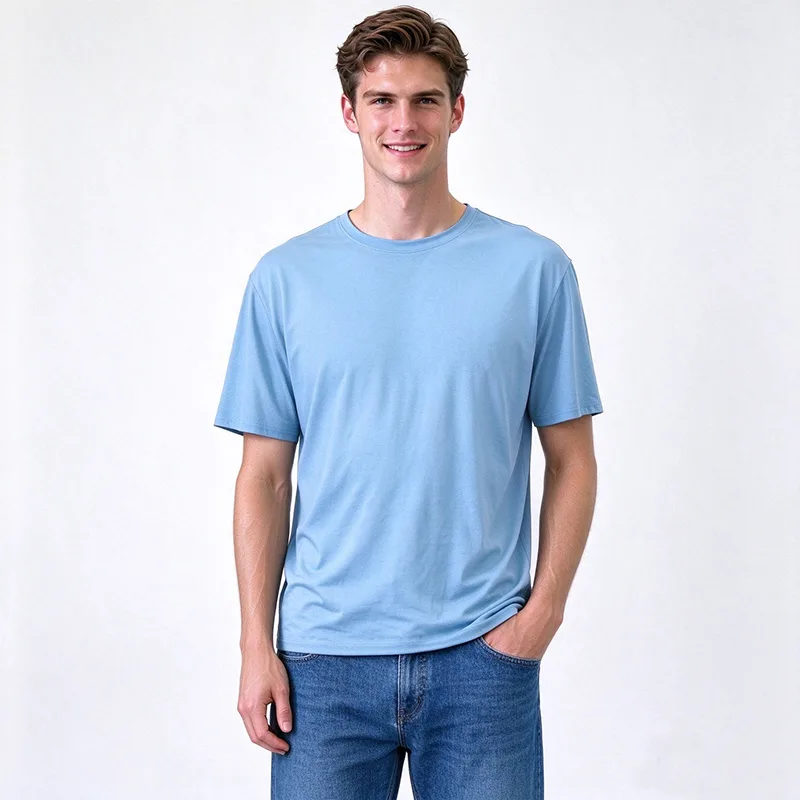
In B2B fabric selection, GSM is the parameter that most directly determines cost and wearing experience. Industry benchmarks:
- 100–140 GSM: Ultralight, suitable for hot-climate basics but lacks opacity and structure
- 140–180 GSM: Lightweight, suitable for summer sun protection and athletic t-shirts
- 180–220 GSM: Midweight, suitable for structured, durable garments
- 220 GSM+: Heavyweight, suitable for cold-weather layering or workwear
At 120 GSM, this fabric sits at the boundary between ultralight and lightweight. For a sun protection t-shirt, this means:
- Lightweight enough for summer heat without trapping warmth, suitable for extended outdoor wear
- Sufficient UV blocking: Combined with the high-density structure of 100% polyester interlock, 120 GSM achieves UPF 50+ protection
- Faster drying: Thinner fabric means shorter moisture evaporation paths. According to research on double-layered interlock fabrics, a configuration with polyester on the inner face and hydrophilic fibers on the outer face achieves excellent overall moisture management, with drying speeds even faster than 100% polyester double-layer fabrics
For brands targeting Australia, Southeast Asia, the Middle East, or other high-sunlight markets, the 120 GSM + UPF 50+ combination is a market-validated configuration.
Moisture Wicking & Quick Dry: The Science Behind the Comfort
Moisture wicking and quick drying are core performance metrics for functional t-shirts, but the underlying mechanisms are often oversimplified.
Polyester fiber itself is hydrophobic — it does not absorb water the way cotton does. This is precisely its advantage in quick drying: moisture does not enter the fiber structure but is conducted through capillary channels between fibers to the fabric surface and rapidly evaporated. Research shows that moisture transfer and drying behavior in double-layered knitted fabrics are influenced by both fiber type and filament count. Increasing polyester filament count actually decreases both moisture management and drying rate, meaning yarn specification selection has a significant impact on final performance.
In practice, this means sweat is rapidly conducted from the skin surface to the fabric's outer layer and evaporated within a short time, avoiding the "wet and sticky" feeling common with pure cotton t-shirts. For those who work or exercise outdoors for extended periods, this performance difference directly affects comfort and productivity.
Technical Specifications at a Glance
| Parameter | Specification |
|---|---|
| Composition | 100% Polyester |
| Weight | 120 GSM |
| Structure | Interlock |
| Key Functions | UPF 50+ sun protection, moisture-wicking, quick-dry |
| Use Cases | Outdoor work, sports, fishing, surfing, daily sun protection |
| Size Range | S–M–L–XL–2XL |
| MOQ | 500 pcs/color |
B2B Sourcing Considerations
When sourcing UPF 50+ sun protection t-shirts, prioritize the following:
UPF test reports. Confirm whether your supplier can provide third-party test reports (e.g., SGS, Intertek, Hohenstein) with UPF ratings tested under AS/NZS 4399 or GB/T 18830-2009. Note that test reports should correspond to the specific color and GSM being ordered, as UPF values can vary by color.
Wash durability testing. For fabrics claiming embedded UPF functionality, request UPF retention data after washing. Generally, embedded protection should maintain stable UPF values after 50 wash cycles.
Color fastness and shrinkage. Polyester fabrics typically have good color fastness, but sublimation and wash fastness for dark shades should still be verified. For shrinkage, 100% polyester interlock with proper pre-shrinking treatment can achieve ≤3% shrinkage in both warp and weft directions.
Hand-feel and breathability samples. At 120 GSM, interlock feels lightweight, and finishing processes vary significantly between suppliers. Always request physical samples for wearing evaluation.
Certifications and compliance. For EU markets, confirm whether the fabric holds Oeko-Tex Standard 100 certification. For Australia, verify that UPF labeling complies with AS/NZS 4399 requirements.
For additional fabric specifications and customization options, visit https://www.kalaiben.com/.
Care & Longevity
- Machine wash at temperatures not exceeding 40°C; avoid chlorine bleach
- Low-temperature tumble drying or air drying is suitable; polyester dries quickly
- Avoid high-temperature ironing; use low heat if needed
- UPF protection is embedded in the fiber and is not significantly affected by normal washing
- Avoid prolonged friction against rough surfaces to extend fabric lifespan
FAQ
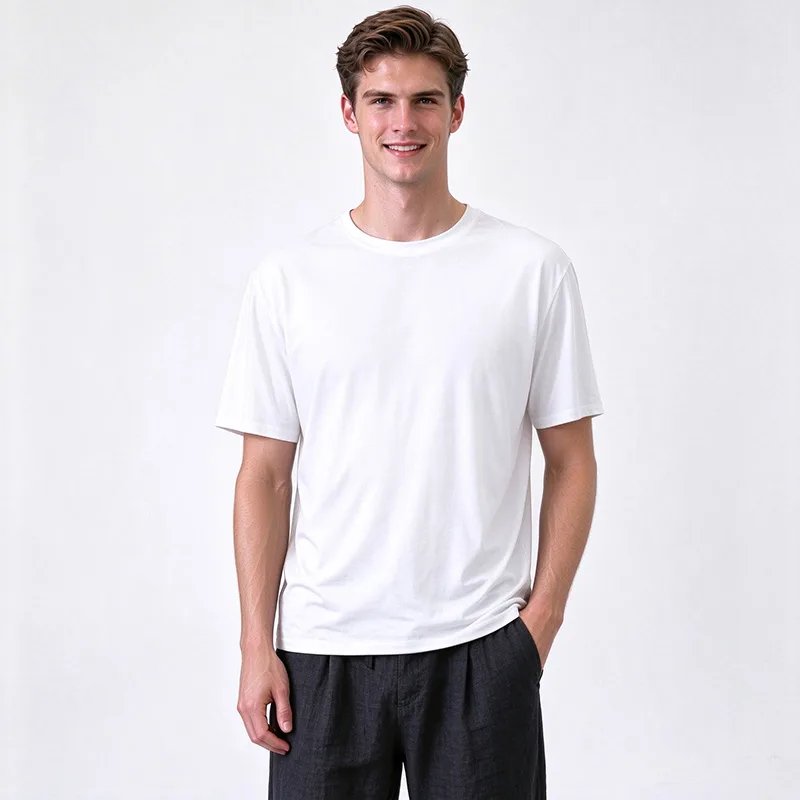
How long does UPF 50+ protection last?
For embedded UPF protection in 100% polyester fabric, protection remains stable throughout the product's lifecycle and does not significantly degrade with washing. Request UPF test data after 50 wash cycles from your supplier for verification.
Is 120 GSM too thin or transparent?
The interlock structure at 120 GSM is denser than single jersey at the same weight. Because the two faces interlock, light penetration paths are more complex, resulting in significantly lower transparency than single jersey at the same GSM.
Is this fabric suitable for printing?
100% polyester is excellent for sublimation and screen printing. Sublimation is particularly well-suited to polyester, delivering vibrant colors without adding fabric weight. For embroidery, keep designs relatively small to avoid pulling and distortion on a lightweight fabric.
What's the difference between UPF 50+ and UPF 50?
Under AS/NZS 4399, UPF 50+ is the highest protection level, blocking over 98% of UV radiation. UPF 50 blocks approximately 97.5%–98%. In practice, the difference is negligible, but UPF 50+ is the most widely recognized label for sun-protective clothing in international markets.
Johtopäätös
The 100% polyester interlock at 120 GSM for a UPF 50+ men's short sleeve t-shirt delivers its core value through embedded UV protection that resists washing out, a dense double-knit structure that achieves UPF 50+ at low weight, and balanced moisture-wicking and quick-dry performance. For B2B buyers targeting high-sunlight markets, this is a configuration that optimally balances protection durability, wearing comfort, and cost control.