




Best OEM Clothing Manufacturer China: How to Choose the Right Factory
Tanggal penerbitan:2026-09-23 Kategori:BERITA Jumlah tampilan:554
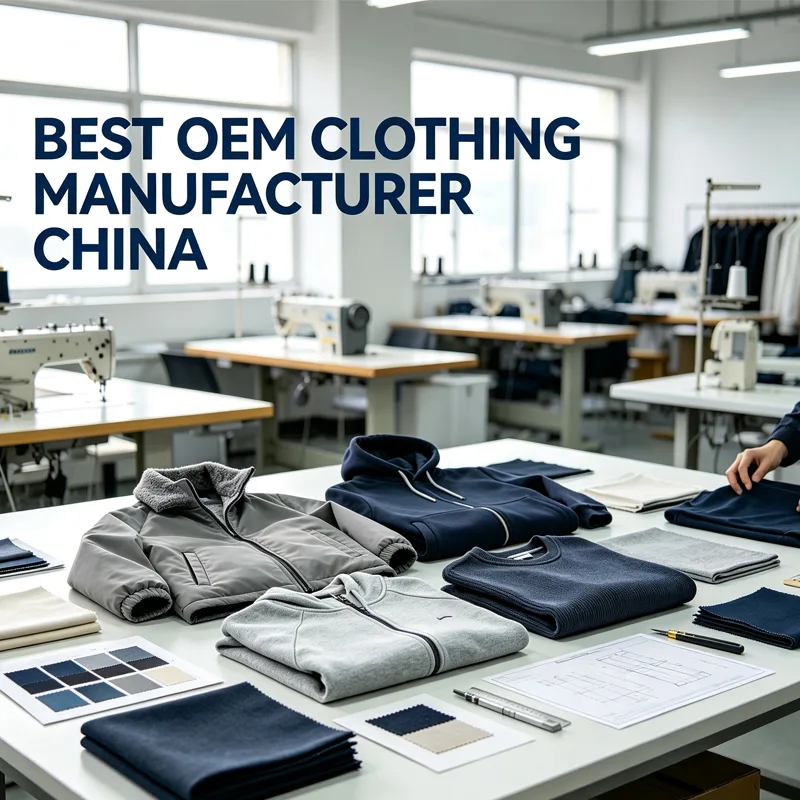
Looking for the best OEM clothing manufacturer China? Learn how to compare factories by product fit, sampling, quality, MOQ, production capacity, and communication.
When buyers search for the best OEM clothing manufacturer China, they are rarely looking for a factory with the lowest price. They want a manufacturer that can make their products correctly, communicate clearly, control quality, and deliver consistently. The challenge is that China has a huge apparel manufacturing base. In 2024, China's apparel and clothing accessory exports reached about $159.1 billion.
So how do you find the right OEM factory?
The answer is simple: do not choose by ranking alone. Choose by fit, evidence, and production performance.
1. What Makes the Best OEM Clothing Manufacturer China?
There is no single factory that is best for every clothing brand.
A factory that specializes in technical outdoor jackets may not be the right choice for basic T-shirts. A factory focused on small fashion runs may not fit a buyer planning large seasonal orders.
The right OEM manufacturer should match your:
- Kategori produk
- Quality requirements
- Order volume
- Kebutuhan penyesuaian
- Harga target
- Delivery schedule
- Communication expectations
Contoh
Imagine two brands.
Brand A needs 300 custom hoodies for a new streetwear launch.
Brand B needs 20,000 technical jackets for an established outdoor label.
They should not choose the same factory simply because that factory appears on a “Top 10” list.
Their production requirements are completely different.
2. Start With Product Fit, Not Factory Size
One of the biggest sourcing mistakes is choosing a factory because it looks impressive.
A large facility does not automatically mean it is the right manufacturer for your product.
Start with product experience.
2.1 Check the Factory's Core Product Categories
Tanyakan:
- What garments does the factory produce regularly?
- Does it specialize in knitwear or woven garments?
- Does it make jackets, hoodies, sportswear, or casualwear?
- Can it handle your construction requirements?
- Does it have experience with similar fabrics?
Contoh
If you need fleece jackets, ask for examples of comparable fleece products.
Do not rely only on a general product catalog.
Look for evidence that the factory understands:
- Berat kain
- Konstruksi jahitan
- Ritsleting
- Hiasan
- Pas
- Penyelesaian
The closer the factory's experience is to your product, the easier technical communication becomes.
3. Compare OEM Clothing Manufacturers by Seven Factors
A useful supplier comparison should go beyond price.
Use these seven factors:
- Pengalaman produk
- Pengembangan sampel
- Pengendalian mutu
- MOQ and production scale
- Komunikasi
- Penyesuaian
- Delivery and production planning
OEM Factory Evaluation Table
| Evaluation Factor | Hal-hal yang Perlu Diperiksa | Mengapa Hal Ini Penting |
|---|---|---|
| Product Fit | Similar garments and fabrics | Reduces technical risk |
| Pengambilan sampel | Sample process and revisions | Reveals development ability |
| Kualitas | Inspection process | Protects bulk orders |
| MOQ | Minimum quantity by product | Fits your business model |
| Kapasitas | Equipment and production scale | Mendukung pertumbuhan |
| Komunikasi | Response and technical clarity | Prevents mistakes |
| Pengiriman | Perencanaan produksi | Protects launch dates |
This framework is more useful than choosing a supplier from a generic “best manufacturer” ranking.
4. Sample Quality Is One of the Best Supplier Tests
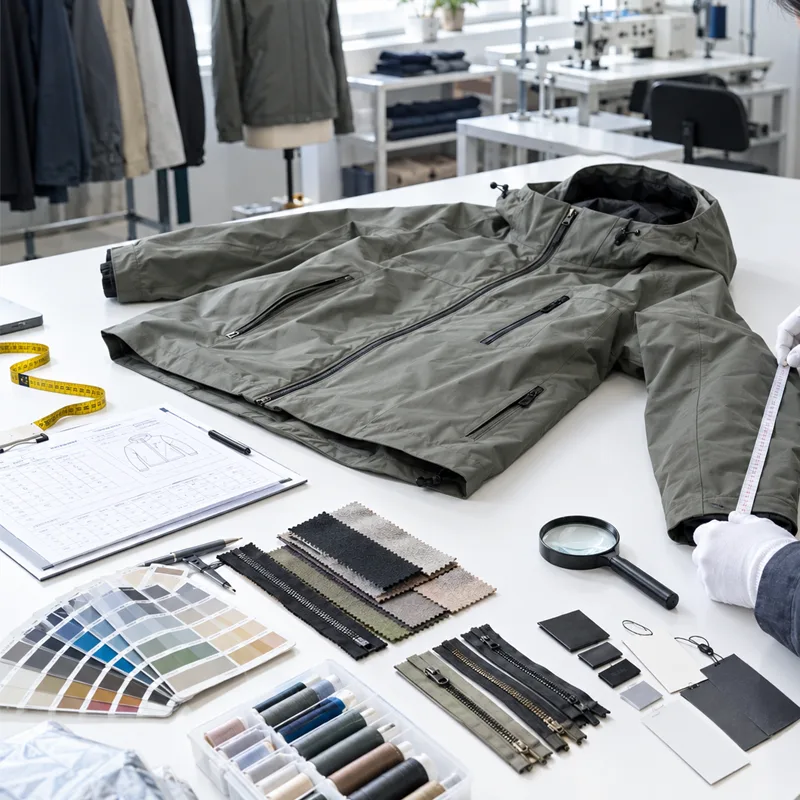
Before placing a large OEM order, test the manufacturer with a sample.
A sample tells you much more than a factory website.
Periksa:
- Kualitas kain
- Pengukuran
- Pas
- Penjahitan
- Konstruksi
- Warna
- Hiasan
- Logo placement
- Penyelesaian
4.1 Do Not Check Only the Finished Look
A garment can look good in photographs and still have production problems.
Look closely at:
- Seam consistency
- Thread tension
- Inside finishing
- Pocket alignment
- Zipper installation
- Posisi label
- Measurement accuracy
Contoh
Suppose you receive a jacket sample.
The outside looks excellent.
But the sleeve measurement is 2 cm shorter than your approved specification.
That is not a small issue if the same pattern goes into bulk production.
A good OEM partner should have a clear process for identifying and correcting this before production starts.
5. How to Compare OEM Clothing Factory Quotes
Price comparison is often misleading.
Two factories may quote different prices for what appears to be the same garment.
But the specifications may not actually match.
Compare the Full Cost Structure
Periksa:
- Komposisi kain
- Berat kain
- Aksesori
- Pencetakan atau bordir
- Label
- Kemasan
- Sample charges
- Pemeriksaan
- Ketentuan pengiriman
- Payment terms
Contoh
Factory A quotes $12.
Factory B quotes $13.
At first glance, Factory A looks cheaper.
But Factory A excludes custom packaging and uses a different fabric specification.
The $1 difference may disappear once both quotes use the same product specification.
Better Rule
Compare like-for-like specifications, not just unit prices.
6. MOQ Matters, But It Should Not Be the Only Number You Compare
MOQ is important for apparel brands.
But MOQ alone does not tell you whether a factory is suitable.
Ask what the MOQ actually applies to.
It may vary by:
- Style
- Warna
- Kain
- Rentang ukuran
- Penyesuaian
- Production method
MOQ Comparison
| MOQ Situation | Usually Suitable For |
|---|---|
| Very small quantity | Testing a new product |
| Small batch | Perusahaan rintisan dan merek yang sedang berkembang |
| Medium production | Established collections |
| Large production | High-volume programs |
Contoh
A brand wants 1,000 hoodies.
The factory says its MOQ is 500 pieces.
That sounds suitable.
But then the factory explains that the MOQ is 500 pieces per color.
If the brand wants four colors, the actual production commitment becomes much larger.
Always ask how MOQ is calculated.
7. Check Whether You Are Dealing With a Factory or a Trading Company
This is one of the most important checks when searching for an OEM clothing manufacturer China.
A trading company may be able to provide excellent service.
But its production model is different from a direct factory.
Factory vs Trading Company
| Faktor | Direct Factory | Perusahaan Perdagangan |
|---|---|---|
| Pengendalian Produksi | Langsung | Through manufacturing partners |
| Technical Communication | Direct factory team | Usually through intermediary |
| Factory Selection | Internal | Supplier network |
| Production Visibility | Lebih tinggi | Depends on supplier |
| Rangkaian Produk | Often more focused | May be broader |
| Service Model | Manufacturing-led | Sourcing-led |
Neither model is automatically better.
The important question is whether the supplier is transparent about its production setup.
What to Ask
- Where is production carried out?
- Who owns the production facility?
- Can you see the factory?
- Who manages quality control?
- Who handles sampling?
- Who handles production issues?
A video factory tour can be useful.
An on-site audit is even stronger when order value justifies the cost.
8. Quality Control Should Start Before Bulk Production
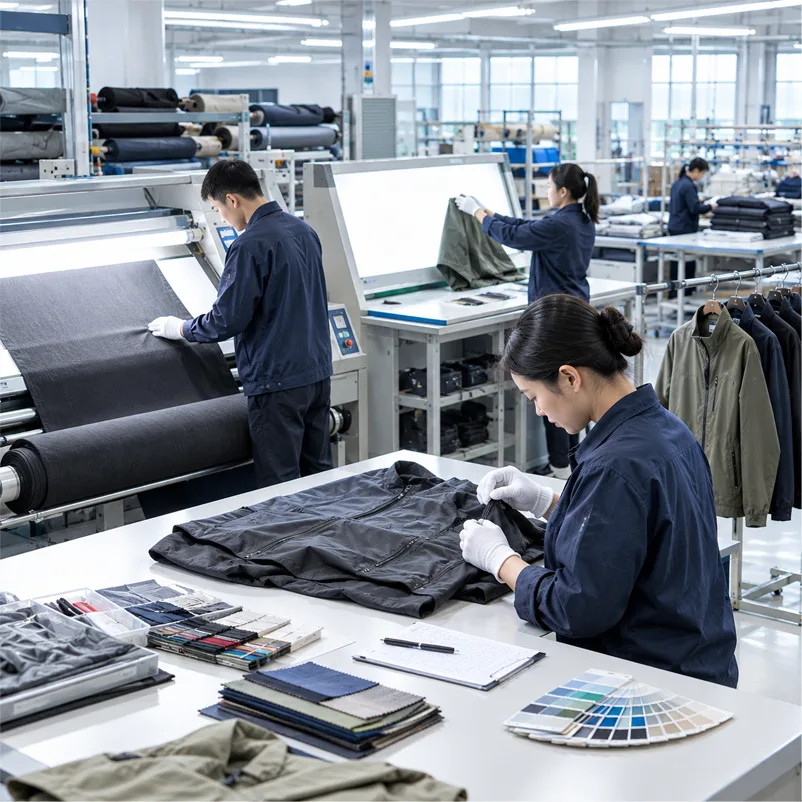
Quality cannot be fixed at the final inspection alone.
A stronger system begins during development.
A Practical Apparel QC Flow
Stage 1: Material Check
Verify:
- Komposisi kain
- Berat
- Warna
- Width
- Required specifications
Stage 2: Sample Approval
Konfirmasi:
- Pengukuran
- Pas
- Konstruksi
- Warna
- Hiasan
Stage 3: Production Monitoring
Periksa:
- Menjahit
- Pengukuran
- Workmanship
- Konsistensi produksi
Stage 4: Final Inspection
Ulasan:
- Finished garments
- Jumlah
- Kemasan
- Label
- Defects
Contoh
If a fabric problem is discovered after 5,000 garments have been sewn, the financial impact can be significant.
If the same issue is discovered during material approval, the problem is much easier to control.
That is why a strong OEM partner treats quality as a process, not a final checkpoint.
9. Communication Is a Manufacturing Skill
Buyers often focus on machines and production capacity.
They sometimes overlook communication.
That can create expensive mistakes.
A good manufacturer should understand:
- Paket teknis
- Measurement charts
- Fabric specifications
- Construction details
- Sample comments
- Packaging instructions
Test Communication Before Placing an Order
Send the same product brief to several factories.
Then compare:
- How many questions do they ask?
- Do they notice missing information?
- Do they understand your specifications?
- Do they identify production risks?
- Is the quotation clear?
Contoh
You send a tech pack for a custom jacket.
Factory A immediately sends a price.
Factory B asks about:
- Berat kain
- Zipper type
- Lining
- Konstruksi jahitan
- Quantity by color
Factory B has demonstrated more technical engagement.
That does not automatically make it the better factory, but it gives you useful evidence about how the supplier approaches your project.
10. Build an OEM Factory Scorecard

Instead of choosing based on impressions, create a simple scorecard.
Score each supplier from 1 to 5 for internal comparison.
| Kategori | Berat | Factory A | Factory B | Factory C |
|---|---|---|---|---|
| Pengalaman Produk | 25% | — | — | — |
| Sample Quality | 20% | — | — | — |
| Quality System | 20% | — | — | — |
| Komunikasi | 15% | — | — | — |
| MOQ Fit | 10% | — | — | — |
| Kapasitas | 10% | — | — | — |
Do not treat the final number as an absolute “best factory” score.
Use it to identify which supplier deserves deeper verification.
The weights should also change by project.
For example, a luxury outerwear brand may put more weight on sample quality and construction.
A startup may put more weight on MOQ and development flexibility.
11. What Should You Send an OEM Clothing Manufacturer?
A clear RFQ makes supplier comparison much easier.
Send as much information as possible.
Informasi Produk
- Jenis produk
- Gambar referensi
- Tech pack
- Size chart
- Komposisi kain
- Berat kain
- Color requirements
- Construction details
Informasi Merek
- Logo
- Label
- Label gantung
- Kemasan
Order Information
- Perkiraan jumlah
- Quantity by color
- Quantity by size
- Target delivery date
- Destination market
Contoh
Instead of sending:
“Please quote 1,000 jackets.”
Send:
“Please quote 1,000 jackets in two colors, five sizes, 100% polyester shell, custom woven label, individual packaging, and delivery to the United States.”
The second inquiry gives the factory enough information to prepare a more useful quotation.
12. When Should You Choose an OEM or ODM Manufacturer?
OEM and ODM are not interchangeable.
Choose OEM When:
- You already have a clear design.
- You have a tech pack.
- Your specifications are fixed.
- You want production according to your requirements.
Consider ODM When:
- You have only a product concept.
- You need pattern development.
- You need material recommendations.
- You want technical support during development.
| Your Situation | More Suitable Model |
|---|---|
| Complete tech pack | OEM |
| Existing approved sample | OEM |
| Product concept only | ODM |
| Need pattern development | ODM |
| Need factory production only | OEM |
| Need development + production | ODM |
Contoh
A mature brand sends a complete technical package for a fleece jacket.
An OEM factory can focus on executing the specifications.
A startup sends only a reference image.
An ODM manufacturer may provide more value because product development is part of the project.
13. How to Find the Best OEM Clothing Manufacturer China for Your Brand
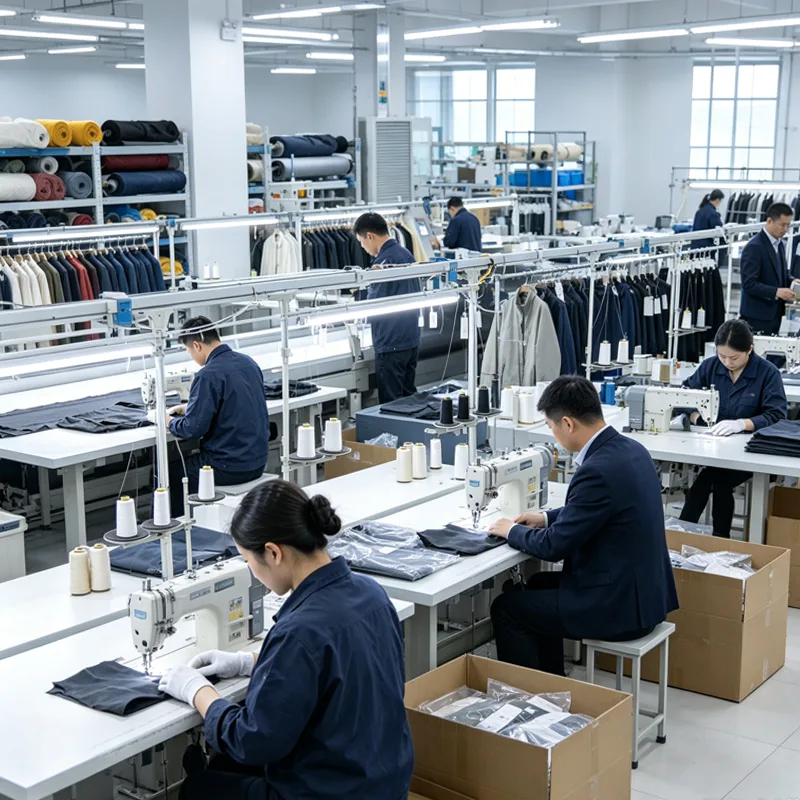
Use this process.
Step 1: Define Your Product
Know your:
- Kategori produk
- Kain
- Jumlah
- Quality level
- Harga target
Step 2: Build a Shortlist
Find several manufacturers with relevant product experience.
Step 3: Send the Same RFQ
Use the same specifications.
This creates a fairer comparison.
Step 4: Compare Responses
Look at:
- Harga
- MOQ
- Questions
- Pengambilan sampel
- Production details
Step 5: Order Samples
Do not judge the factory only from its website.
Step 6: Verify Production Capability
Ask for:
- Factory information
- Production photos
- Relevant product examples
- Quality procedures
Consider an audit for larger orders.
Step 7: Start With a Controlled Order
Once the supplier passes your checks, begin with a manageable production order.
This gives both sides a chance to test the working relationship.
14. What About KALAIBEN?
KALAIBEN is one example of a China-based apparel manufacturer offering OEM and ODM production.
Its published capabilities include knitted and woven apparel, casualwear, sportswear, outdoorwear, children's apparel, product development, pattern making, sampling, and mass production.
The company states that its production facility covers approximately 6,000㎡, with 700+ production machines, nearly 700 employees, and annual capacity of approximately 600,000 pieces or sets.
For buyers evaluating an OEM supplier, the important point is not simply the factory size. The key question is whether the manufacturer's capabilities match the product and production requirements.
You can review its manufacturing capabilities through the KALAIBEN official website.
15. Best OEM Clothing Manufacturer China: A Buyer Checklist
Before approving a supplier, ask:
Product Fit
- Does the factory make my product category?
- Does it understand my fabric?
- Can it meet my construction requirements?
Pengambilan sampel
- Can it develop an accurate sample?
- Can it handle revisions?
- Can it follow my measurement specifications?
Produksi
- Is the production setup clear?
- Does capacity fit my order?
- Can it support future orders?
Kualitas
- What happens before bulk production?
- How is quality checked during production?
- What happens if defects are found?
Commercial Terms
- What is the MOQ?
- What does the quotation include?
- What are the payment terms?
- What are the delivery terms?
Komunikasi
- Does the team understand technical information?
- Are questions answered clearly?
- Are production changes documented?
16. The Best OEM Clothing Manufacturer Is the Best Fit for Your Project
Searching for the best OEM clothing manufacturer China is not really about finding a universal number-one factory.
It is about finding a manufacturer that fits your product, quantity, quality expectations, development needs, and communication style.
A strong selection process looks like this:
Product fit → RFQ → sample → factory verification → quality review → controlled production → long-term evaluation
This approach gives buyers something more useful than a generic supplier ranking.
It gives them a repeatable way to make better sourcing decisions.
For brands ready to discuss a custom apparel project, KALAIBEN provides OEM and ODM manufacturing support from product development and sampling through production and customized labeling and packaging.











