




Clothing OEM Factory: What Brands Should Know Before Starting Production
公開日時:2026-10-08 カテゴリ:ニュース 閲覧数:528
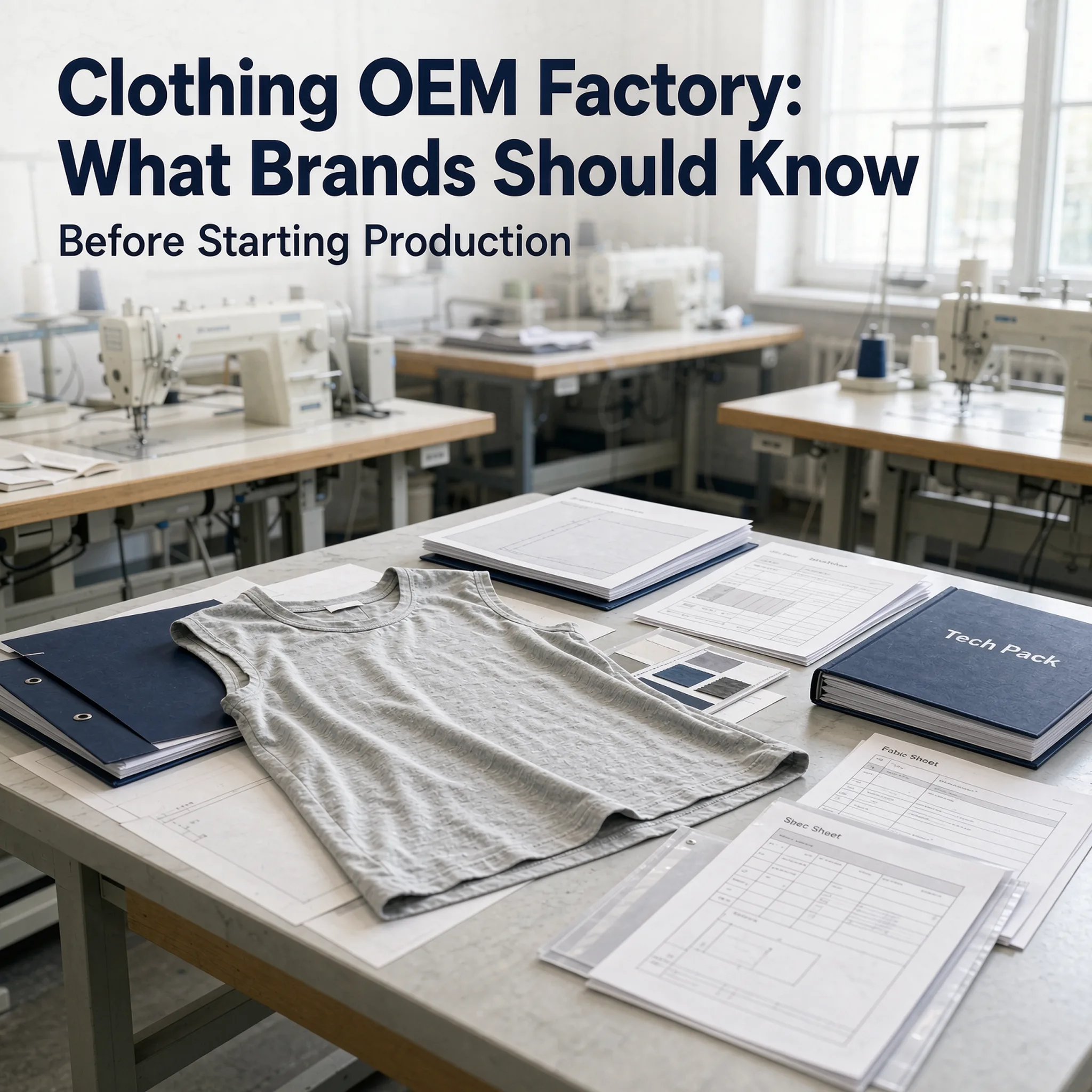
Looking for a clothing OEM factory? Learn how OEM production works, what to prepare, how to evaluate samples, MOQ, quality control, and bulk production before placing an order.
Choosing the right clothing OEM factory can determine whether a new apparel project stays on schedule or turns into repeated samples, unexpected costs, and quality problems.
A professional OEM factory should do more than sew garments. It should understand your specifications, turn them into accurate samples, control materials and production, and reproduce the approved product consistently at scale.
For brands, the key is knowing what to check before production starts.
1. What Does a Clothing OEM Factory Do?
A clothing OEM factory manufactures garments according to the buyer's own specifications, designs, patterns, samples, or technical requirements.
Depending on the project, OEM services can include:
- テックパックのレビュー
- Pattern making
- 生地の調達
- サンプルの開発
- Fit adjustment
- カスタムカラー
- Labels and branding
- Printing or embroidery
- 量産
- Quality inspection
- パッケージ
The buyer controls the product requirements, while the factory provides the technical and manufacturing capability to turn those requirements into finished garments.
2. What Should You Prepare Before Contacting an OEM Factory?
You do not need a perfect technical package to start a conversation.
However, better information usually leads to a more useful quotation.
2.1 Product Information
Start with:
- Garment category
- Product images or sketches
- 参照サンプル
- Target quantity
- サイズ範囲
- Intended market
- Expected launch date
2.2 Technical Information
If available, provide:
- Tech pack
- Measurement chart
- 生地の組成
- GSM
- Color references
- Trim specifications
- Construction details
- Artwork
- ラベルの要件
If some details are missing, say so clearly.
A capable OEM factory should identify the missing information instead of making assumptions that may affect the final garment.
3. How Does the OEM Clothing Production Process Work?
A typical OEM project follows several stages:
Product brief → Technical review → Sampling → Sample approval → Material preparation → Bulk production → Quality inspection → Packing
The exact process varies by garment.
A basic T-shirt may require a relatively simple development process, while a technical jacket can involve more materials, construction details, trims, and testing.
The important point is that bulk production should not start before the product specifications are clearly approved.
4. Why Is the Sample So Important?
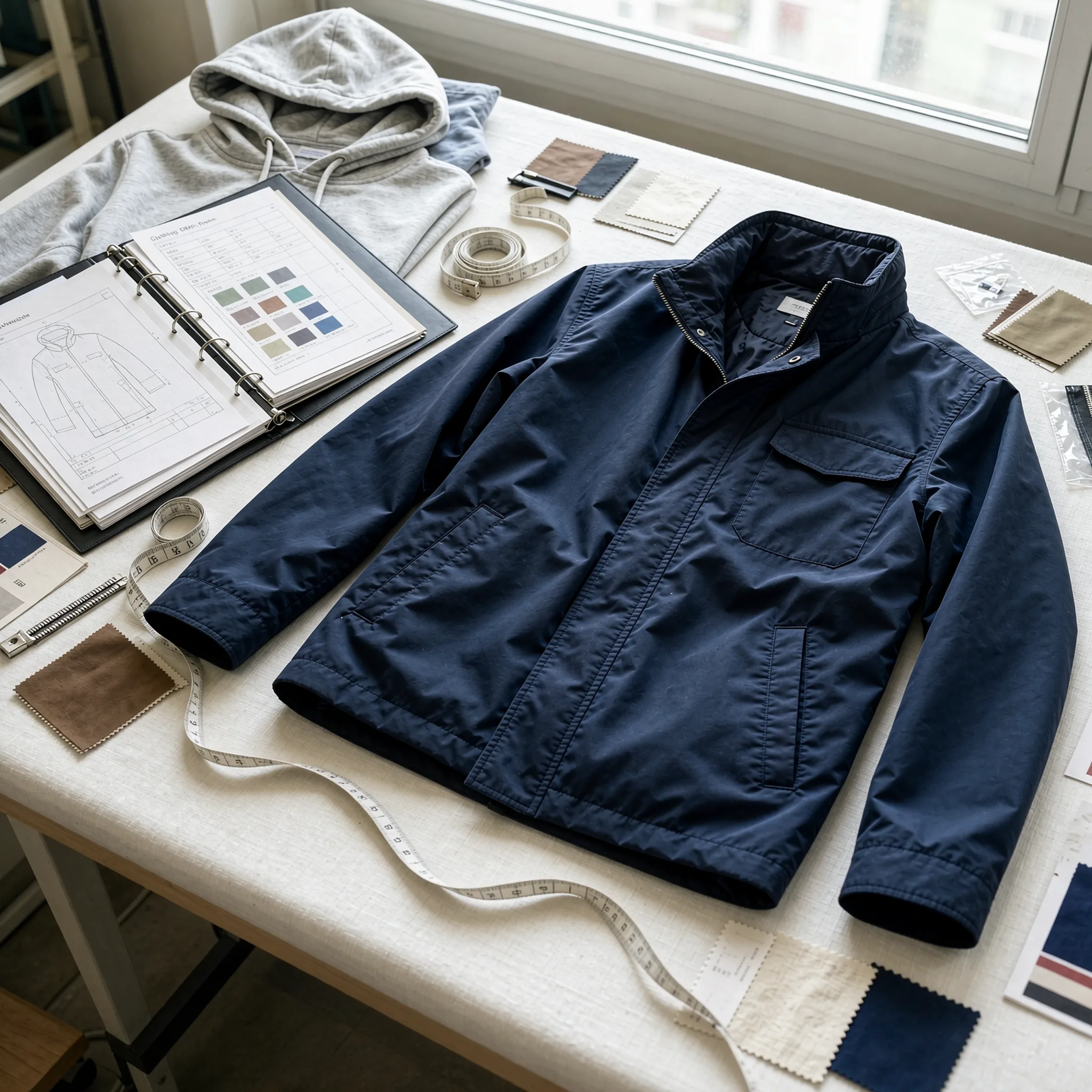
The sample is not simply a visual preview.
It becomes a reference for bulk production.
Before approval, check:
| Area | What to Review |
|---|---|
| フィット | Overall shape and wearing comfort |
| 測定値 | Chest, length, sleeve, shoulder, etc. |
| 生地 | Composition, GSM, hand feel |
| 色 | Against the approved reference |
| 建設 | Seams, panels, pockets |
| Trims | Zippers, buttons, cords |
| ブランディング | Labels, prints, embroidery |
| 仕上げ | Threads, pressing, appearance |
Consider a jacket with a sleeve measurement that is 1.5 cm longer than the intended specification.
It may look like a small issue on one sample. If it is repeated throughout a production run, however, the same problem affects the entire order.
That is why sample approval is one of the most important risk-control stages in OEM production.
5. What Makes a Good OEM Factory Different?
A factory's real capability is often easier to see during development than in its product catalog.
5.1 Technical Understanding
Can the factory understand your tech pack and identify unclear specifications?
5.2 Development Capability
Can it make patterns, develop samples, and adjust fit?
5.3 Material Knowledge
Can it recommend or source suitable fabrics and trims?
5.4 Production Consistency
Can it reproduce the approved sample across the full order?
5.5 Problem Solving
When something does not work, can the factory explain the problem and offer a practical solution?
These capabilities matter more than simply having a large product catalog.
6. How Much Customization Can an OEM Factory Provide?
OEM production is useful because the product can be adapted to the brand's requirements.
Common customization may include:
- 生地
- 色
- フィット
- 測定値
- ポケット
- Closures
- ラベル
- 刺繍
- 印刷
- ハンガータグ
- パッケージ
However, not every factory has the same capabilities.
Ask specifically about the customization your product requires rather than assuming that “OEM” means unlimited customization.
7. How Does MOQ Work With Clothing OEM Production?
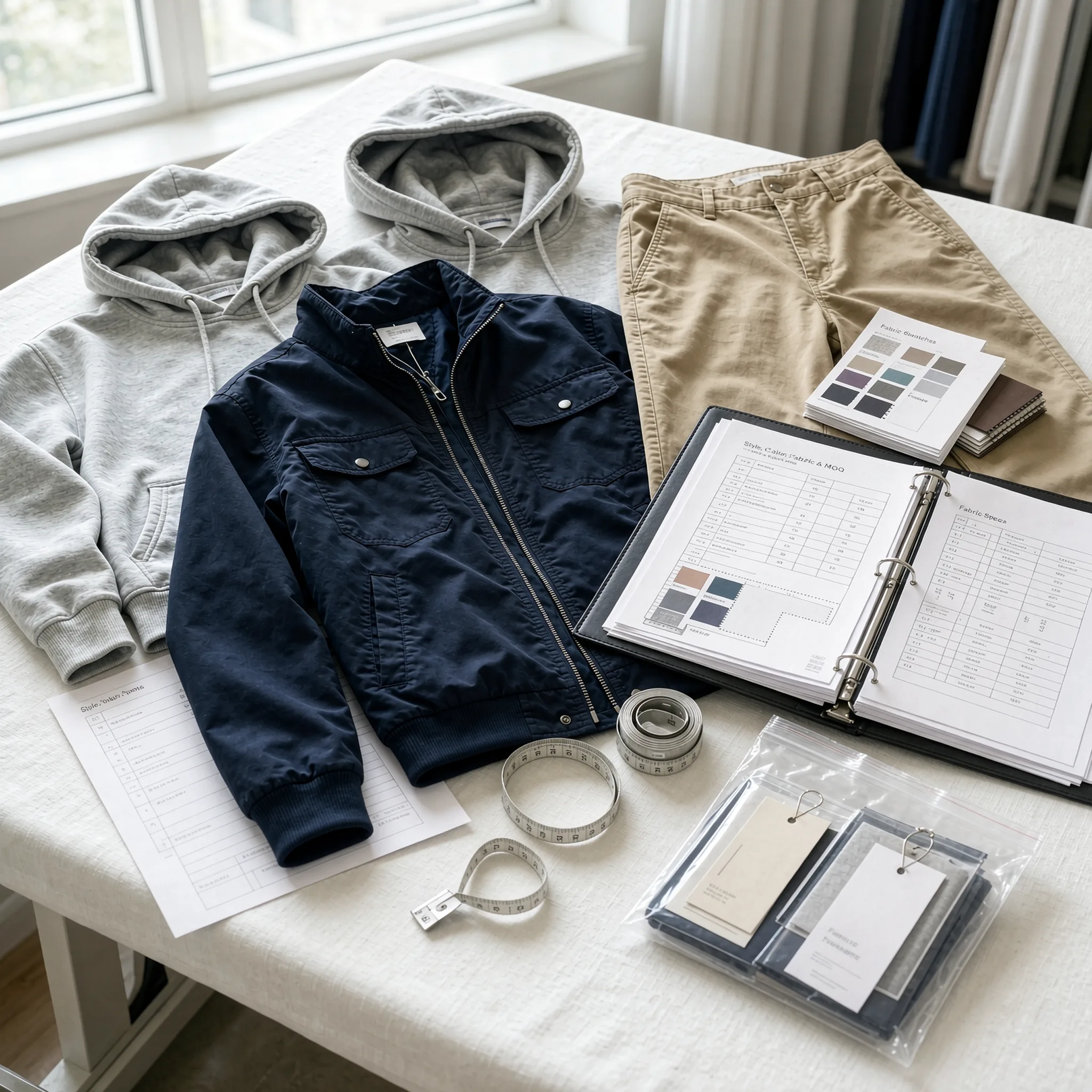
There is no single MOQ that applies to every OEM clothing project.
MOQ can depend on:
- Product type
- 生地
- 色
- Number of styles
- Construction complexity
- カスタマイズ
- Fabric supplier requirements
- Production process
For example, a factory may quote MOQ per style, while a fabric supplier may require a separate minimum quantity for a custom material or color.
So instead of asking only:
“What is your MOQ?”
ask:
“What is your MOQ per style, color, and fabric?”
This gives you a much clearer picture of the actual order requirement.
8. How Should You Evaluate an OEM Factory's Quality Control?
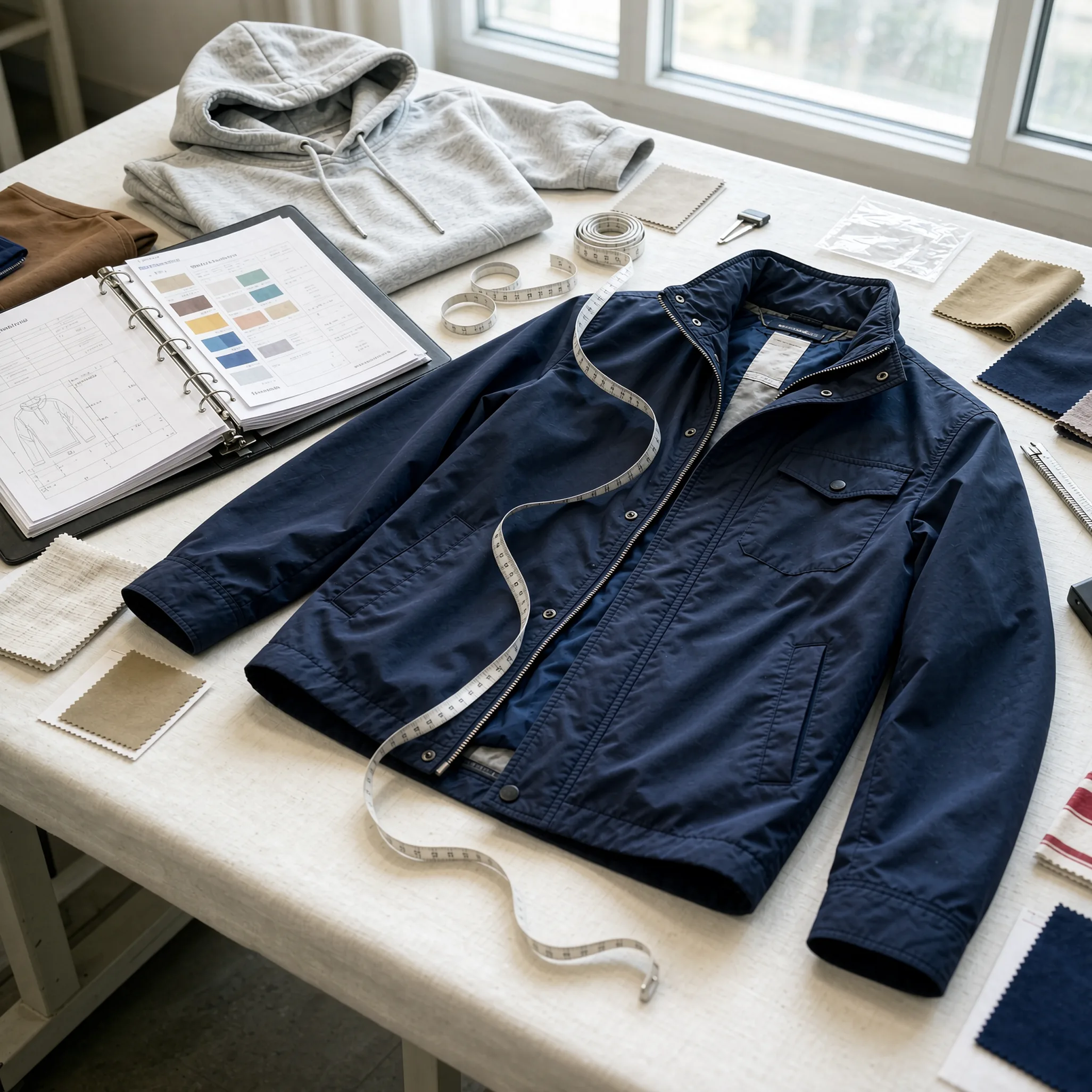
Quality control should not happen only after production is finished.
A practical system can include:
Material inspection → Cutting → Sewing → In-process checks → Finishing → Final inspection
The approved sample and final specifications should remain the reference throughout production.
Important quality points can include:
- 生地の組成
- GSM
- 測定値
- 色の均一性
- ステッチ
- 縫い目の構造
- Trims
- ブランディング
- 仕上げ
- パッケージ
Avoid vague requirements such as:
“We need premium quality.”
Instead, define measurable requirements.
For example:
Fabric: 100% polyester, specified GSM
Fit: approved measurement chart
Color: approved color standard
Construction: approved sample
Branding: final artwork
Clear specifications reduce misunderstandings between buyer and factory.
9. How Should You Compare OEM Factory Quotes?
The lowest unit price is not always the lowest total cost.
When comparing quotations, check whether each factory is using the same assumptions.
Compare:
| Cost Factor | What to Confirm |
|---|---|
| Unit price | Based on what quantity? |
| 最小発注数量(MOQ) | Per style, color, or fabric? |
| Sample | Included or charged separately? |
| 生地 | Which composition and GSM? |
| ブランディング | Included or additional? |
| パッケージ | Standard or customized? |
| リードタイム | From order or material approval? |
| Shipping | Included or excluded? |
A $1 difference in unit price may be less important than repeated sample revisions, material substitutions, or bulk-quality problems.
10. What Lead Time Should You Expect?
Do not calculate lead time only from the sewing stage.
A complete project can involve:
Material sourcing → Pattern development → Sampling → Revisions → Approval → Material preparation → Bulk production → Inspection → Packing
The timeline therefore depends on:
- Product complexity
- Fabric availability
- Custom materials
- Sample revisions
- 注文数量
- 生産能力
- Quality requirements
Ask the factory to explain when the lead time starts.
“30 days production time” means very different things if the clock starts after the deposit, fabric approval, or final sample approval.
11. Common Mistakes When Working With an OEM Factory
11.1 Choosing Only by Price
A low quotation can be attractive, but it may not include the same materials, packaging, quality requirements, or production assumptions.
Always compare specifications before comparing prices.
11.2 Skipping Sample Approval
Never treat the sample as optional when fit, measurements, or construction matter.
11.3 Giving Vague Specifications
“High quality” is difficult to manufacture against.
Use measurable requirements wherever possible.
11.4 Asking Only About MOQ
MOQ without knowing how it is calculated is incomplete information.
Clarify style, color, fabric, and material minimums.
11.5 Changing Specifications During Production
Late changes can affect materials, patterns, production schedules, and costs.
Finalize critical specifications before bulk production begins.
12. How to Test a New Clothing OEM Factory
A first project can be treated as a supplier validation process.
Start by evaluating:
- コミュニケーション
- Technical understanding
- Sample quality
- Revision handling
- Material consistency
- Production management
- 品質管理
- Delivery performance
Also keep a complete production record:
- Approved sample
- Final tech pack
- Measurement chart
- Fabric specification
- Color reference
- Trim information
- Branding artwork
- Packaging requirements
- 最終見積書
These records become especially valuable when you reorder the same product.
13. OEM or ODM: Which One Do You Need?
The difference is mainly about who leads product development.
OEM: The brand provides detailed product requirements and the factory manufactures according to them.
ODM: The factory takes a larger role in product development, such as pattern making, material recommendations, and sample development.
If you already have a complete tech pack and specifications, OEM may be the more straightforward model.
If you have a product concept but limited technical resources, ODM may provide more development support.
Some brands use both approaches across different products.
14. A Practical OEM Factory Checklist
Before placing an order, confirm:
- Does the factory make your product category?
- Can it follow your technical specifications?
- Can it develop accurate samples?
- Can it source your required materials?
- What is the MOQ and how is it calculated?
- How is quality inspected?
- How is the approved sample controlled?
- What customization is available?
- What does the quoted lead time include?
- Can the factory support repeat orders?
If these questions have clear answers, you have a much stronger basis for evaluating the supplier.
15. Choosing a Clothing OEM Factory for Long-Term Production
The best clothing OEM factory is not necessarily the largest or cheapest supplier.
For most brands, a stronger long-term partner is one that can consistently:
Understand → Develop → Sample → Produce → Inspect → Repeat
The first order should therefore be viewed as more than a purchase.
It is also a test of the factory's communication, technical capability, quality management, and production consistency.
Once those areas are proven, repeat production becomes easier to manage and scale.
If you already have a garment design, tech pack, reference sample, or product brief, the next step is to send the available information to an OEM factory and request a technical review and production quotation.











