




스타트업을 위한 최고의 의류 제조업체: 고려해야 할 사항
게시일:2026-08-27 분류:뉴스 조회수:648
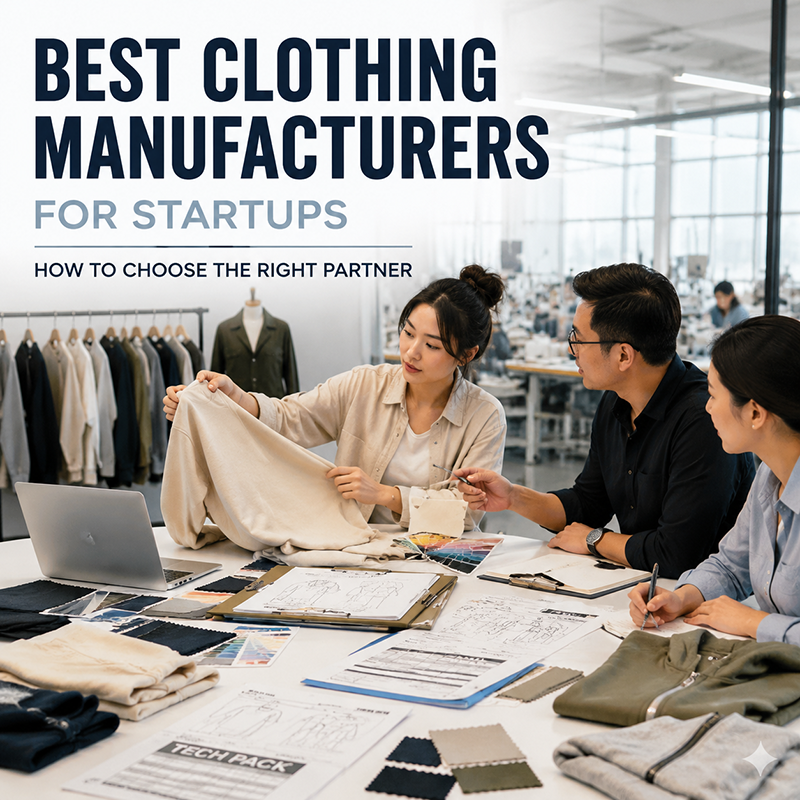
Finding the right clothing manufacturer is one of the most important decisions for a new fashion brand.
A great product idea is only the beginning. To turn that idea into a finished garment, you need a manufacturing partner that understands your product requirements, communicates clearly, maintains consistent quality and can support your business as it grows.
For startups, this decision can be even more important.
New clothing brands often work with limited budgets, smaller initial collections and evolving product requirements. Choosing a manufacturer based only on the lowest price can therefore create problems later.
So, what makes a clothing manufacturer a good choice for a startup?
The answer depends on your product, business model and production requirements.
Here are the key factors to consider.
1. Look for Experience With Your Product Category
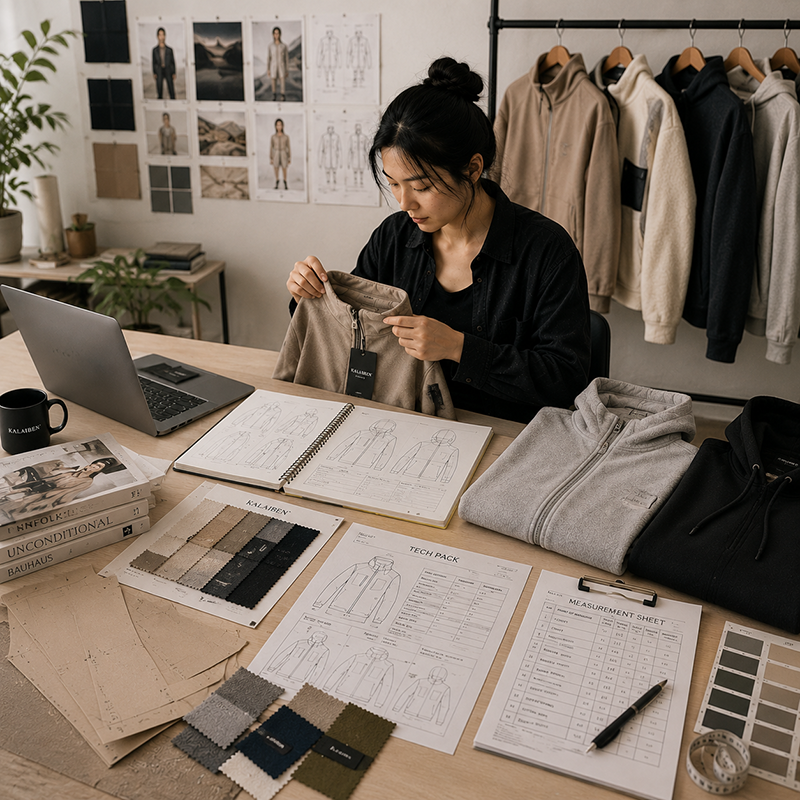
Not every clothing manufacturer specializes in the same products.
Some factories focus on basic T-shirts and casualwear, while others have experience with jackets, fleece, sportswear, children's clothing or technically constructed garments.
Before contacting a manufacturer, identify your main product category.
For example, your brand may focus on:
- 캐주얼 의류
- 스포츠웨어
- 아웃도어 의류
- Knitwear
- Woven garments
- 아동복
- 재킷
- Fleece products
- 일상 필수 아이템
A manufacturer with relevant experience may understand the construction, materials and production challenges associated with your products more quickly.
This can make communication and product development more efficient.
2. Check Their Fabric Capabilities
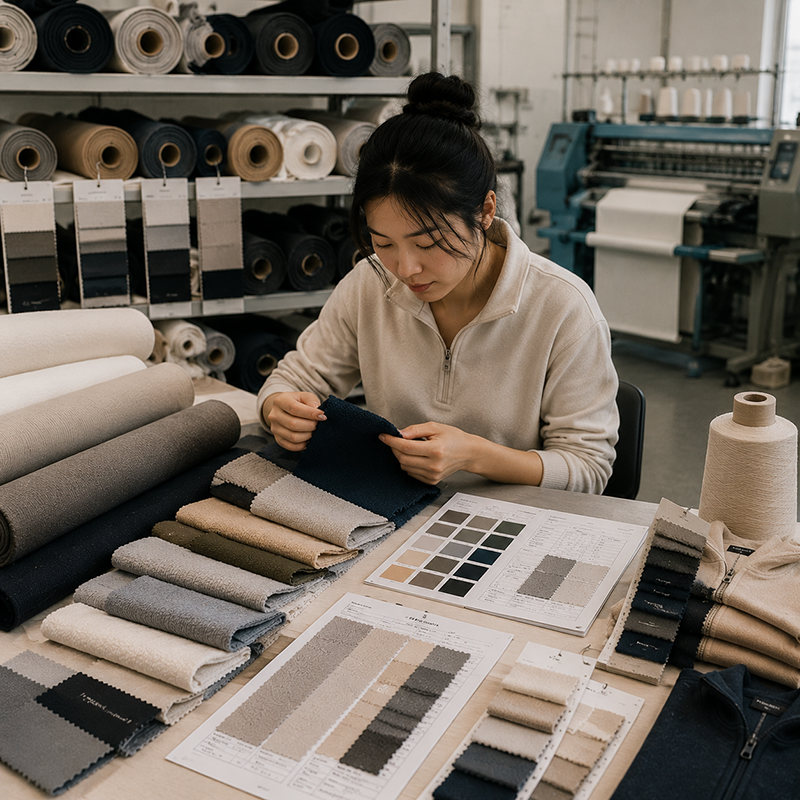
Fabric is one of the most important parts of clothing development.
A manufacturer may produce excellent garments, but if its fabric capabilities do not match your requirements, product development can become more complicated.
When evaluating a manufacturer, ask about:
- Fabric types
- 섬유 구성
- 원단 중량
- GSM
- 스트레치
- 마무리
- Color options
- 원단 조달
- Custom fabric development
This is especially important for brands that want to build a consistent product identity around specific materials.
KALAIBEN operates an integrated textile and garment business. Its textile operation produces knitted fabrics and uses equipment including high-speed single-side machines, double-side machines, terry machines, fleece machines and rib machines.
For brands developing knitwear, casualwear or fleece-related products, having access to textile capabilities within the broader manufacturing operation can help simplify communication between fabric and garment development.
3. Ask About Product Development and Sampling
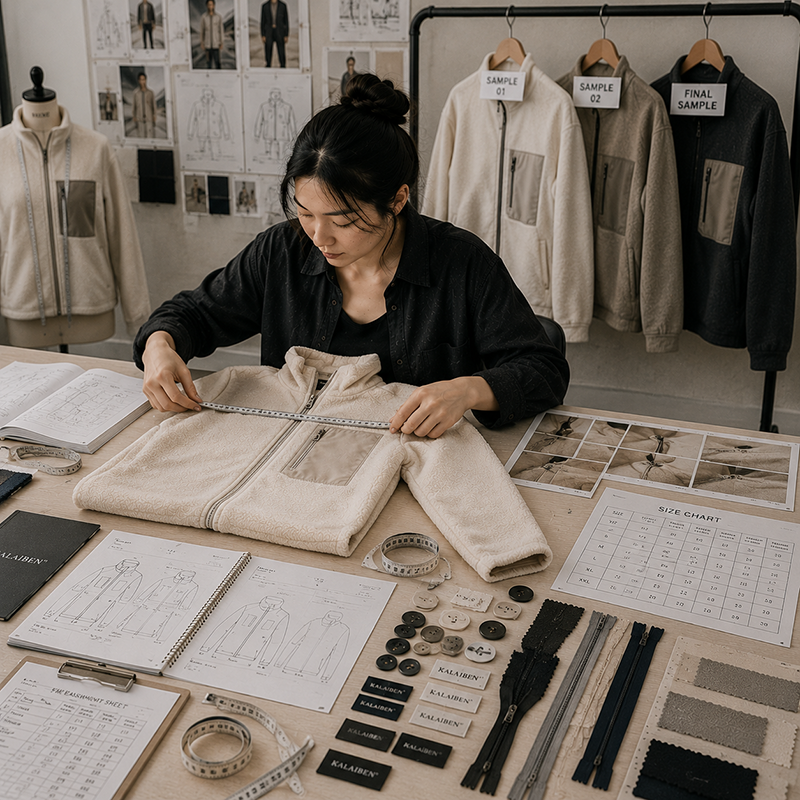
A startup should not evaluate a manufacturer only by its bulk production capabilities.
Product development matters just as much.
Before placing a large order, you may need to develop:
- Patterns
- 샘플
- 치수
- Fabric specifications
- Color standards
- 트림
- 라벨
- 포장
- 시공 세부 사항
Ask the manufacturer how its sampling process works.
You should understand:
- How samples are developed
- How revisions are handled
- How measurements are confirmed
- How fabric is approved
- How final specifications are documented
A clear sampling process can help reduce misunderstandings before bulk production begins.
4. Understand the Manufacturer's MOQ
MOQ means Minimum Order Quantity.
This is particularly important for startups.
A new clothing brand may want to test the market before investing heavily in inventory. If the manufacturer's MOQ is too high for your business model, you may end up purchasing more products than you can realistically sell.
When comparing manufacturers, ask:
- Is MOQ calculated per style?
- Is MOQ calculated per color?
- Does fabric MOQ affect the order?
- Can different sizes be combined?
- Does customization change the MOQ?
There is no universally "best" MOQ.
The right MOQ is the one that fits your expected sales, budget and inventory strategy.
5. Do Not Compare Manufacturers Only by Price
Price is obviously important.
However, the lowest quotation does not necessarily represent the lowest overall cost.
A manufacturer with a lower unit price may create additional costs if there are:
- Quality problems
- Delayed production
- Communication issues
- Fabric inconsistencies
- 잘못된 측정값
- Packaging problems
- Repeated sample revisions
When comparing manufacturers, consider the complete manufacturing process.
A slightly higher initial quotation may be more practical if the manufacturer provides better product development, communication, quality control and production reliability.
6. Evaluate Quality Control
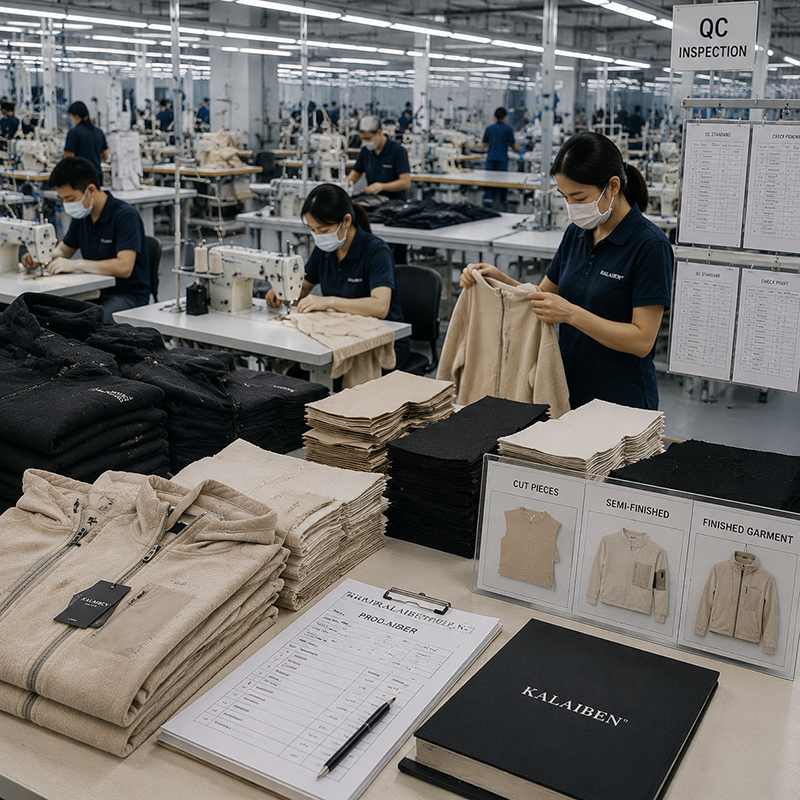
Quality control should be considered before production starts, not only after garments are finished.
Ask potential manufacturers how they manage quality during:
Fabric → Cutting → Sewing → Finishing → Inspection → Packing
Important quality points may include:
- 원단 검사
- Measurement checks
- Stitching quality
- Color consistency
- Garment construction
- 트림
- Label placement
- Final inspection
- 포장
A clear quality-control process gives startups a better understanding of how the manufacturer manages production consistency.
7. Consider Production Capacity
A startup may begin with a small collection, but its production requirements can change quickly if a product performs well.
This means you should think beyond your first order.
질문:
- What is the manufacturer's production capacity?
- What product categories can it handle?
- Can production scale with demand?
- How are production schedules managed?
- What happens when order quantities increase?
KALAIBEN's company information states that its garment operation has more than 380 employees and annual garment production of approximately 700,000–1,000,000 pieces. Its main products include knitted and woven casual garments and outdoor sportswear.
This type of production scale can be relevant when a growing brand needs to move from product development into larger-scale manufacturing.
8. Communication Matters More Than You Think
Many manufacturing problems begin with unclear communication.
A good manufacturer should be able to clearly discuss:
- Product specifications
- 원단 필요량
- 샘플
- 치수
- Production schedules
- 포장
- 품질 요건
- Shipping arrangements
For international startups, communication is especially important because product development may involve multiple rounds of feedback.
Before placing an order, pay attention to how quickly and clearly a manufacturer responds to your questions.
Good communication during the quotation stage can be an early indication of how the production relationship may work later.
9. Look at Their Product Range
A manufacturer's product range can tell you a lot about its capabilities.
For example, if a company works with both knitted and woven garments, it may have broader experience across different construction methods.
KALAIBEN describes its main apparel categories as knitted and woven casual garments and outdoor sportswear. The company also develops its own KALAIBEN adult clothing brand and BOWTAD children's clothing brand.
For startups, working with a manufacturer that understands different product categories can be useful when a brand expands its collection over time.
10. Consider an Integrated Textile and Garment Manufacturer
There can be advantages to working with a manufacturer that has capabilities across multiple stages of the textile and apparel process.
예를 들어:
Fabric Development
↓
제품 개발
↓
표본 추출
↓
Garment Manufacturing
↓
품질 관리
↓
포장
An integrated structure can potentially make communication between fabric and garment development more direct.
KALAIBEN operates as an integrated textile and garment industry and trade company, with its headquarters in Quanzhou, Fujian Province, and a Jiangxi subsidiary focused on textile and garment operations.
For brands that care about fabric selection and garment development together, this type of manufacturing structure may be worth considering.
11. Check Whether the Manufacturer Understands Startups
A startup does not necessarily have the same requirements as a large established fashion company.
You may need more support with:
- 제품 개발
- 표본 추출
- 원단 선택
- Technical specifications
- MOQ planning
- 포장
- Production planning
A manufacturer that is willing to communicate through these stages can be more useful than one that simply accepts production orders.
When contacting a manufacturer, explain your brand concept and product plans clearly.
This allows the manufacturer to determine whether its capabilities are suitable for your project.
12. Ask the Right Questions Before Choosing a Manufacturer
Before making your final decision, prepare a list of questions.
제품 개발
- Can you develop samples from our designs?
- Can you work with our tech packs?
- How many sample revisions are possible?
원단
- What fabrics do you specialize in?
- Can you provide fabric options?
- Can you develop custom fabric requirements?
Production
- What is the MOQ?
- What is the estimated lead time?
- What product categories do you manufacture?
Quality
- How is quality checked?
- When does inspection take place?
- How are production issues handled?
의사소통
- Who will manage the project?
- How will production updates be shared?
- How are changes confirmed?
The answers can help you compare manufacturers based on real business requirements instead of simply comparing quotations.
13. Common Mistakes Startups Should Avoid
Choosing Only Based on Price
The cheapest quotation is not always the best option.
Ordering Too Much Too Early
Large inventory can create unnecessary financial pressure.
Skipping the Sample Stage
Bulk production should not be the first time you see the finished product.
Providing Incomplete Specifications
Unclear product information can lead to misunderstandings.
Ignoring Fabric Quality
Fabric affects comfort, appearance, durability and overall product positioning.
Not Asking About MOQ
A manufacturer's MOQ can significantly affect your initial inventory investment.
Failing to Plan for Growth
Choose a manufacturing relationship that can potentially support your future product development and production needs.
14. How to Compare Clothing Manufacturers
Instead of asking:
"Which clothing manufacturer is the cheapest?"
ask:
"Which manufacturer is the best fit for my clothing brand?"
You can compare potential manufacturers using these categories:
| 요인 | What to Evaluate |
|---|---|
| Product Experience | Experience with your clothing category |
| Fabric Capability | Suitable materials and fabric development |
| 표본 추출 | Development and revision process |
| 최소 주문 수량(MOQ) | Suitable for your initial order |
| 품질 관리 | Inspection and production standards |
| 생산 능력 | 향후 주문 처리 능력 |
| 의사소통 | Response time and clarity |
| 리드 타임 | Production planning |
| 포장 | Labels and customized packaging |
| Overall Value | Balance of quality, service and cost |
This approach gives you a more complete picture of a manufacturer's suitability.
15. Why the Right Manufacturing Partner Matters
A clothing manufacturer is more than a company that produces garments.
For a startup, the right manufacturing partner can become an important part of the product development process.
They may help you move from:
Idea
→ 디자인
→ 원단
→ Sample
→ Production
→ Finished Product
The better these stages work together, the easier it can be to develop a consistent clothing collection.
KALAIBEN's business covers textile production and garment manufacturing, with experience across knitted and woven casualwear and outdoor sportswear. The company also operates its own KALAIBEN adult brand and BOWTAD children's brand.
This combination of textile and apparel capabilities represents the type of integrated manufacturing structure that clothing startups can consider when evaluating potential production partners.
결론
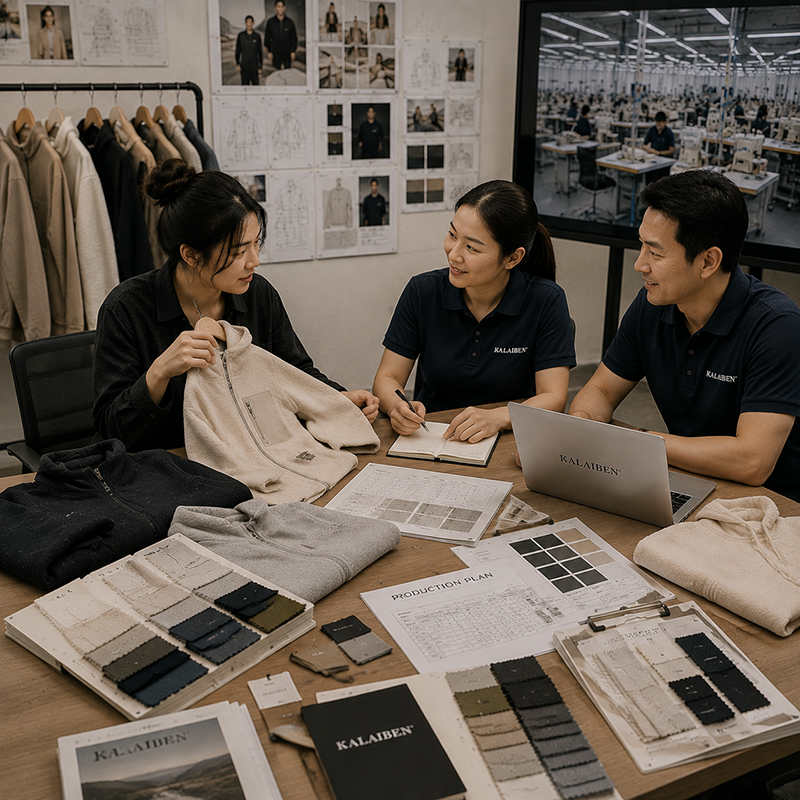
Finding the best clothing manufacturers for startups is not about finding one manufacturer that is universally "the best."
It is about finding the manufacturer that best matches your:
- 제품 카테고리
- 원단 필요량
- Development needs
- 최소 주문 수량(MOQ)
- Budget
- Quality expectations
- Production volume
- Growth plans
Before making a decision, look beyond the factory quotation.
Consider product development, fabric capabilities, sampling, MOQ, quality control, production capacity and communication.
For startups, a reliable manufacturing relationship can make the transition from a clothing concept to a finished collection much easier to manage.
The goal is not simply to find a factory that can make clothes.
The goal is to find a manufacturing partner that can help turn your product ideas into consistent, production-ready garments.











