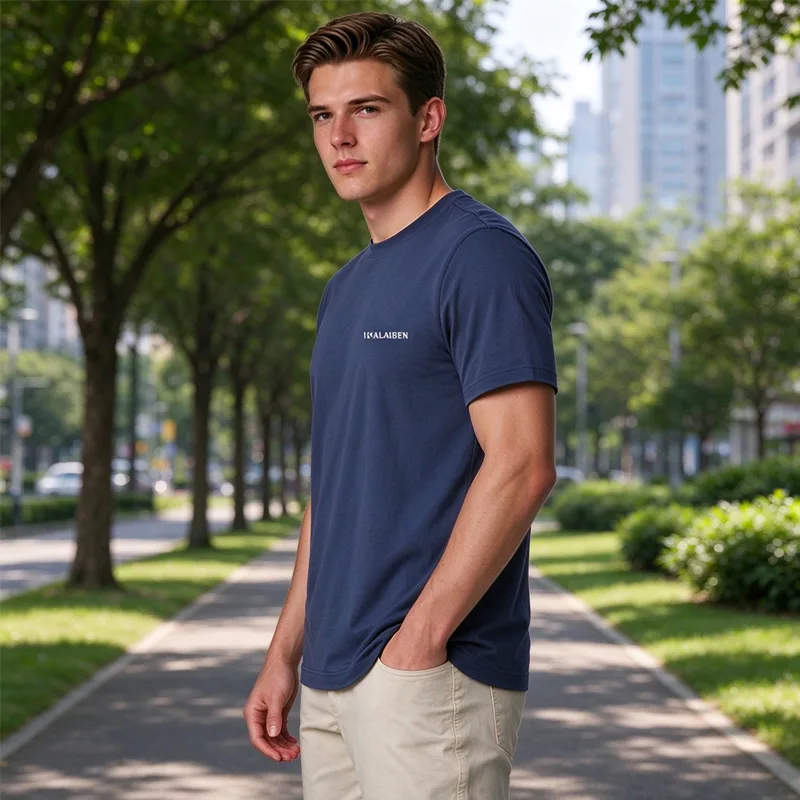
Lyocell Cotton Men's Short Sleeve T-Shirt: The 55/31/14 Blend Explained
Data publicării:2026-10-07 Categorie:ȘTIRI Număr de vizualizări:365
If you're sourcing a men's short sleeve t-shirt fabric that delivers cooling, antibacterial performance, and a premium hand feel without inflating your cost-per-unit, a lyocell cotton blend is worth serious evaluation. This article breaks down the engineering logic behind a 55% cotton, 31% polyester, 14% lyocell composition and explains what 160 GSM actually means for the end wearer.
What Is a Lyocell Cotton Men's Short Sleeve T-Shirt?
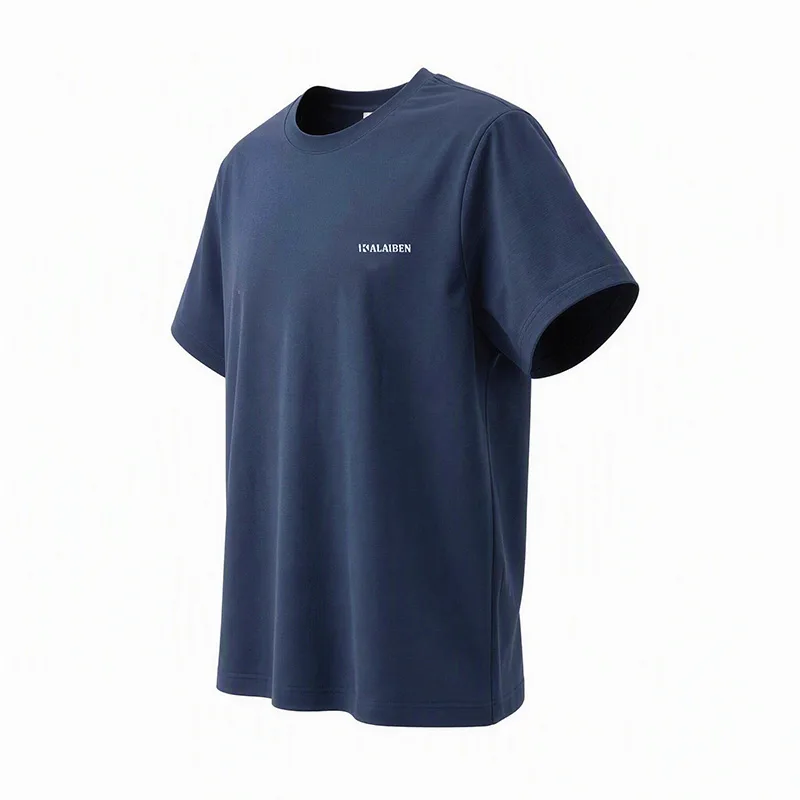
A lyocell cotton t-shirt is a short-sleeve top made from a blend of lyocell fiber and cotton. Lyocell is a regenerated cellulose fiber derived from wood pulp, produced through a closed-loop process with solvent recovery rates exceeding 99%. In the apparel industry, it is often recognized under the TENCEL™ trademark.
Compared to a pure cotton tee, a lyocell cotton blend maintains cotton's natural skin-friendliness while significantly improving drape, wrinkle resistance, and moisture-wicking capability. This makes the lyocell cotton men's short sleeve t-shirt particularly well-suited for warm-weather wear and smart-casual settings where both comfort and appearance matter.
The 55/31/14 Blend: Why This Ratio Matters
Most lyocell cotton t-shirts on the market use two-fiber blends with typical ratios of 67% lyocell / 33% cotton or 70% lyocell / 30% cotton. These fabrics feel excellent, but they present two challenges in bulk B2B production: higher lyocell content increases fabric cost and reduces wrinkle resistance, while the absence of synthetic fiber support leads to deformation after repeated washing.
The 55% cotton / 31% polyester / 14% lyocell three-fiber formulation is fundamentally an engineered ratio designed for B2B volume production.
What Each Fiber Contributes
| Fiber | Percentage | Core Function |
|---|---|---|
| Cotton | 55% | Provides natural skin-friendly feel and breathability; forms the fabric base |
| Polyester | 31% | Enhances dimensional stability, wrinkle resistance, and abrasion resistance; reduces shrinkage |
| Lyocell | 14% | Improves softness, drape, and moisture-wicking; delivers a silky hand feel |
The precision of this ratio lies in the interplay: polyester compensates for lyocell's wet-strength limitations, while lyocell injects the smooth, fluid quality that cotton-polyester fabrics inherently lack. According to mechanical studies on lyocell fibers, standard lyocell exhibits higher breaking strength than viscose in both wet and dry states. At 14%, lyocell content is sufficient to noticeably improve hand feel without disproportionately raising cost or compromising dimensional stability.
Fabric Performance Advantages
Cooling & Moisture Management
Lyocell's nanofibrillar structure gives it exceptional hydrophilicity and wicking capability. Research shows that lyocell textiles possess excellent comfort and thermoregulatory properties. In practice, this means sweat is rapidly conducted from the skin surface to the fabric's outer layer and evaporated, rather than being retained within the fiber structure as it is in pure cotton.
Combined with the quick-drying characteristics of 31% polyester, this fabric dries noticeably faster than a 100% cotton t-shirt. For wearers in warm environments or during extended wear, the difference is immediately perceptible.
Antibacterial Function
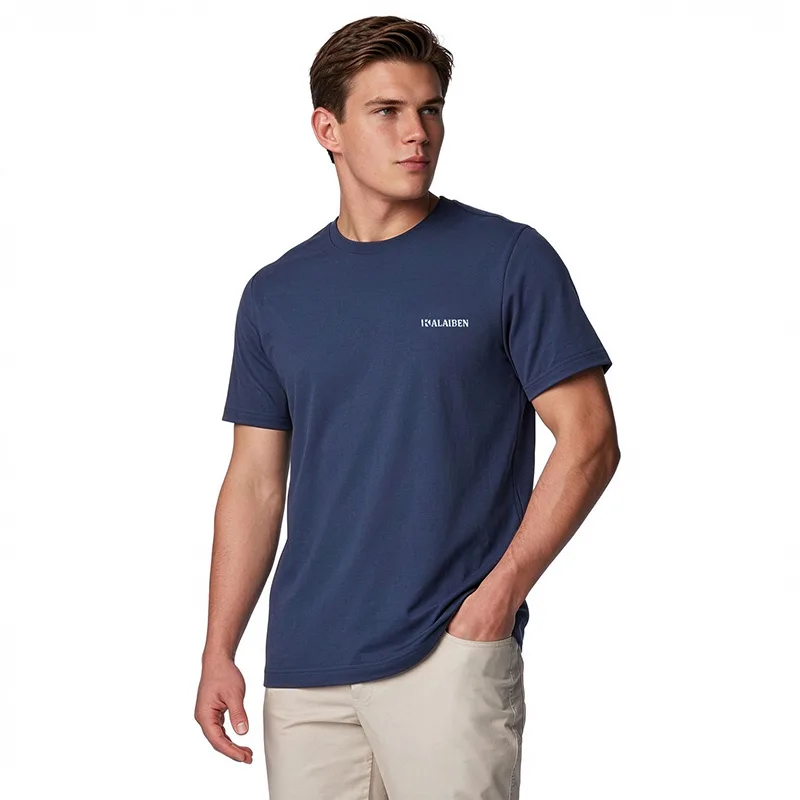
The fabric's built-in antibacterial finish inhibits bacterial proliferation on the fiber surface, reducing odor formation. Unlike solutions that rely solely on a topical coating, this antibacterial function maintains its activity after multiple wash cycles. Lyocell's inherent high moisture absorption also helps maintain a dry surface environment, physically suppressing bacterial growth.
Mint Microcapsule Friction-Release Fragrance Technology
This is the fabric's most distinctive technical feature. Peppermint essential oil is encapsulated in microcapsules that are bonded to the fiber surface. When the wearer moves and friction occurs between the fabric and skin, the microcapsule walls rupture and release mint fragrance. This technology represents a well-established application of microencapsulation in functional textiles.
It should be noted that the fragrance release is progressive — areas of frequent friction (underarms, back) release more noticeably, and the effect gradually diminishes with wear time. For brands, this creates a "surprise moment" for the end consumer.
Fabric Technical Specifications at a Glance
| Parameter | Specification |
|---|---|
| Composition | 55% Cotton / 31% Polyester / 14% Lyocell |
| Greutate | 160 GSM |
| Key Functions | Cooling, antibacterial, moisture-wicking, friction-release mint fragrance |
| Use Cases | Summer daily wear, smart casual, light activity |
| Size Range | S–M–L–XL–2XL |
| Cantitate minimă de comandă | 500 pcs/color |
What Does 160 GSM Mean?
In B2B t-shirt sourcing, GSM is the parameter that most directly determines cost and end-use suitability. Industry benchmarks are as follows: 140–180 GSM falls into the lightweight category, suitable for summer basics and hot-climate markets; 200 GSM and above is mid-to-heavyweight, better suited for workwear or structured garments requiring durability.
At 160 GSM, this fabric sits comfortably in the upper-middle of the lightweight range. This means:
- Lightweight enough for summer wear without trapping heat
- Not as thin or transparent as sub-140 GSM fabrics
- Balances comfort with the durability threshold B2B buyers require
For brands targeting Southern Europe, Southeast Asia, or the Southern United States, 160 GSM is a market-validated safe zone.
B2B Sourcing Considerations
When sourcing lyocell cotton short sleeve t-shirts, prioritize the following:
Fabric certification. Lyocell's sustainability credentials are a core selling point. Confirm whether your supplier can provide fiber origin certification (such as TENCEL™ trademark authorization or FSC certification), as this directly affects your brand's ability to legally use "sustainable fabric" messaging.
Color fastness testing. Lyocell dyes exceptionally well with excellent color fixation and fade resistance. However, third-party color fastness reports should still be requested before bulk production, particularly for dark colorways.
Hand-feel samples. Weaving and finishing quality varies significantly between suppliers. Always request physical samples before confirming an order to evaluate softness, drape, and actual mint fragrance intensity.
Shrinkage control. Both cotton and lyocell swell when wet. Reputable suppliers should provide pre-shrinking treatment. Specify shrinkage tolerances in your contract (typically ≤5% warp and ≤5% weft).
For additional fabric specifications and customization options, visit https://www.kalaiben.com/.
Care & Longevity
- Use a laundry bag for machine washing; water temperature should not exceed 30°C
- Avoid high-temperature tumble drying; air drying preserves fabric shape best
- Lyocell loses strength when wet — avoid wringing or twisting forcefully
- Mint microcapsule effect diminishes with wash cycles; this is inherent to microencapsulation technology
FAQ
Will a lyocell cotton t-shirt pill?
Lyocell has better pill resistance than viscose, but pilling remains possible under repeated mechanical friction. The 31% polyester content provides solid anti-pilling support. Request Martindale pilling test data from your supplier before purchasing.
Is this fabric suitable for printing or embroidery?
The 160 GSM knit is compatible with screen printing and digital printing; the polyester content also supports sublimation printing. For embroidery, keep designs relatively small to avoid pulling and distortion on a lightweight fabric.
How long does the mint fragrance last?
This depends on the microcapsule bonding process and wearing frequency. Under normal wear and washing conditions, the fragrance effect typically lasts 20–30 wash cycles. Confirm exact figures with your supplier's test reports.
Concluzie
The 55/31/14 lyocell cotton blend men's short sleeve t-shirt delivers its core value through an engineered three-fiber ratio that addresses the cost and stability limitations of conventional two-fiber lyocell cotton fabrics in B2B production, while offering perceivable functional differentiation through cooling, antibacterial, and mint microcapsule technologies. For brands targeting warm-weather markets, it represents a pragmatic balance between cost, performance, and marketable features.