




Best Clothing Manufacturers for Startups: How to Choose the Right Manufacturing Partner
Дата публикации:2026-09-02 Категория:НОВОСТИ Количество просмотров:558
Introduction
Starting a clothing brand involves many decisions.
You need to develop products, choose fabrics, create samples, establish pricing, manage inventory, and eventually produce garments at a consistent quality.
Among all these decisions, finding one of the best clothing manufacturers for startups
can have a significant impact on the development of your brand.
For a new clothing business, the biggest manufacturer is not necessarily the best manufacturer.
A startup may need a supplier that can provide:
- Reasonable MOQ
- Поддержка разработки продукции
- Разработка образцов
- Clear communication
- Подходящие варианты ткани
- Надежное производство
- Стабильное качество
- Flexible cooperation
The ideal manufacturing partner should match the current needs of your business while also being capable of supporting future growth.
This guide explains what startups should consider when comparing clothing manufacturers.
1. What Makes a Clothing Manufacturer Good for Startups?
Startups have different needs from established apparel companies.
A large brand may place very large orders and already have an established technical team.
A startup may still be developing its first collection.
It may need more support with:
- Product development
- Выбор ткани
- Sampling
- Измерения
- Production specifications
- Брендинг
- Упаковка
- Order planning
Therefore, when evaluating a manufacturer, startups should look beyond production capacity.
The better question is:
Can this manufacturer support my business at its current stage and as it grows?
2. Look for Relevant Product Experience
The first factor to consider is product specialization.
A manufacturer should ideally have experience producing the type of clothing your brand is developing.
For example:
Casualwear Brand
You may look for experience with:
- T-shirts
- Sweatshirts
- Hoodies
- Casual jackets
- Vests
Outdoor Brand
Relevant experience may include:
- Fleece
- Outdoor jackets
- Vests
- Спортивная одежда
- Functional casualwear
Children's Brand
You may want a manufacturer experienced in children's garments and appropriate sizing requirements.
KALAIBEN's company profile states that its primary products include knitted and woven casual garments and outdoor sportswear. The company also develops its own BOWTAD children's brand and KALAIBEN adult brand.
For startups developing these categories, relevant product experience can make communication and product development more straightforward.
3. Consider MOQ Carefully
MOQ means Minimum Order Quantity.
This is particularly important for startups.
A new brand may not want to invest heavily in inventory before knowing which products will sell.
When comparing manufacturers, ask:
- What is the MOQ per style?
- What is the MOQ per color?
- Does fabric affect MOQ?
- Does customization affect MOQ?
- Can different sizes be combined within one style?
- What happens with repeat orders?
Do not assume that the manufacturer with the lowest quoted price is automatically the best choice.
MOQ and total production conditions can have a major impact on your actual business costs.
4. Sample Development Is Essential
For a startup, the first product sample is often an important learning stage.
It allows you to identify problems before investing in bulk production.
Review:
Подходит
Does the garment fit the intended customer?
Измерения
Do actual measurements match the size chart?
Ткань
Does the fabric have the intended weight and hand feel?
Строительство
Are seams, pockets, collars, cuffs, and closures correct?
Внешний вид
Does the finished garment match your original concept?
The first sample may require revisions.
That is part of product development.
5. Evaluate Fabric Capabilities
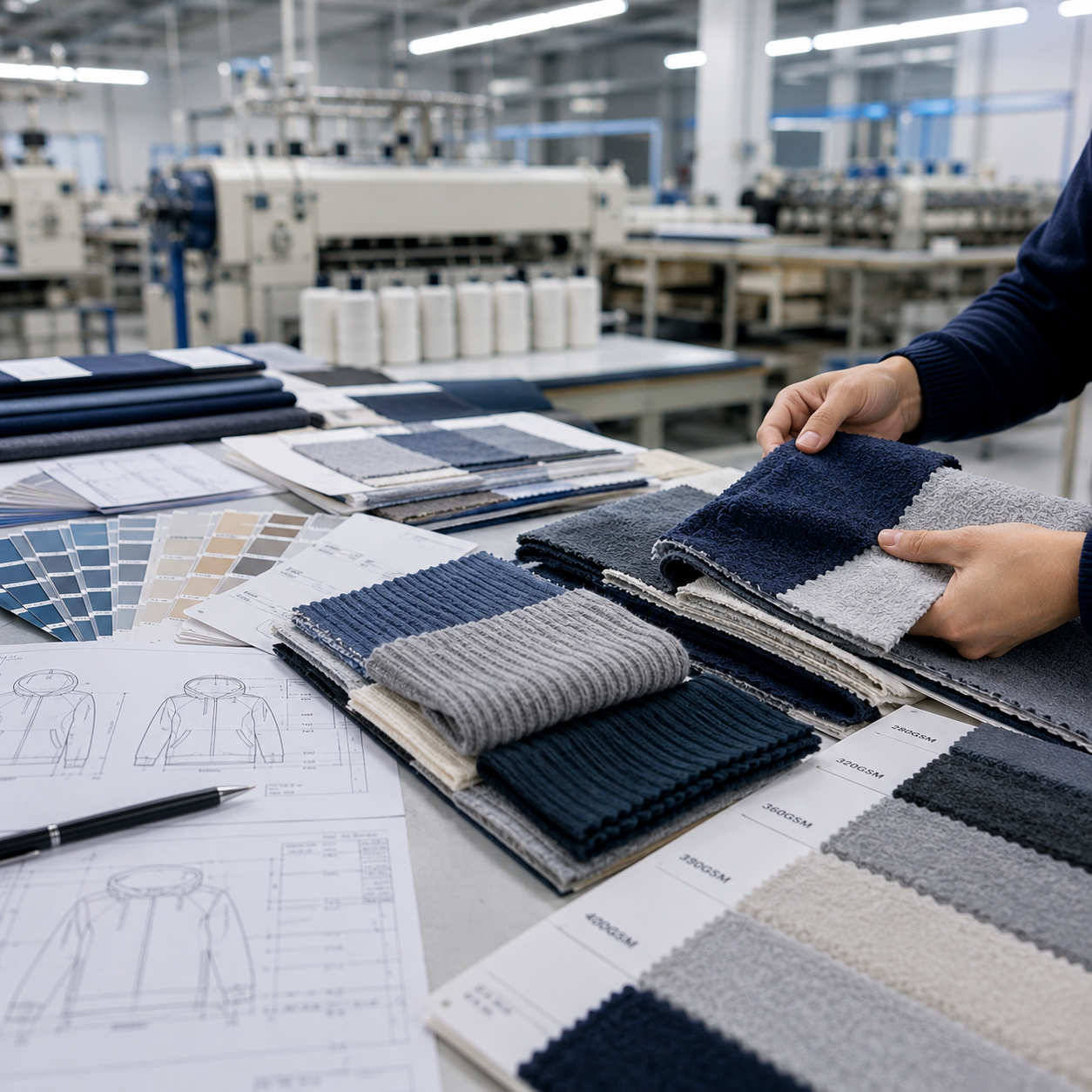
Fabric can strongly influence the final appearance and performance of a garment.
A startup should understand:
- Fiber composition
- Fabric weight
- Строительство
- Stretch
- Hand feel
- Цвет
- Surface finish
KALAIBEN's company profile describes its knitting fabric operation as having more than 30 employees and equipment including high-speed single-side machines, double-side machines, terry machines, fleece machines, and rib machines.
For brands developing knitted products, the ability to discuss fabric requirements alongside garment development can be useful.
6. Don't Choose a Manufacturer Based Only on Price
Price is obviously important.
However, the cheapest quotation may not produce the lowest overall cost.
A startup should also consider:
Sample Cost
Production Cost
Настройка
Упаковка
Potential Revision Costs
Inventory Risk
A slightly higher unit price may sometimes be more practical if the supplier provides better product development support and more consistent production.
The objective is not simply to minimize the quotation.
It is to achieve a workable balance between:
Cost + Quality + MOQ + Development + Reliability
7. Check Production Capabilities
Production capacity becomes increasingly important as a startup grows.
KALAIBEN's company information states that its Jiangxi production base covers approximately 30 acres with a construction area of 26,000㎡ and that the company has more than 380 employees. It identifies knitted and woven casualwear and outdoor sportswear as its primary products.
The company profile also states an annual garment production capacity of approximately 700,000–1,000,000 pieces.
For a startup, however, production scale should not be the only consideration.
You should ask:
Can the manufacturer handle my first order?
and later:
Can the manufacturer handle my larger repeat orders?
8. Communication Is Especially Important for Startups
New brands often do not have a large technical or sourcing team.
As a result, communication with the manufacturer becomes particularly important.
You may need to discuss:
- Дизайн
- Ткань
- Измерения
- Samples
- Revisions
- Colors
- Брендинг
- Упаковка
- Production schedules
Before choosing a supplier, consider how clearly the manufacturer responds to your questions.
A good manufacturing relationship should make complex product information easier to understand.
9. Look at the Complete Manufacturing Process
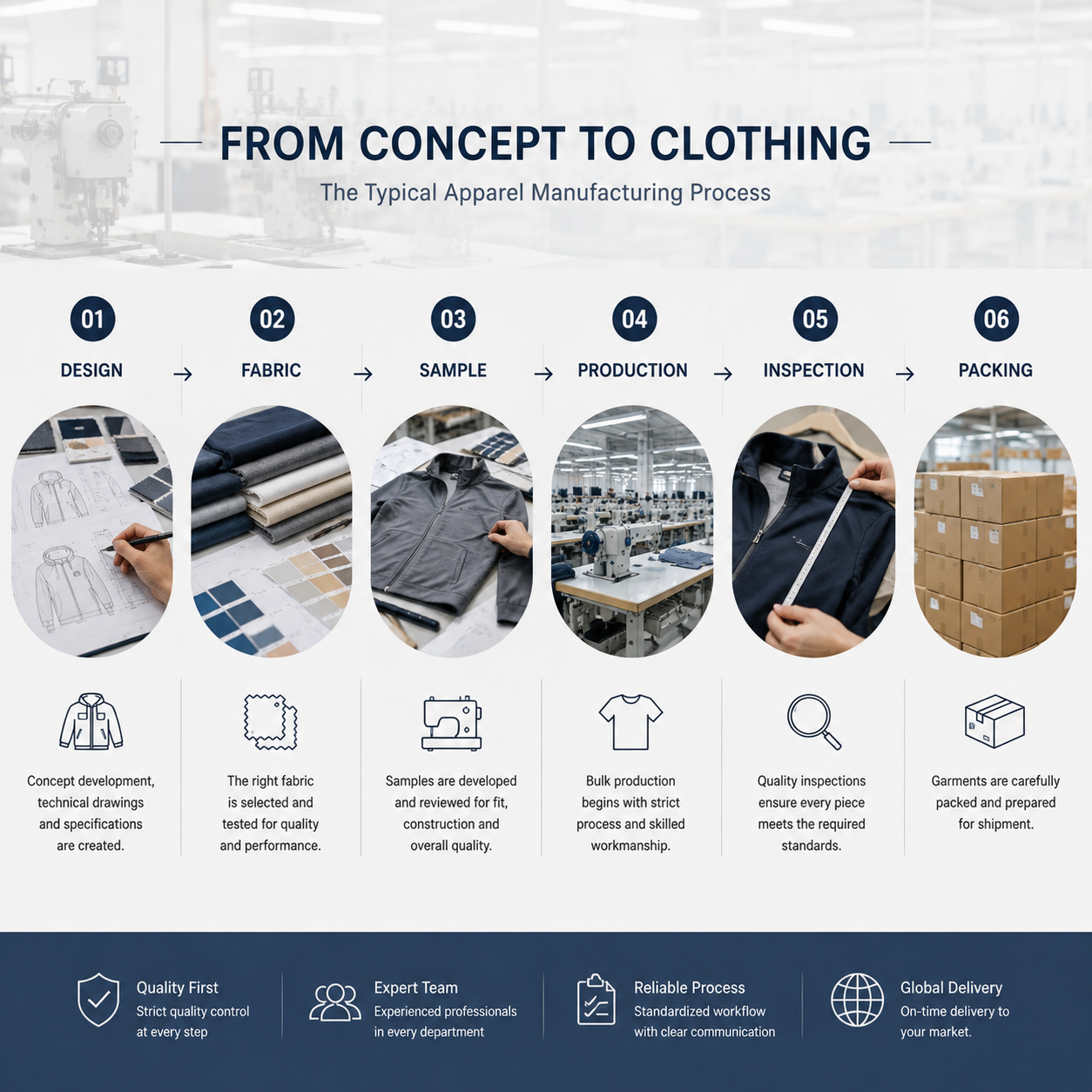
A startup should understand how its product moves from an idea to a finished garment.
A typical process can look like:
Дизайн
↓
Fabric Selection
↓
Sample Development
↓
Sample Revision
↓
Sample Approval
↓
Production
↓
Резка
↓
Шитье
↓
Отделка
↓
Проверка
↓
Упаковка
The 2025 BSCI report for Jiangxi KALAIBEN identifies production activities including cutting, sewing, ironing, inspection, and packing.
Understanding the process helps startups know when important decisions need to be confirmed.
10. Quality Requirements Should Be Written Down
One common mistake for new brands is relying on general instructions such as:
"Please make the quality good."
Instead, provide specific requirements.
For example:
- Fabric composition
- Fabric weight
- Size chart
- Measurement tolerance
- Stitching requirements
- Color standard
- Logo placement
- Label specifications
- Упаковка
A written specification creates a shared reference between the brand and manufacturer.
11. Consider the Manufacturer's Long-Term Potential
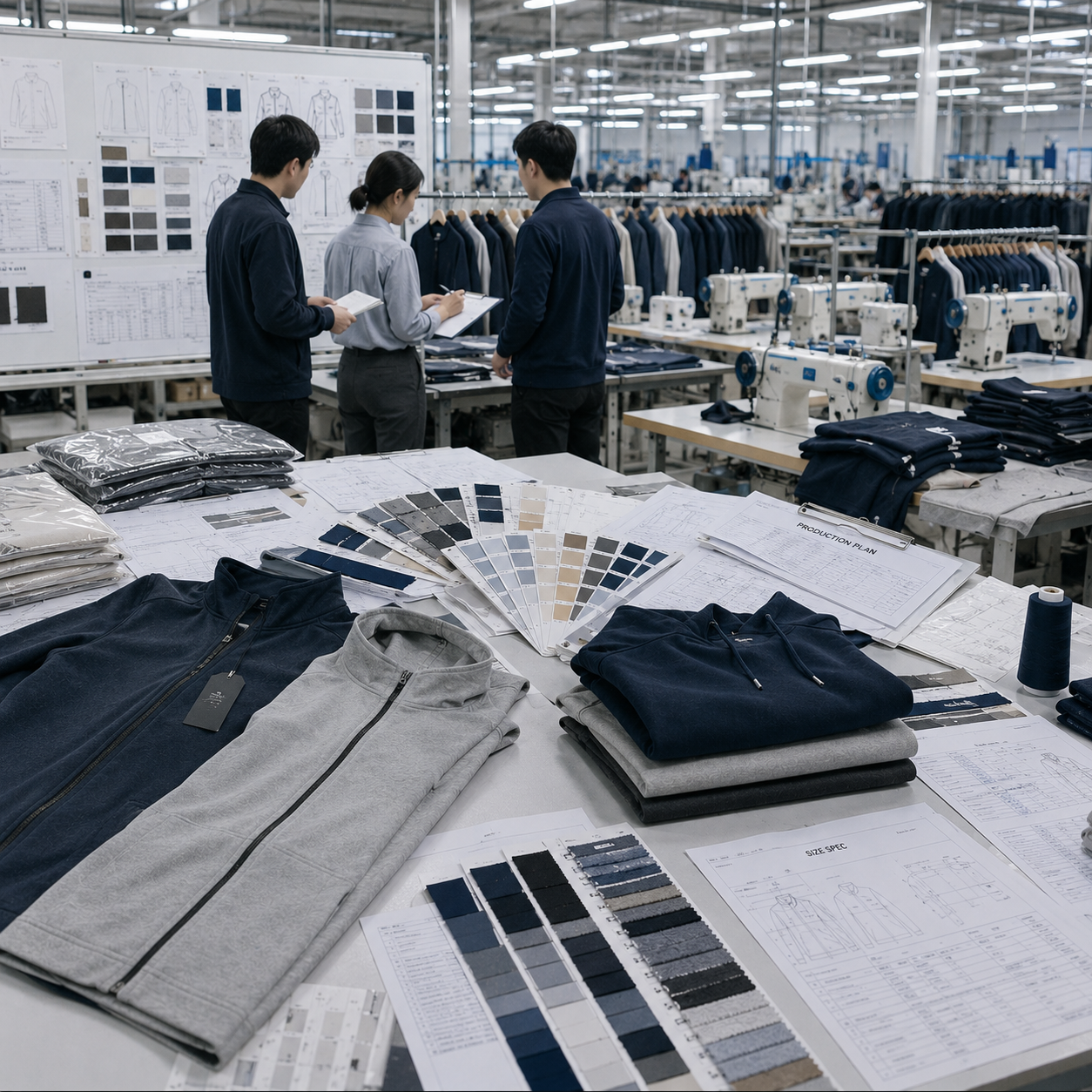
Your first order may be relatively small.
But if your brand succeeds, your requirements may change.
You may eventually need:
- More colors
- More sizes
- More styles
- Большие партии
- Seasonal collections
- Повторные заказы
Therefore, startups should consider whether a potential manufacturer can support this development.
The best supplier for a startup is not necessarily the one that offers the lowest price on the first order.
It may be the manufacturer that can grow with the brand.
12. A Practical Checklist for Startups
Before choosing a clothing manufacturer, compare:
| Фактор | What to Check |
|---|---|
| Product Experience | Does the factory make your type of garment? |
| Ткань | Can it meet your material requirements? |
| MOQ | Does the quantity fit your business? |
| Samples | Can it develop and revise samples? |
| Качество | Are specifications clearly defined? |
| Production | Can it handle your expected volume? |
| Коммуникация | Can requirements be communicated clearly? |
| Настройка | Can branding and garment details be customized? |
| Repeat Orders | Can successful products be reproduced? |
| Growth | Can production scale with your brand? |
Why KALAIBEN May Be Relevant for Growing Apparel Brands
KALAIBEN is an integrated industry and trade company specializing in weaving and knitted garments. Its company profile identifies knitted and woven casual garments and outdoor sportswear as its primary product categories.
The company also operates knitted fabric production capabilities and has a Jiangxi garment production base.
For startups developing casualwear, outdoor apparel, sportswear, and related garments, these capabilities provide a basis for discussing product development and manufacturing requirements.
FAQ
What should startups look for in a clothing manufacturer?
Startups should consider MOQ, product experience, sampling, fabric capabilities, quality, communication, production capacity, customization, and long-term cooperation.
What MOQ is suitable for a startup clothing brand?
There is no universal MOQ. The appropriate quantity depends on the product, fabric, business model, budget, and expected demand.
Should startups order samples?
Yes. Samples allow a startup to evaluate the product before committing to bulk production.
Is the cheapest clothing manufacturer the best choice?
Not necessarily. Startups should evaluate total production conditions rather than unit price alone.
Can a startup work with a large clothing manufacturer?
Yes, provided the manufacturer's MOQ, product capabilities, communication, and development process match the startup's requirements.
Conclusion
Finding the best clothing manufacturers for startups is about finding the right fit between your brand and your manufacturing partner.
Instead of focusing on one factor, evaluate:
MOQ + Product Experience + Sampling + Fabric + Quality + Communication + Production + Long-Term Support
A good manufacturing partner should not only help you produce your first collection.
It should ideally provide a foundation for future product development and growth.
Are you developing your first apparel collection? Contact KALAIBEN with your product concept, fabric requirements, estimated quantity, and customization details to discuss your manufacturing project.











