




T-shirts personnalisés en gros : guide pratique pour les marques de vêtements et les entreprises
Date de publication :2026-09-07 Catégorie :ACTUALITÉS Nombre de visites :606
Introduction
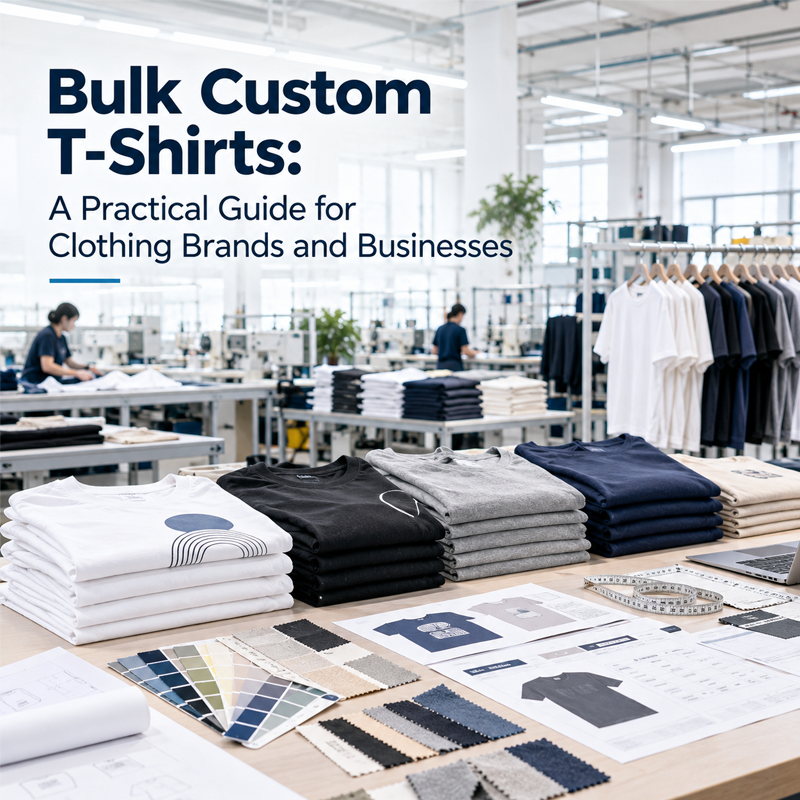
Bulk custom T-shirts are widely used by clothing brands, businesses, teams, events, organizations, and promotional programs.
However, ordering hundreds or thousands of customized T-shirts is very different from buying a small number of ready-made garments.
Bulk production requires decisions about:
- Tissu
- Confection de vêtements
- Couleurs
- Sizes
- Œuvre d'art
- Impression
- Étiquettes
- Quantité
- Emballage
The right manufacturing process can help brands achieve consistent quality across a large order.
This guide explains what buyers should consider when planning a bulk custom T-shirt order.
1. What Are Bulk Custom T-Shirts?
Bulk custom T-shirts are garments produced in larger quantities and customized according to a buyer's requirements.
Customization can involve:
- Tissu
- Couleur
- Ajustement
- Œuvre d'art
- Impression
- Broderie
- Étiquettes
- Emballage
For clothing brands, bulk custom T-shirts can be developed as part of a private label collection.
For organizations and businesses, they can also be used for:
- Team apparel
- Events
- Staff clothing
- Merchandise
- Promotional campaigns
2. Why Do Brands Order Custom T-Shirts in Bulk?
Bulk production can provide several advantages.
Consistent Product Quality
Producing a larger quantity under one approved specification can help maintain consistency.
Better Production Planning
Manufacturers can organize materials, patterns, cutting, sewing, and decoration according to the total order.
Brand Customization
Brands can develop their own:
- Couleurs
- Graphics
- Étiquettes
- Sizes
- Caractéristiques techniques du produit
Scalable Production
Bulk manufacturing can support brands moving from product development into commercial sales.
3. Choosing the Right T-Shirt Fabric
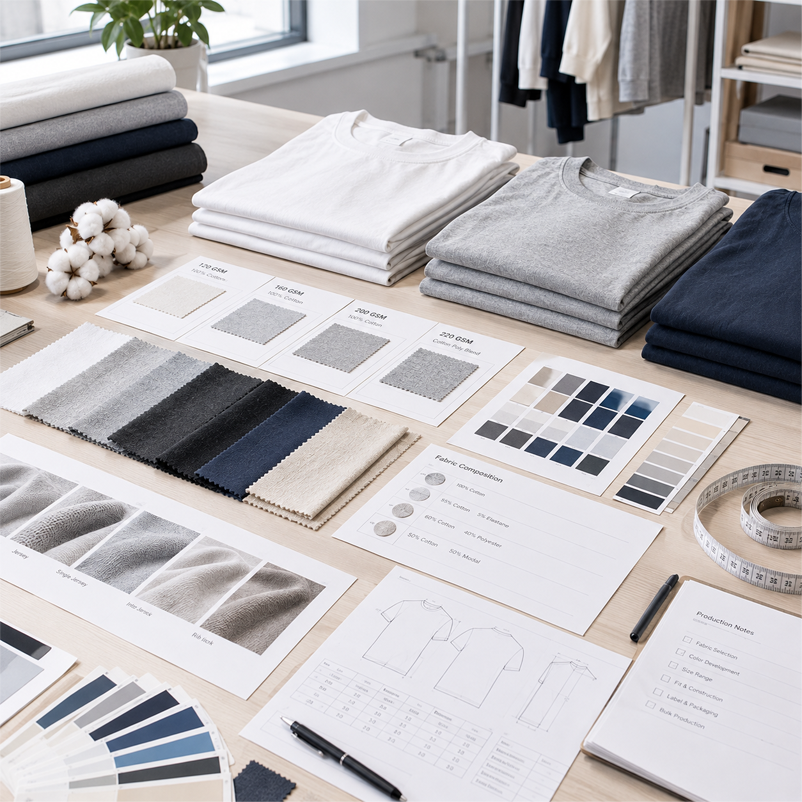
Fabric is one of the most important decisions.
Parmi les options courantes, on trouve :
Cotton
Popular for its natural hand feel and everyday comfort.
Cotton Blends
Blended fabrics can provide different combinations of comfort, durability, and performance.
Recycled or Sustainable Options
Brands with sustainability goals may explore alternative material choices.
Different Fabric Weights
T-shirt weight affects:
- Sensation au toucher
- Structure
- Respirabilité
- Aspect
- Perceived quality
The correct fabric depends on the intended product and target customer.
4. Choosing T-Shirt Fit and Construction
A bulk T-shirt order should have clearly defined specifications.
Brands should consider:
- Regular fit
- Oversized fit
- Relaxed fit
- Slim fit
They should also define:
- Structure du manche
- Longueur des manches
- Longueur du corps
- Largeur des épaules
- Hem construction
An approved sample should be used as a reference before bulk production.
5. Custom Printing Options
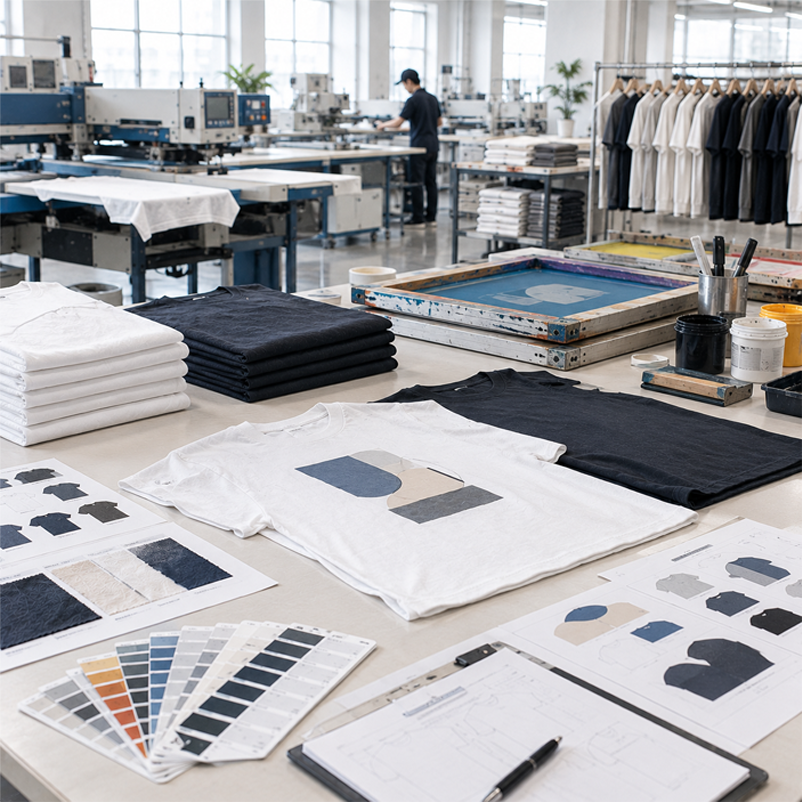
Bulk custom T-shirts can use different decoration methods.
Screen Printing
Suitable for many graphic applications and larger production quantities.
Broderie
Can provide a raised, textured finish.
Other Decoration Methods
Depending on the artwork and garment requirements, manufacturers may recommend other suitable techniques.
The best method depends on:
- Œuvre d'art
- Nombre de couleurs
- Tissu
- Placement
- Quantité
- Desired appearance
6. Artwork Preparation for Bulk Production
Artwork should be finalized before mass production.
Brands should confirm:
- Dimensions de l'œuvre
- Position d'impression
- Couleurs
- Format de fichier
- Placement
- Méthode de décoration
A production-ready artwork file helps the manufacturer create a more consistent result across the order.
Whenever possible, brands should approve a physical sample before bulk production begins.
7. Why a Pre-Production Sample Matters
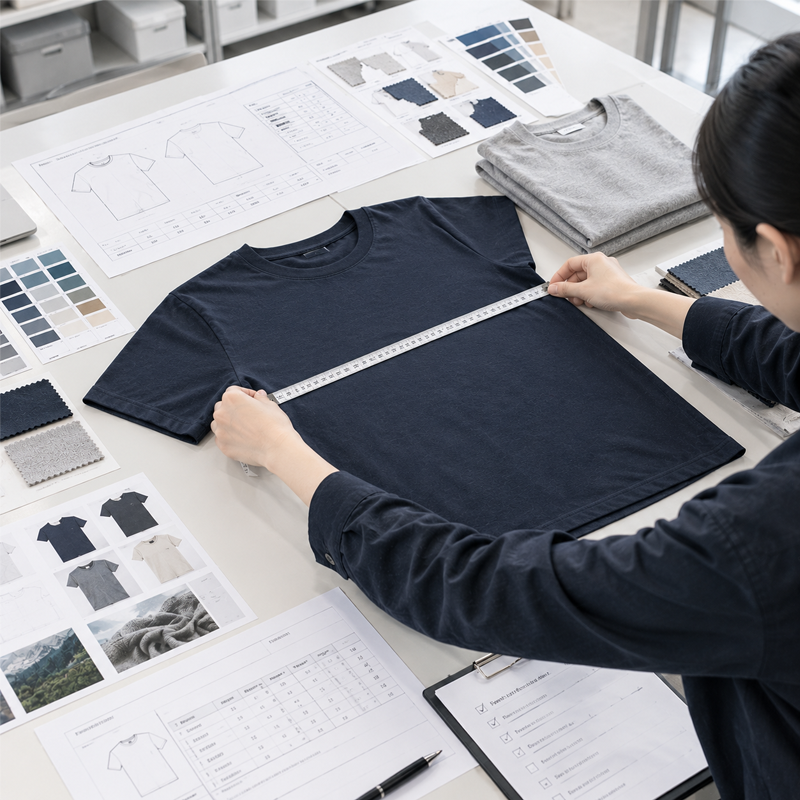
A sample allows buyers to see the actual product before committing to the full order.
Review:
- Tissu
- Ajustement
- Dimensions
- Couleur
- Construction
- Étiquettes
If changes are necessary, they should be confirmed before production begins.
The approved sample then becomes an important reference for the production team.
8. Understanding MOQ for Bulk T-Shirts
MOQ signifie Quantité minimale de commande.
Different manufacturers may set different MOQs depending on:
- Type de produit
- Tissu
- Couleur
- Personnalisation
- Production process
Brands should ask whether MOQ applies:
- Per style
- Per color
- Per size
- Or to the total order
Understanding MOQ before development can prevent unexpected production limitations.
9. Size and Color Planning
Bulk T-shirt orders often include multiple sizes and colors.
Brands should prepare a clear breakdown such as:
- XS
- S
- M
- L
- XL
- 2XL
Color planning should also be confirmed in advance.
Important details include:
- Références de couleurs
- Quantity per color
- Size distribution
- Uniformité des couleurs
Clear production quantities help manufacturers plan materials and production more efficiently.
10. Quality Control for Bulk Custom T-Shirts
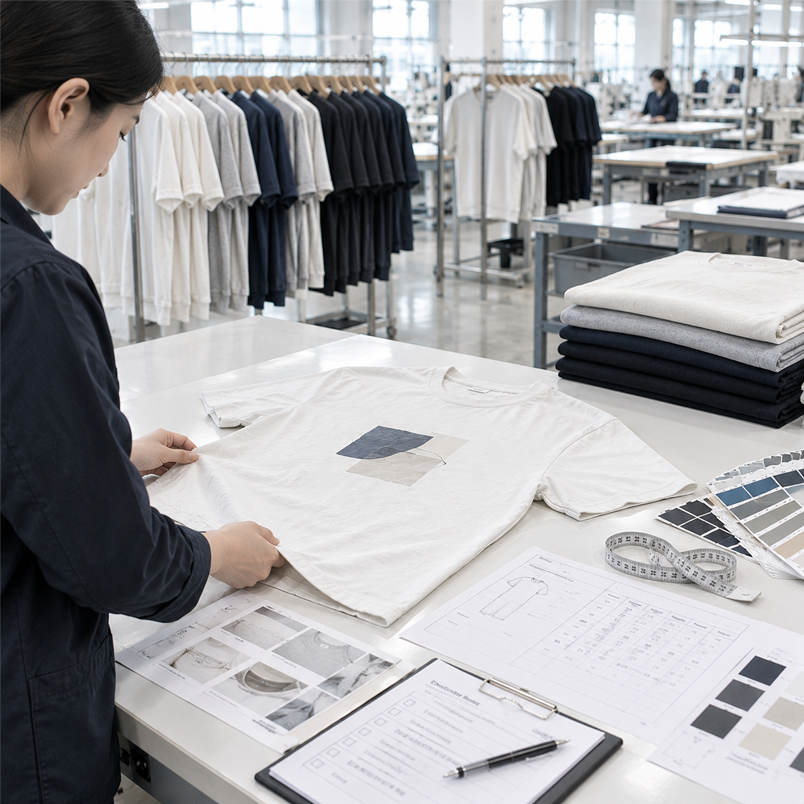
Quality control becomes especially important when producing large quantities.
Manufacturers may check:
Dimensions
Are garments within the agreed size tolerances?
Tissu
Is the fabric consistent in weight, appearance, and hand feel?
Couture
Are seams and stitching clean and consistent?
Impression
Is the artwork correctly positioned and applied?
Couleur
Are garments consistent with the approved color?
Finition
Are labels, trims, threads, and packaging correctly completed?
Clear specifications make these checks easier.
11. How to Calculate the Right Order Quantity
Ordering too little can create stock shortages.
Ordering too much can increase inventory pressure.
Brands should consider:
- Expected sales
- Market demand
- Product launch plans
- Available storage
- Repeat production lead times
For new brands, it can be useful to begin with a realistic production quantity and scale future orders based on actual market performance.
12. What Should You Send to a T-Shirt Manufacturer?
A manufacturer will usually need clear product information.
Préparation :
Informations sur le produit
- T-shirt style
- Quantité
- Gamme de tailles
- Couleurs
Fabric Information
- Composition
- Poids
- Texture
- Exigences de performance
Personnalisation
- Œuvre d'art
- Taille d'impression
- Emplacement de l'impression
- Exigences en matière d'étiquetage
Production Information
- Date de livraison prévue
- Exigences en matière d'emballage
- Shipping destination
The more organized the information, the easier it is for the manufacturer to provide an accurate quotation and production assessment.
13. How to Choose a Bulk Custom T-Shirt Manufacturer
When comparing suppliers, look at more than unit price.
Réfléchissez à ceci :
Expérience produit
Does the manufacturer specialize in T-shirts?
Caractéristiques du tissu
Can they provide the materials you need?
Personnalisation
Can they handle your printing, embroidery, and labeling requirements?
Échantillonnage
Do they provide a clear approval process?
Contrôle qualité
How do they manage consistency across bulk orders?
Capacité de production
Can they handle your expected volume?
Communication
Can they respond clearly to technical and production questions?
14. Common Mistakes in Bulk T-Shirt Orders
Choosing Only by Price
A lower price does not necessarily mean better overall value.
Skipping the Sample
Bulk production should follow an approved sample.
Providing Unclear Artwork
Poor artwork specifications can lead to inconsistent results.
Ignoring Size Distribution
A total quantity is not enough. Manufacturers also need the size breakdown.
Changing Specifications During Production
Late changes can create delays and additional costs.
15. Bulk Custom T-Shirts for Growing Clothing Brands
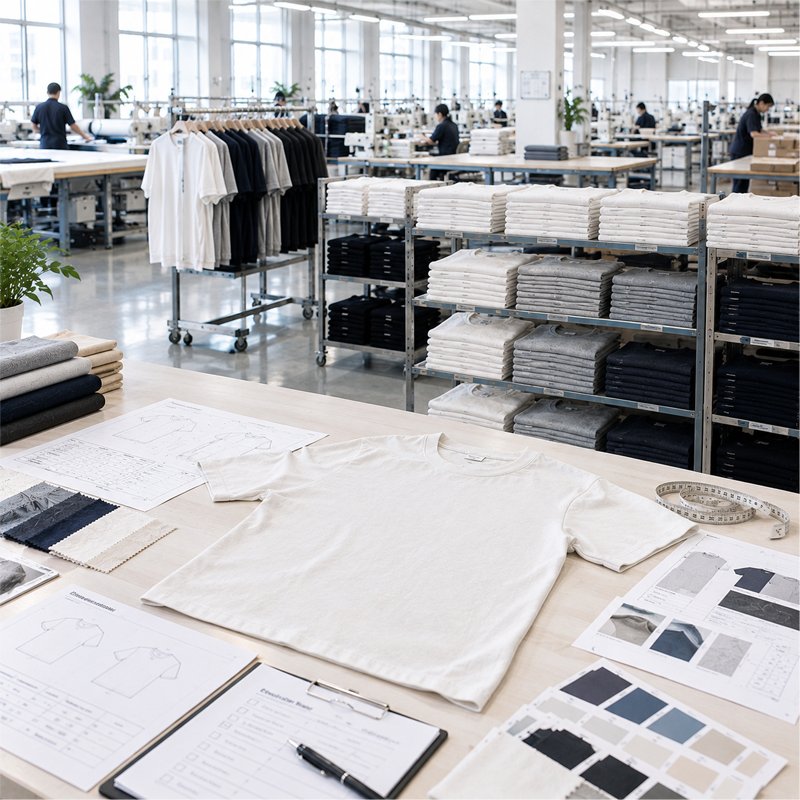
For an emerging apparel brand, T-shirts can be an effective starting point because they are versatile and relatively easy to develop compared with more technically complex garments.
Brands can use bulk T-shirt production to establish:
- Signature colors
- Brand graphics
- Core fits
- Seasonal collections
- Repeatable product lines
Once a successful product is established, the same manufacturing partner may also support additional apparel categories.
Conclusion
Ordering bulk custom T-shirts requires more planning than simply choosing a garment and adding a logo.
Brands should carefully define:
- Tissu
- Ajustement
- Couleurs
- Sizes
- Œuvre d'art
- Décoration
- Quantité
- Exigences de qualité
A reliable manufacturer can help coordinate these requirements from sampling through bulk production.
The most important step is to establish clear specifications and approve the actual sample before production begins.
With proper planning, bulk custom T-shirt manufacturing can provide brands with consistent products and a scalable foundation for future apparel collections.











