




T-Shirt Manufacturer: How to Choose the Right Supplier for Your Brand
公開日時:2026-09-14 カテゴリ:ニュース 閲覧数:513
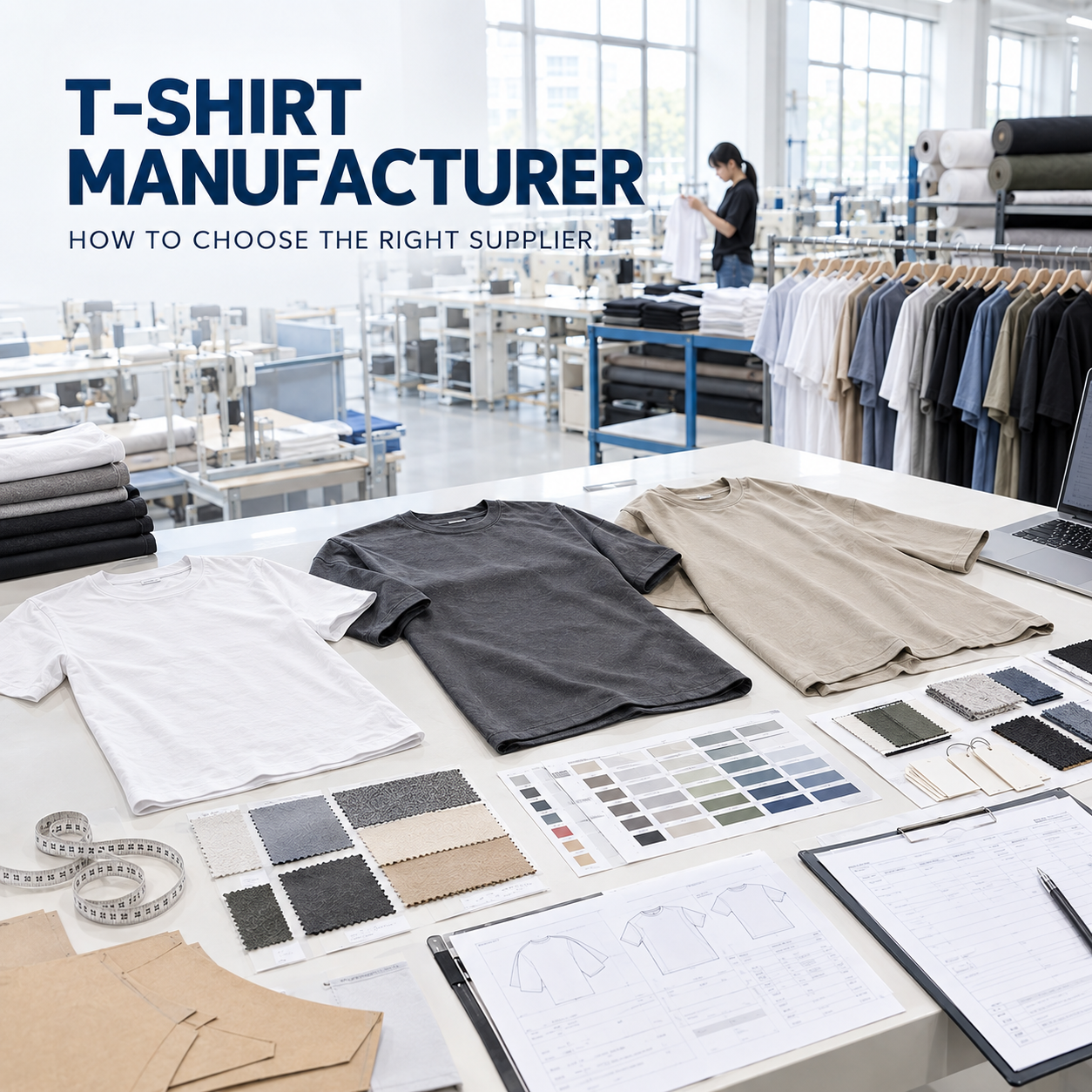
適切なものを見つける t-shirt manufacturer is an important step for any clothing brand, retailer, wholesaler, or private-label business. The right supplier can help you control quality, manage production costs, and keep your product consistent as your orders grow.
T-shirts look simple. Production is not. Fabric choice, GSM, fit, stitching, shrinkage, color, printing, and sizing all affect the final product. A reliable supplier should understand these details and turn your specifications into stable bulk production.
This guide explains what to check before choosing a T-shirt manufacturing partner.
1. What Does a T-Shirt Manufacturer Do?
A T-shirt manufacturer produces garments based on a buyer's design and production requirements.
Depending on the supplier, services may include:
- 生地の調達
- パターンの開発
- 試作
- 切断
- 裁縫
- 印刷
- 刺繍
- Washing
- Label application
- Quality inspection
- パッケージ
- 量産
Some factories focus on basic T-shirts. Others specialize in premium, oversized, organic, promotional, or performance styles.
Example: Choosing a Supplier for a New Collection
A streetwear brand wants to launch three T-shirt styles.
The first style uses a standard cotton jersey.
The second uses heavyweight cotton.
The third has an oversized fit with custom printing.
A manufacturer experienced in these constructions can usually provide better development support than a supplier focused only on basic promotional T-shirts.
The product requirements should match the factory's real capabilities.
2. Custom T-Shirt Manufacturer: What Can You Customize?
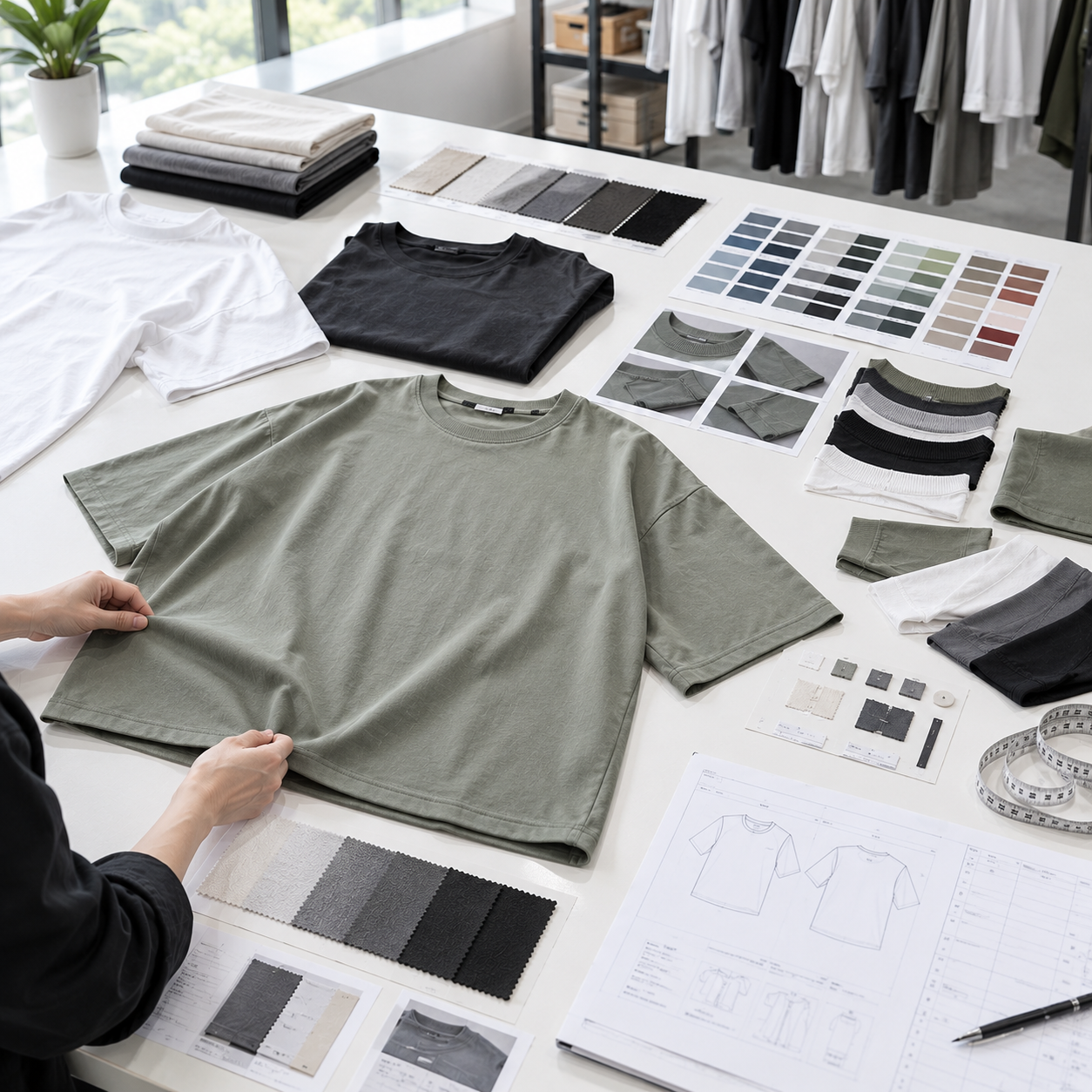
A custom T-shirt manufacturer should be able to work from a tech pack, reference sample, design drawing, or detailed specifications.
Common customization options include:
- 生地の組成
- Fabric GSM
- 服のフィット感
- Body length
- Sleeve length
- Neck construction
- Rib specifications
- Garment color
- 印刷
- 刺繍
- Woven labels
- ハンガータグ
- パッケージ
Customization levels vary between manufacturers.
Example: Developing an Oversized T-Shirt
Suppose a streetwear brand wants a heavyweight oversized T-shirt.
The specification may include:
- 260 GSM cotton jersey
- Dropped shoulders
- Wider body
- Longer sleeves
- Reinforced neck rib
- Custom garment dye
- Front embroidery
These changes affect fabric consumption, pattern construction, sewing time, and production cost.
A capable manufacturer should explain these effects before bulk production.
3. Wholesale T-Shirt Manufacturer: What Should Buyers Check?
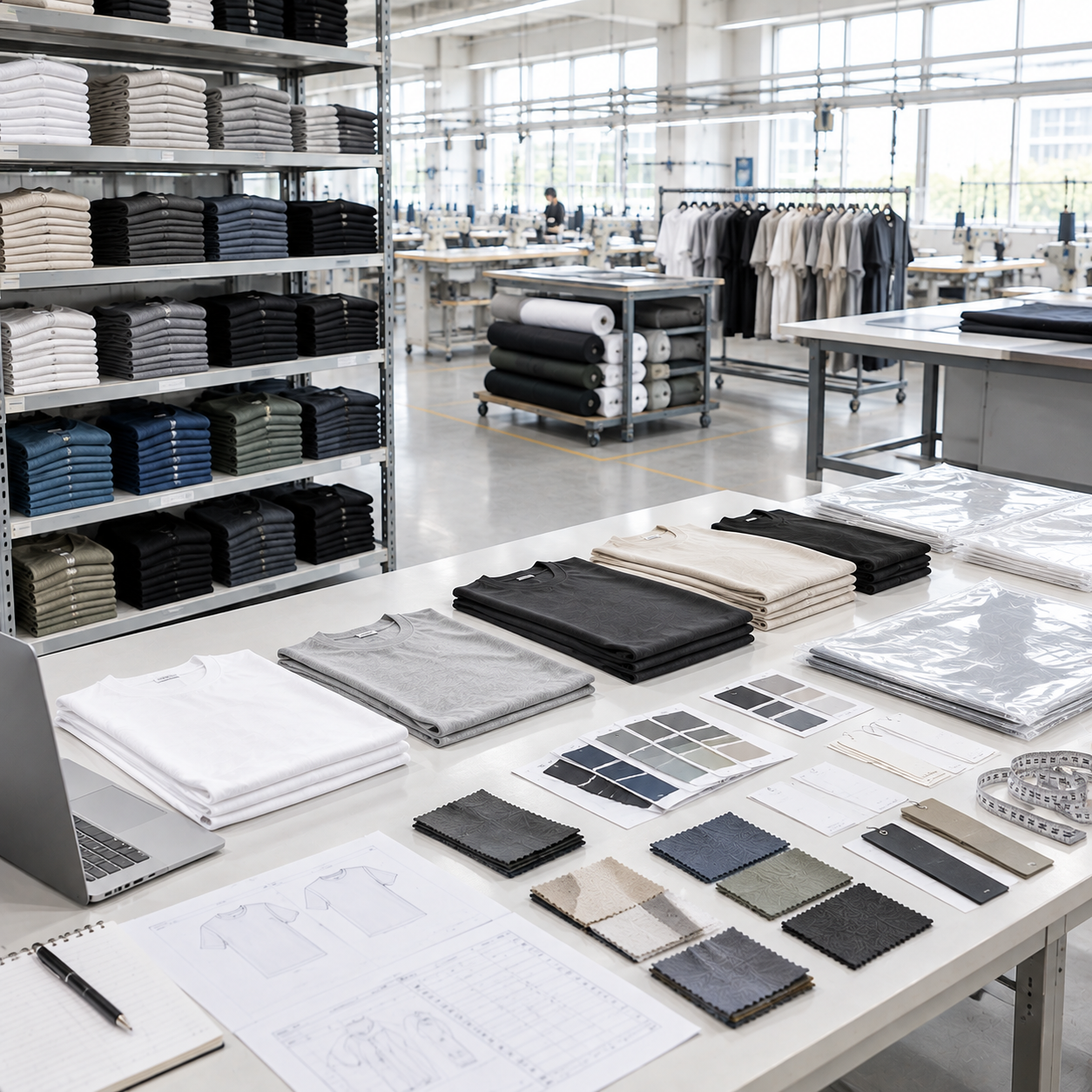
A wholesale T-shirt manufacturer usually handles larger production quantities. Buyers should look beyond the unit price.
Compare suppliers based on:
| 因子 | 確認すべき事項 | その重要性 |
|---|---|---|
| 最小発注数量(MOQ) | Quantity per style and color | Controls inventory |
| 生地 | Composition and GSM | Affects quality and cost |
| サンプリング | Development process | Reduces production risk |
| リードタイム | Sample and bulk timeline | 立ち上げ計画の策定を支援 |
| 品質管理 | Inspection standards | 一貫性を確保する |
| カスタマイズ | 利用可能なオプション | Supports product identity |
| Capacity | Production capability | 成長を促進する |
| パッケージ | ラベルと梱包 | Supports retail sales |
Example: Comparing Two Quotes
Supplier A offers a T-shirt at $3.80.
Supplier B quotes $4.10.
Supplier A may look cheaper.
But if Supplier B uses more stable fabric, provides better samples, and has stronger quality control, the additional cost may be justified.
Compare the complete production package.
Do not compare unit prices without comparing specifications.
4. Private Label T-Shirt Manufacturer: How Does It Work?

A private label T-shirt manufacturer produces garments under your own brand identity.
This model works well for:
- Fashion brands
- Streetwear labels
- E-commerce businesses
- Retailers
- Promotional businesses
- Lifestyle brands
- Corporate clothing suppliers
Private-label production may include:
- Neck labels
- サイズ表示
- Woven labels
- ハンガータグ
- 特注パッケージ
- 印刷
- 刺繍
- カスタムカラー
Example: Building a Private Label T-Shirt
A new brand starts with a blank heavyweight T-shirt.
The brand then develops its own fit, color palette, neck label, hang tag, packaging, and artwork.
The finished garment becomes part of the brand's product system rather than a generic blank product.
Consistency matters.
The same brand should maintain stable measurements, colors, fabric quality, and branding details across future orders.
5. How to Choose a T-Shirt Manufacturer
Choosing a t-shirt manufacturer requires more than checking a website.
Look at actual production experience.
5.1 Check Product Experience
Ask what types of T-shirts the factory produces regularly.
Relevant experience may include:
- Basic T-shirts
- Heavyweight T-shirts
- Oversized T-shirts
- Premium cotton T-shirts
- Organic cotton T-shirts
- Garment-dyed T-shirts
- Printed T-shirts
- Embroidered T-shirts
- Performance T-shirts
Example: Heavyweight vs. Lightweight T-Shirts
A lightweight 160 GSM T-shirt requires different handling from a 280 GSM heavyweight style.
The heavier garment may need different sewing settings, pattern considerations, and finishing processes.
A factory should understand these differences before quoting production.
6. T-Shirt Fabric Selection

Fabric is one of the biggest factors affecting T-shirt quality.
Common options include:
- 100% cotton
- Cotton-polyester blends
- Organic cotton
- Recycled blends
- ポリエステル
- Cotton-spandex
- Performance jersey
Buyers should consider more than fiber composition.
Important specifications include:
- GSM
- Hand feel
- ストレッチ
- Shrinkage
- ピリング耐性
- 色堅牢度
- 通気性
- 耐久性
- Fabric construction
Example: 180 GSM vs. 260 GSM
An 180 GSM cotton T-shirt usually feels lighter and more breathable.
A 260 GSM T-shirt generally feels heavier and more substantial.
Neither is automatically better.
The right choice depends on the target product and market.
A summer basics brand may prefer a lighter fabric.
A streetwear brand may prefer heavyweight jersey.
7. T-Shirt Sampling and Product Development
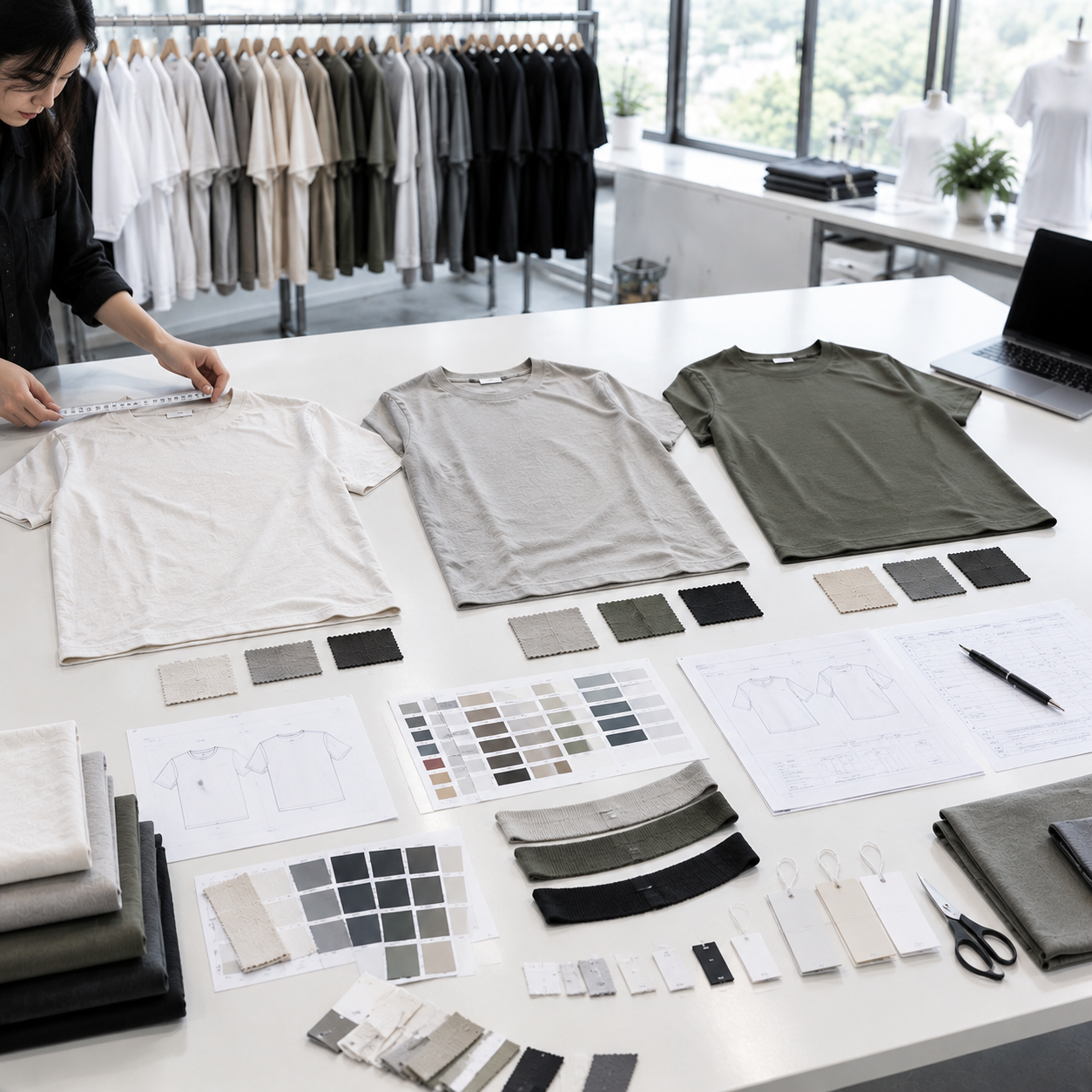
Sampling is a critical step before bulk production.
A typical process may include:
- 設計レビュー
- テックパックのレビュー
- 生地の選定
- 最初のサンプル
- フィット感のレビュー
- パターンの調整
- Revised sample
- 試作サンプル
- 量産
What Should You Check?
確認:
- Chest measurement
- Body length
- Shoulder width
- Sleeve length
- Neck opening
- Neck rib
- 縫い目の構造
- 生地の重さ
- 色
- Print position
- 刺繍
- ラベルの位置
Example: Fixing Fit Before Bulk Production
A brand orders a sample for an oversized T-shirt.
The chest width looks correct.
But the sleeve opening is too narrow.
The problem can be corrected during the sample stage.
If the brand discovers it after producing 3,000 pieces, the correction becomes much more expensive.
A sample is a production checkpoint, not just a visual preview.
8. T-Shirt Printing and Embroidery
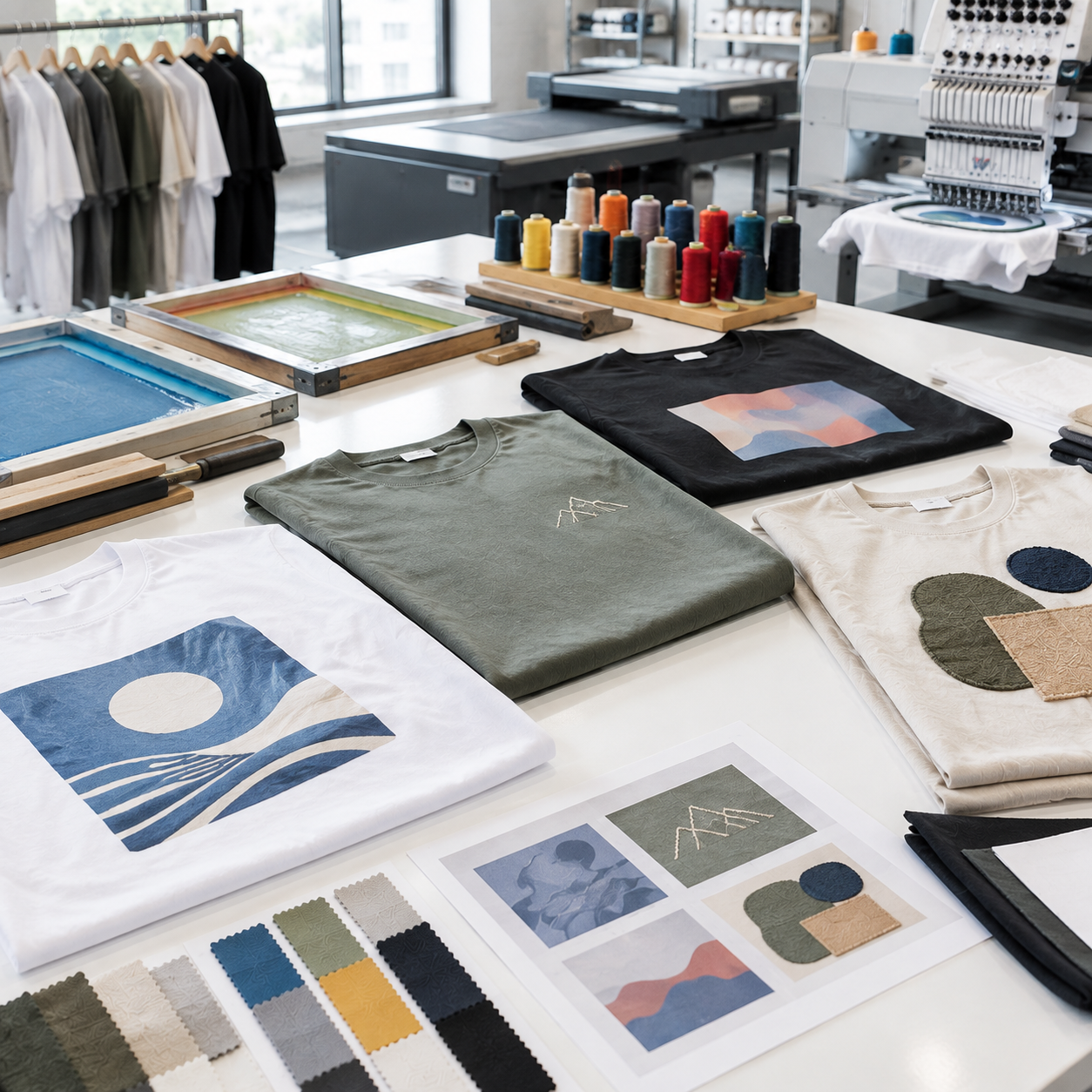
Decoration can change the production process significantly.
Common options include:
- Screen printing
- Digital printing
- Heat transfer
- 刺繍
- Appliqué
- Embossing
- Special-effect printing
Each method has different advantages.
Example: Screen Printing vs. Embroidery
A large graphic across the front of a T-shirt may work well with screen printing.
A small chest logo may work better with embroidery.
The right method depends on artwork size, fabric, quantity, appearance, and budget.
A good manufacturer should recommend a suitable decoration method instead of automatically using the cheapest option.
9. T-Shirt Quality Control
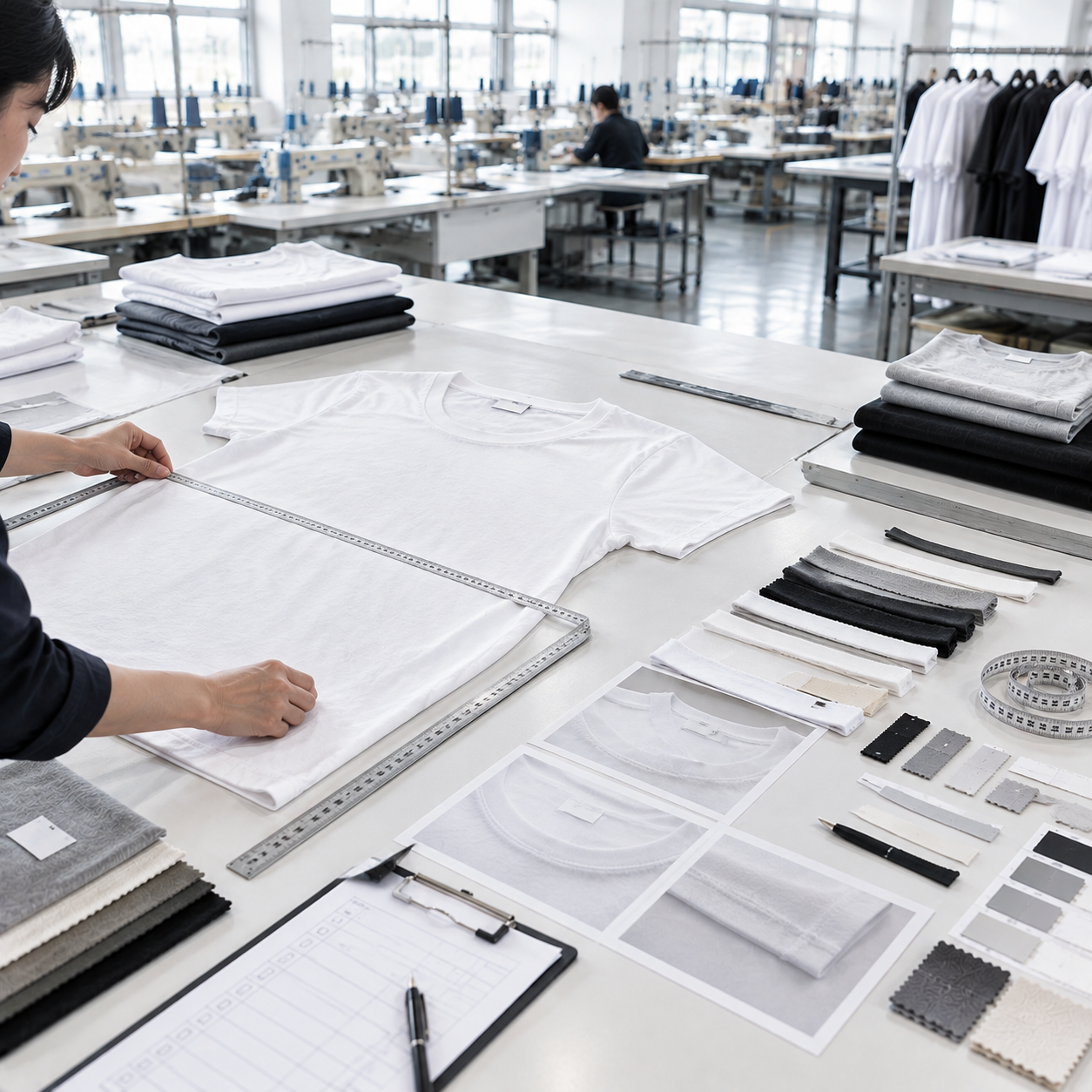
Quality control should start before sewing.
A professional process can include:
- 生地の検査
- 色検査
- Pre-production sample approval
- 切断検査
- 縫製検査
- 測定の確認
- Printing inspection
- Embroidery inspection
- 完成品の最終検査
- 梱包検査
Common T-Shirt Quality Problems
注目すべき点:
- Uneven stitching
- ほつれ
- 測定値の誤り
- ねじれた縫い目
- Neckline distortion
- Fabric holes
- 色のバリエーション
- Shrinkage
- Print cracking
- Misaligned artwork
- Poor embroidery
Example: Shrinkage After Washing
A T-shirt may fit correctly before washing.
After washing, the body length may become shorter.
This can create serious sizing problems.
For this reason, buyers should discuss shrinkage expectations and finishing requirements before approving bulk production.
10. How Much Does a T-Shirt Manufacturer Charge?
T-shirt pricing depends on the complete specification.
Key cost factors include:
- 生地の組成
- GSM
- 生地の品質
- Garment weight
- Pattern complexity
- Sewing construction
- 印刷
- 刺繍
- ラベル
- パッケージ
- 注文数量
- Finishing process
Example: Two T-Shirts With Different Costs
| 特集 | Basic T-Shirt | Premium T-Shirt |
|---|---|---|
| 生地 | Standard cotton | Premium heavyweight cotton |
| GSM | 下へ | より高い |
| フィット | 標準 | カスタム |
| Decoration | なし | 刺繍 |
| ラベル | 標準 | カスタム |
| パッケージ | Basic | カスタム |
| 開発 | シンプル | Detailed |
| 製造コスト | 下へ | より高い |
The product specification should always come first.
Once specifications are fixed, supplier quotations become much easier to compare.
11. T-Shirt Manufacturer vs. Trading Company
Some suppliers operate their own factories.
Others coordinate production through partner factories.
どちらのモデルも機能します。.
The right choice depends on your business needs.
| 因子 | メーカー直販 | 商社 |
|---|---|---|
| 工場間の連携 | ダイレクト | Through supplier |
| 生産管理 | 通常は高い | パートナー次第です |
| 製品開発 | 多くの場合、より強い | 場合による |
| Factory Network | Own capacity | 複数の工場にアクセスできる場合があります |
| 製品ラインナップ | Based on own capability | さらに広がりを見せる可能性がある |
| Pricing | 直接生産 | サービスマージンが含まれる場合があります |
| おすすめ | Long-term production | Multi-category sourcing |
Example: When a Trading Company Helps
A retailer needs T-shirts, jackets, bags, and accessories.
Working with multiple factories can become difficult.
A trading company may coordinate different suppliers.
But a brand developing a specialized T-shirt collection may prefer direct communication with a manufacturer.
The right model depends on your production strategy.
12. Questions to Ask a T-Shirt Manufacturer
Prepare a supplier questionnaire before requesting a quotation.
質問:
- What T-shirt products do you specialize in?
- What fabrics can you source?
- What GSM options are available?
- 最小注文数量(MOQ)はどのくらいですか?
- Is MOQ calculated by style or color?
- カスタムサンプルの開発は可能ですか?
- テックパックに基づいて作業できますか?
- What printing methods do you offer?
- Can you provide embroidery?
- Can you produce private-label garments?
- サンプルの納期はどのくらいですか?
- 大量生産のリードタイムはどのくらいですか?
- How do you control quality?
- どのような梱包オプションがありますか?
- What export markets do you serve?
Clear questions lead to more accurate quotations.
They also make supplier comparison easier.
13. How to Compare T-Shirt Manufacturers
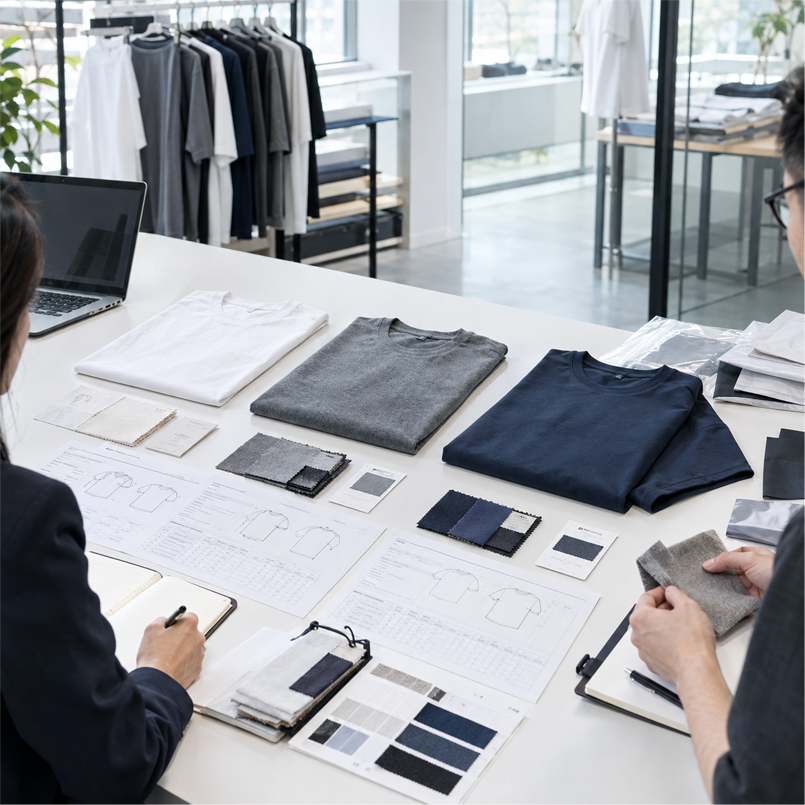
Do not select a supplier based only on price.
Build a simple supplier scorecard.
| 評価対象領域 | サプライヤーA | サプライヤーB | サプライヤーC |
|---|---|---|---|
| T-Shirt Experience | 高い | 中 | 高い |
| 生地の種類 | 高い | 高い | 中 |
| 最小発注数量(MOQ)の柔軟性 | 中 | 高い | 低 |
| サンプル開発 | 高い | 中 | 高い |
| 印刷 | 高い | 中 | 高い |
| 品質管理 | 高い | 中 | 高い |
| 生産能力 | 中 | 高い | 高い |
| 価格 | 中 | 高い | 中 |
Example: Choosing for a New Brand
A new clothing brand may prioritize:
- 最小発注数量(MOQ)が低い
- Sample flexibility
- カスタマイズ
- 競争力のある価格設定
An established retailer may prioritize:
- 生産能力
- Stable quality
- Consistent fabric
- Reliable delivery
There is no universal "best" supplier.
The best supplier is the one that matches your actual production requirements.
14. T-Shirt Production Capacity and Scalability
A manufacturer may handle a 500-piece order successfully.
That does not automatically mean they can handle 10,000 pieces.
規模拡大を行う前に、生産能力について確認してください。.
確認:
- 月間生産能力
- Number of sewing lines
- Fabric sourcing capability
- Quality control team
- Sample room
- 生産スケジューリング
- 繁忙期の収容能力
例:500個から5,000個への生産拡大
A brand starts with 500 T-shirts.
The product performs well.
次の注文は5,000個に達する。.
The supplier now needs to maintain the same fabric, measurements, color, stitching, and finishing across a much larger production run.
A scalable manufacturer should have systems in place to control these variables.
15. T-Shirt Manufacturer Checklist
Before approving a supplier, review:
- 製品体験
- Fabric options
- GSM specifications
- 最小発注数量(MOQ)
- サンプルの開発
- テックパックの対応能力
- Printing options
- Embroidery options
- プライベートブランドサービス
- 品質管理
- 生産能力
- リードタイム
- パッケージ
- 配送条件
- 最終見積書
A clear checklist reduces mistakes.
It also helps buyers compare several manufacturers using the same criteria.
16. Finding the Right T-Shirt Manufacturer
右 t-shirt manufacturer should fit your product, market, order volume, quality expectations, and growth plan.
Start with your product specifications.
Define the fabric, GSM, fit, measurements, colors, decoration, labels, packaging, and quantity.
Then evaluate manufacturers based on their actual capabilities.
Request samples before placing a large order.
品質管理を確認してください。.
Confirm MOQ and production lead times.
Compare quotations using identical specifications.
Price matters.
But consistent quality, reliable production, and clear communication matter just as much.
A strong manufacturing partner should help you move from design to sample, from sample to bulk production, and from a small launch to long-term growth.











