




Výrobca tričiek: Ako vybrať toho správneho dodávateľa pre vašu značku
Dátum zverejnenia:2026-09-14 Kategória:SPRÁVY Počet zobrazení:518
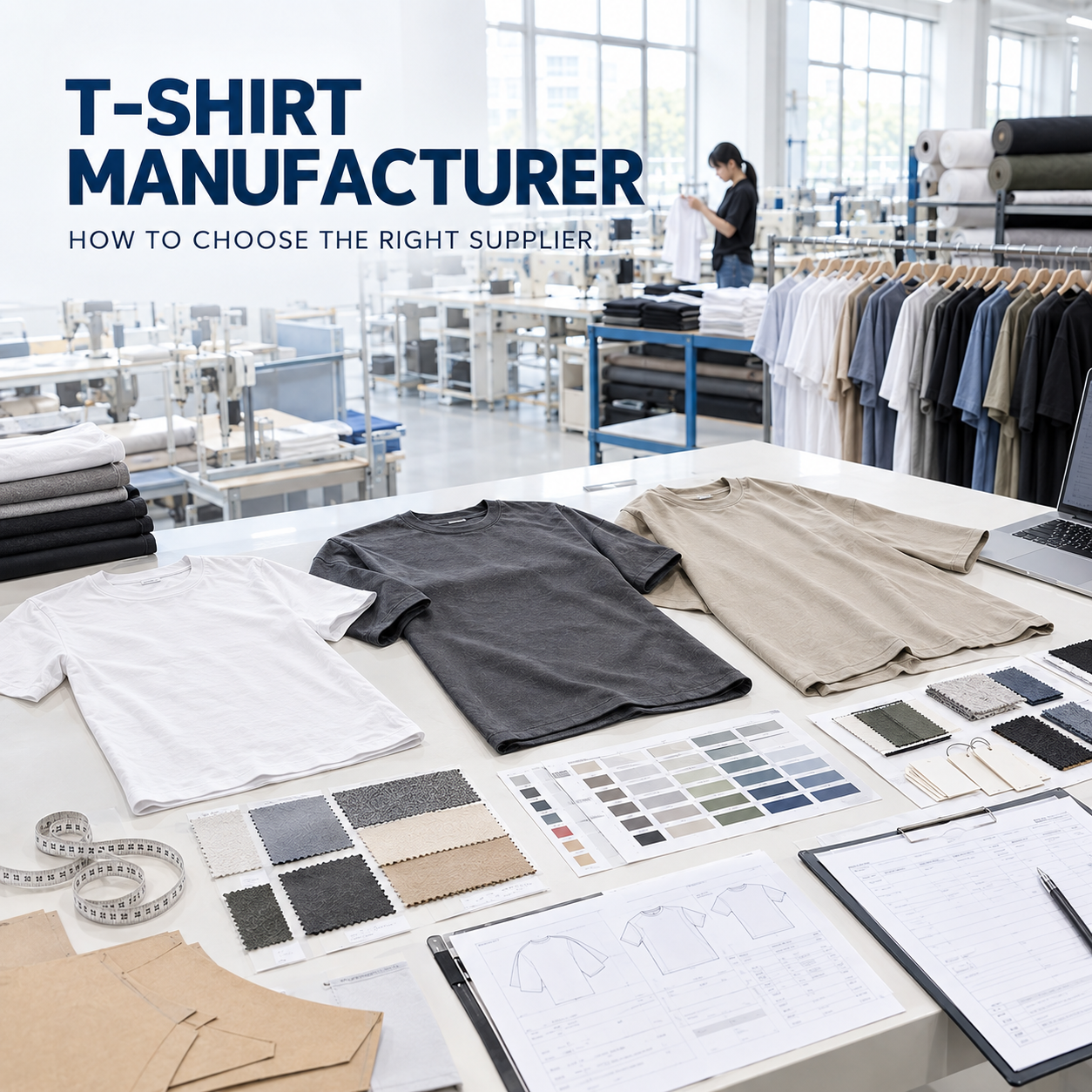
Nájdenie toho správneho t-shirt manufacturer is an important step for any clothing brand, retailer, wholesaler, or private-label business. The right supplier can help you control quality, manage production costs, and keep your product consistent as your orders grow.
T-shirts look simple. Production is not. Fabric choice, GSM, fit, stitching, shrinkage, color, printing, and sizing all affect the final product. A reliable supplier should understand these details and turn your specifications into stable bulk production.
This guide explains what to check before choosing a T-shirt manufacturing partner.
1. What Does a T-Shirt Manufacturer Do?
A T-shirt manufacturer produces garments based on a buyer's design and production requirements.
Depending on the supplier, services may include:
- Získavanie textílií
- Pattern development
- Sample making
- Rezanie
- Šitie
- Tlač
- Výšivka
- Washing
- Label application
- Kontrola kvality
- Balenie
- Bulk production
Some factories focus on basic T-shirts. Others specialize in premium, oversized, organic, promotional, or performance styles.
Example: Choosing a Supplier for a New Collection
A streetwear brand wants to launch three T-shirt styles.
The first style uses a standard cotton jersey.
The second uses heavyweight cotton.
The third has an oversized fit with custom printing.
A manufacturer experienced in these constructions can usually provide better development support than a supplier focused only on basic promotional T-shirts.
The product requirements should match the factory's real capabilities.
2. Custom T-Shirt Manufacturer: What Can You Customize?
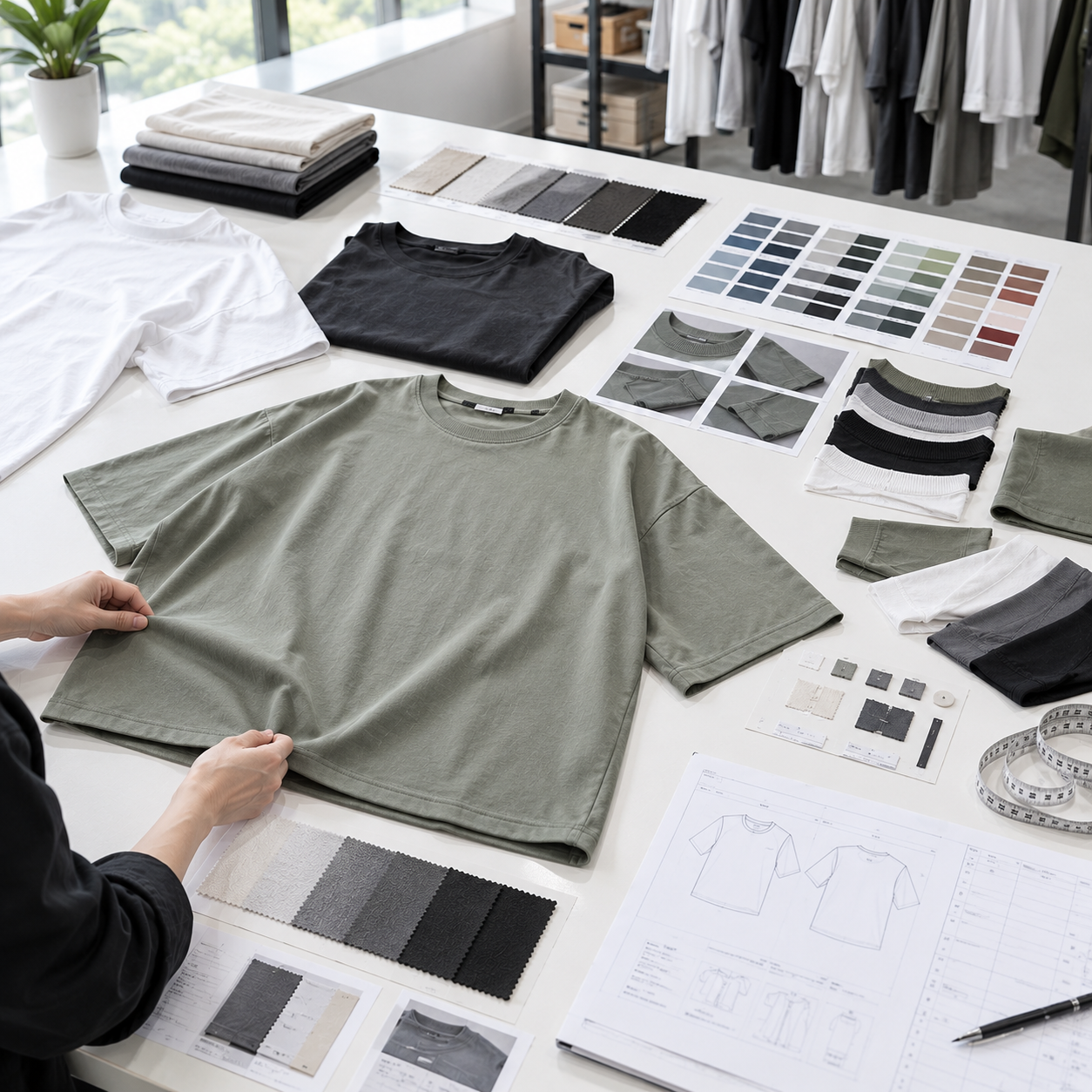
A custom T-shirt manufacturer should be able to work from a tech pack, reference sample, design drawing, or detailed specifications.
Common customization options include:
- Zloženie tkaniny
- Fabric GSM
- Garment fit
- Dĺžka tela
- Dĺžka rukáva
- Neck construction
- Rib specifications
- Farba odevu
- Tlač
- Výšivka
- Tkané štítky
- Visiace štítky
- Balenie
Customization levels vary between manufacturers.
Example: Developing an Oversized T-Shirt
Suppose a streetwear brand wants a heavyweight oversized T-shirt.
The specification may include:
- 260 GSM cotton jersey
- Dropped shoulders
- Wider body
- Longer sleeves
- Reinforced neck rib
- Custom garment dye
- Front embroidery
These changes affect fabric consumption, pattern construction, sewing time, and production cost.
A capable manufacturer should explain these effects before bulk production.
3. Wholesale T-Shirt Manufacturer: What Should Buyers Check?
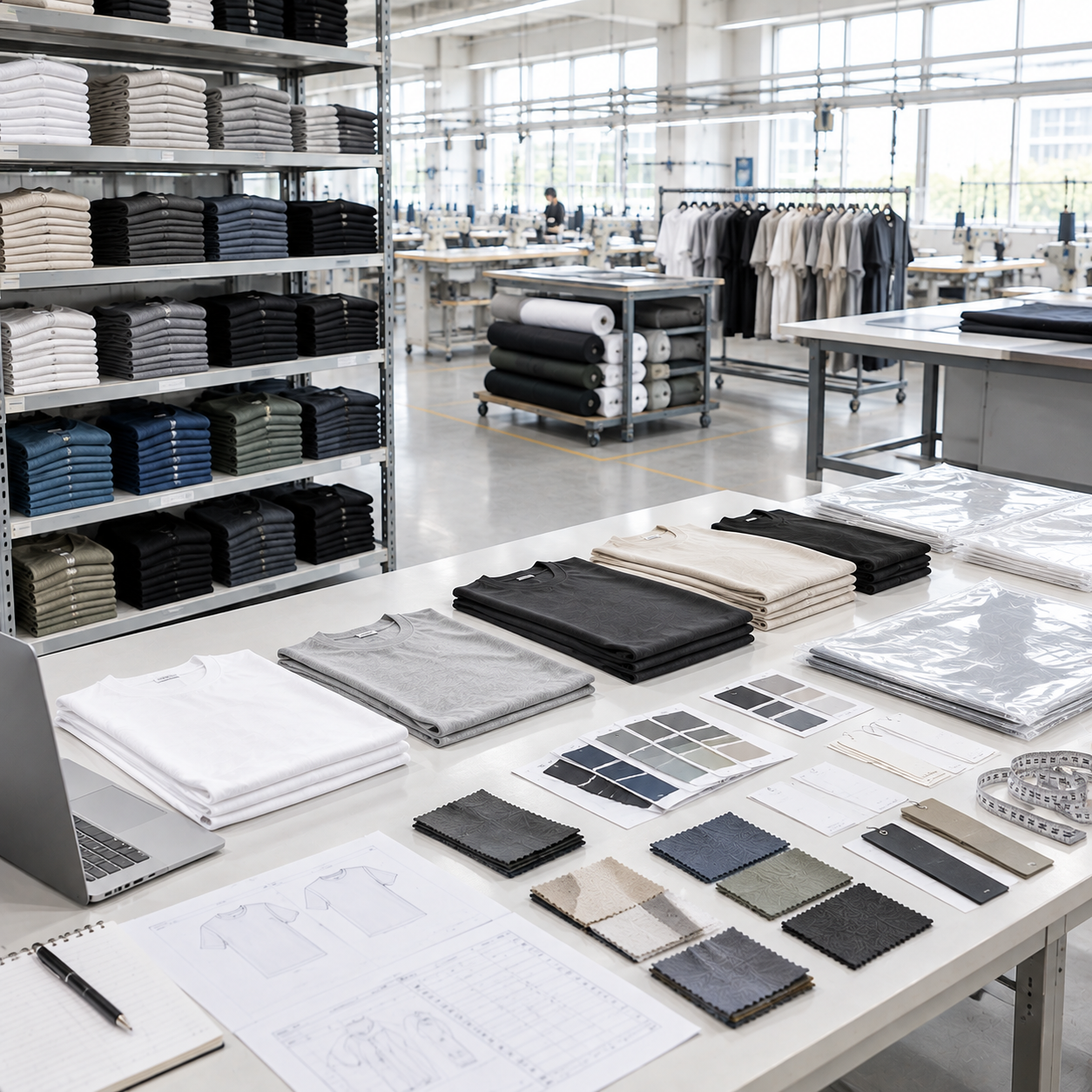
A wholesale T-shirt manufacturer usually handles larger production quantities. Buyers should look beyond the unit price.
Compare suppliers based on:
| Faktor | What to Check | Why It Matters |
|---|---|---|
| Minimálne objednané množstvo | Quantity per style and color | Controls inventory |
| Tkanina | Composition and GSM | Affects quality and cost |
| Odber vzoriek | Development process | Reduces production risk |
| Lead Time | Sample and bulk timeline | Supports launch planning |
| Kontrola kvality | Inspection standards | Protects consistency |
| Prispôsobenie | Available options | Supports product identity |
| Kapacita | Production capability | Supports growth |
| Balenie | Labels and packing | Supports retail sales |
Example: Comparing Two Quotes
Supplier A offers a T-shirt at $3.80.
Supplier B quotes $4.10.
Supplier A may look cheaper.
But if Supplier B uses more stable fabric, provides better samples, and has stronger quality control, the additional cost may be justified.
Compare the complete production package.
Do not compare unit prices without comparing specifications.
4. Private Label T-Shirt Manufacturer: How Does It Work?
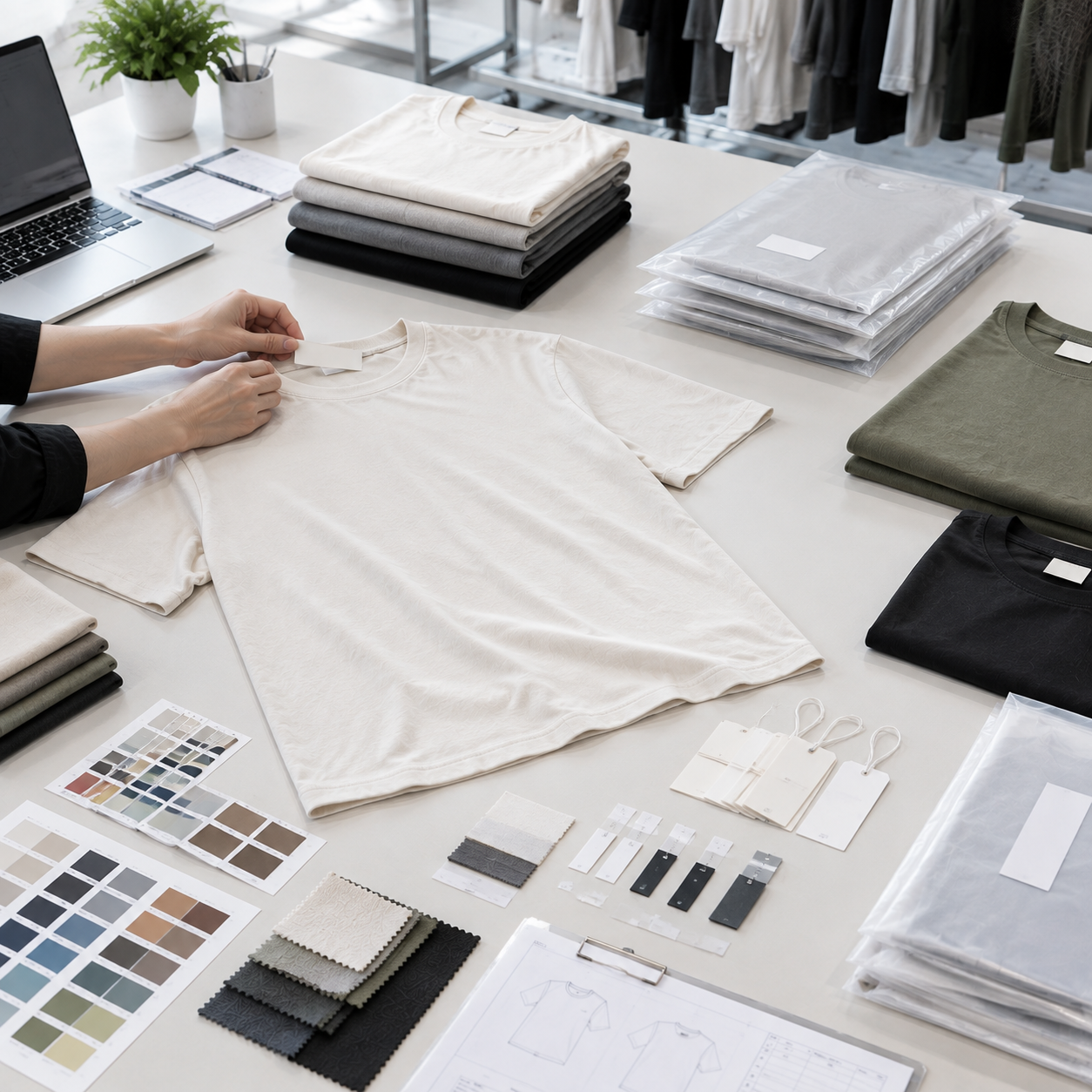
A private label T-shirt manufacturer produces garments under your own brand identity.
This model works well for:
- Fashion brands
- Streetwear labels
- E-commerce businesses
- Retailers
- Promotional businesses
- Lifestyle brands
- Corporate clothing suppliers
Private-label production may include:
- Neck labels
- Štíky s veľkosťou
- Tkané štítky
- Visiace štítky
- Balenie na mieru
- Tlač
- Výšivka
- Vlastné farby
Example: Building a Private Label T-Shirt
A new brand starts with a blank heavyweight T-shirt.
The brand then develops its own fit, color palette, neck label, hang tag, packaging, and artwork.
The finished garment becomes part of the brand's product system rather than a generic blank product.
Consistency matters.
The same brand should maintain stable measurements, colors, fabric quality, and branding details across future orders.
5. How to Choose a T-Shirt Manufacturer
Výber t-shirt manufacturer requires more than checking a website.
Look at actual production experience.
5.1 Check Product Experience
Ask what types of T-shirts the factory produces regularly.
Relevant experience may include:
- Basic T-shirts
- Heavyweight T-shirts
- Tričká vo veľkých veľkostiach
- Premium cotton T-shirts
- Organic cotton T-shirts
- Garment-dyed T-shirts
- Printed T-shirts
- Embroidered T-shirts
- Performance T-shirts
Example: Heavyweight vs. Lightweight T-Shirts
A lightweight 160 GSM T-shirt requires different handling from a 280 GSM heavyweight style.
The heavier garment may need different sewing settings, pattern considerations, and finishing processes.
A factory should understand these differences before quoting production.
6. T-Shirt Fabric Selection

Fabric is one of the biggest factors affecting T-shirt quality.
Common options include:
- 100% cotton
- Cotton-polyester blends
- Organic cotton
- Recycled blends
- Polyester
- Cotton-spandex
- Performance jersey
Buyers should consider more than fiber composition.
Important specifications include:
- GSM
- Pocit v rukách
- Strečing
- Shrinkage
- Odolnosť proti žmolkovaniu
- Colorfastness
- Breathability
- Trvanlivosť
- Fabric construction
Example: 180 GSM vs. 260 GSM
An 180 GSM cotton T-shirt usually feels lighter and more breathable.
A 260 GSM T-shirt generally feels heavier and more substantial.
Neither is automatically better.
The right choice depends on the target product and market.
A summer basics brand may prefer a lighter fabric.
A streetwear brand may prefer heavyweight jersey.
7. T-Shirt Sampling and Product Development
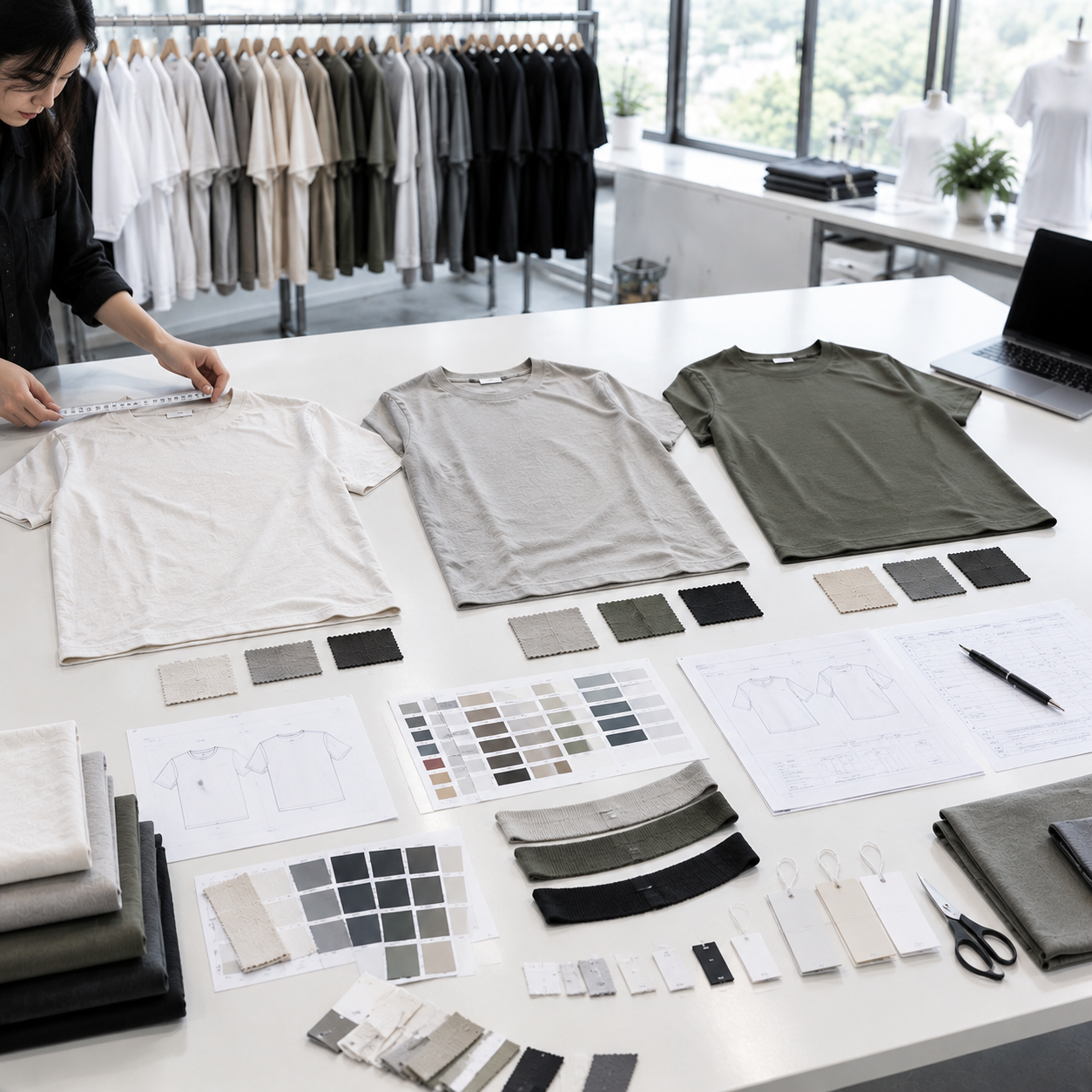
Sampling is a critical step before bulk production.
A typical process may include:
- Design review
- Tech pack review
- Výber látky
- First sample
- Fit review
- Pattern adjustment
- Revised sample
- Predvýrobný vzor
- Bulk production
What Should You Check?
Inspect:
- Chest measurement
- Dĺžka tela
- Shoulder width
- Dĺžka rukáva
- Neck opening
- Neck rib
- Seam construction
- Hmotnosť tkaniny
- Farba
- Print position
- Výšivka
- Label position
Example: Fixing Fit Before Bulk Production
A brand orders a sample for an oversized T-shirt.
The chest width looks correct.
But the sleeve opening is too narrow.
The problem can be corrected during the sample stage.
If the brand discovers it after producing 3,000 pieces, the correction becomes much more expensive.
A sample is a production checkpoint, not just a visual preview.
8. T-Shirt Printing and Embroidery
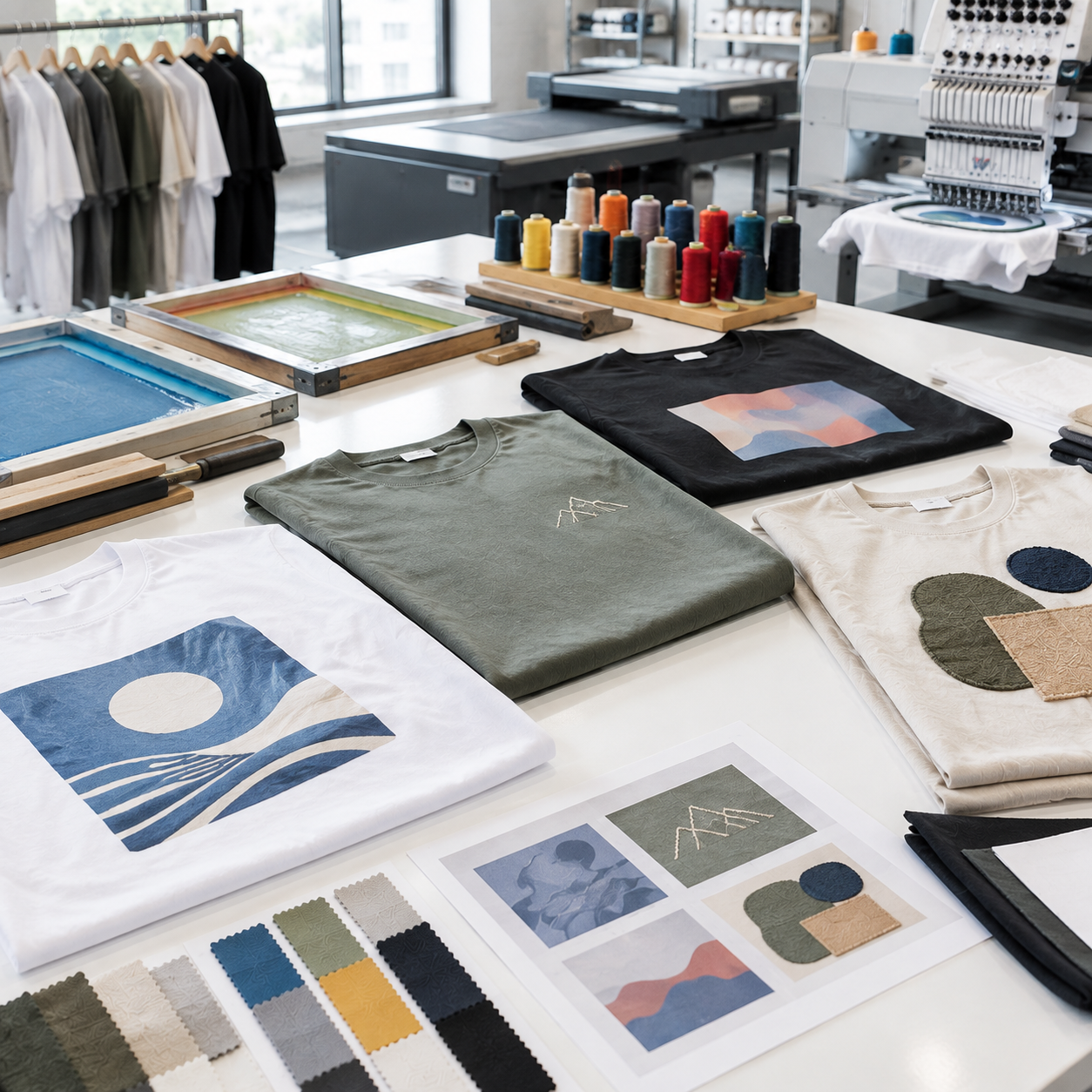
Decoration can change the production process significantly.
Common options include:
- Sieťotlač
- Digital printing
- Heat transfer
- Výšivka
- Appliqué
- Embossing
- Special-effect printing
Each method has different advantages.
Example: Screen Printing vs. Embroidery
A large graphic across the front of a T-shirt may work well with screen printing.
A small chest logo may work better with embroidery.
The right method depends on artwork size, fabric, quantity, appearance, and budget.
A good manufacturer should recommend a suitable decoration method instead of automatically using the cheapest option.
9. T-Shirt Quality Control
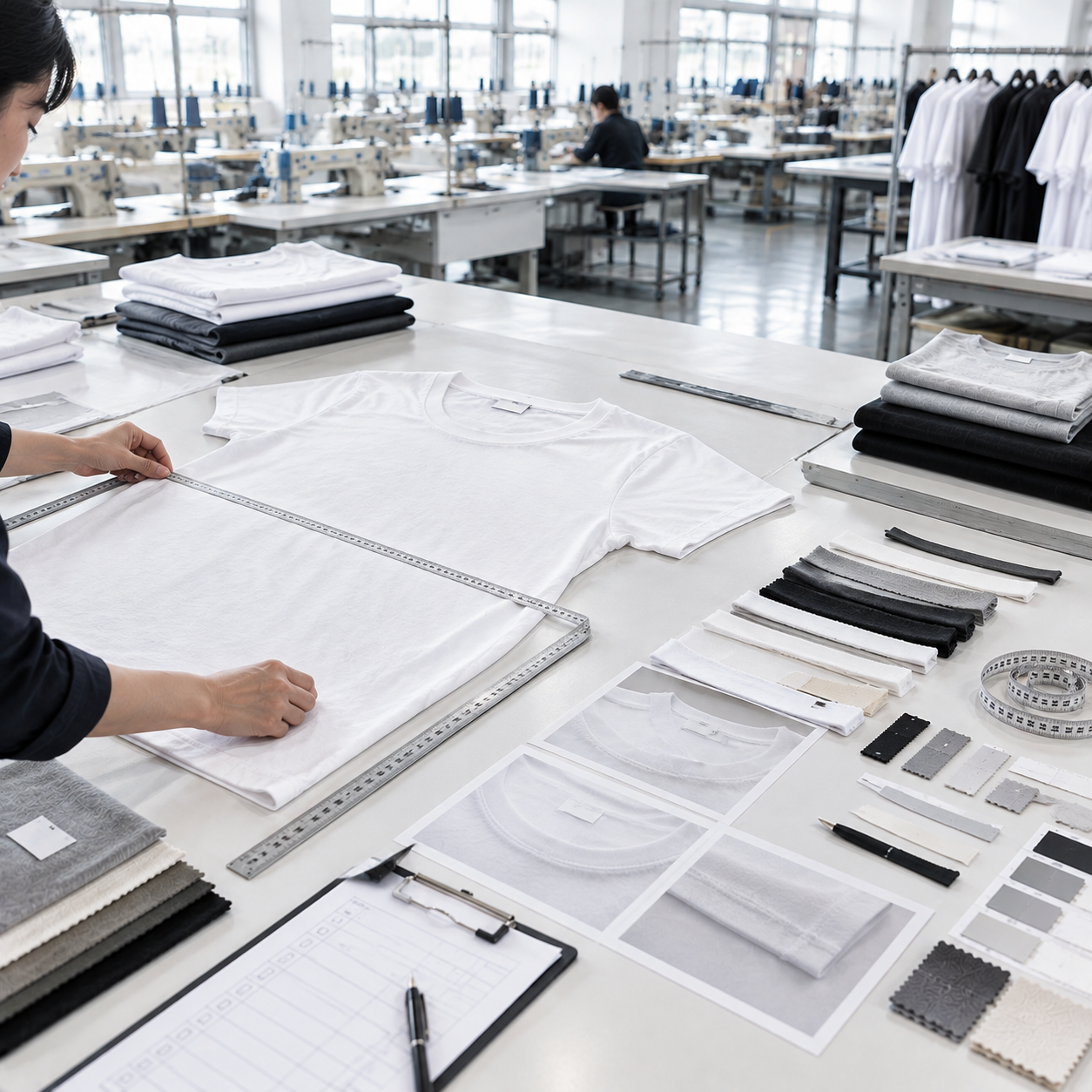
Quality control should start before sewing.
A professional process can include:
- Kontrola tkanín
- Color inspection
- Pre-production sample approval
- Cutting inspection
- Kontrola šitia
- Measurement checking
- Printing inspection
- Embroidery inspection
- Final garment inspection
- Packing inspection
Common T-Shirt Quality Problems
Watch for:
- Uneven stitching
- Loose threads
- Incorrect measurements
- Twisted seams
- Neckline distortion
- Fabric holes
- Color variation
- Shrinkage
- Print cracking
- Misaligned artwork
- Poor embroidery
Example: Shrinkage After Washing
A T-shirt may fit correctly before washing.
After washing, the body length may become shorter.
This can create serious sizing problems.
For this reason, buyers should discuss shrinkage expectations and finishing requirements before approving bulk production.
10. How Much Does a T-Shirt Manufacturer Charge?
T-shirt pricing depends on the complete specification.
Key cost factors include:
- Zloženie tkaniny
- GSM
- Fabric quality
- Garment weight
- Pattern complexity
- Sewing construction
- Tlač
- Výšivka
- Štítky
- Balenie
- Order quantity
- Finishing process
Example: Two T-Shirts With Different Costs
| Funkcia | Basic T-Shirt | Premium T-Shirt |
|---|---|---|
| Tkanina | Standard cotton | Premium heavyweight cotton |
| GSM | Nižšie | Vyššie |
| Vhodné | Standard | Custom |
| Dekorácia | None | Výšivka |
| Štítky | Standard | Custom |
| Balenie | Basic | Custom |
| Vývoj | Simple | Detailed |
| Production Cost | Nižšie | Vyššie |
The product specification should always come first.
Once specifications are fixed, supplier quotations become much easier to compare.
11. T-Shirt Manufacturer vs. Trading Company
Some suppliers operate their own factories.
Others coordinate production through partner factories.
Both models can work.
The right choice depends on your business needs.
| Faktor | Direct Manufacturer | Trading Company |
|---|---|---|
| Factory Communication | Direct | Through supplier |
| Production Control | Zvyčajne vyššia | Depends on partners |
| Vývoj produktov | Often stronger | Rôzne |
| Factory Network | Own capacity | May access multiple factories |
| Product Range | Based on own capability | Potentially broader |
| Pricing | Direct production | May include service margin |
| Best For | Long-term production | Multi-category sourcing |
Example: When a Trading Company Helps
A retailer needs T-shirts, jackets, bags, and accessories.
Working with multiple factories can become difficult.
A trading company may coordinate different suppliers.
But a brand developing a specialized T-shirt collection may prefer direct communication with a manufacturer.
The right model depends on your production strategy.
12. Questions to Ask a T-Shirt Manufacturer
Prepare a supplier questionnaire before requesting a quotation.
Opýtajte sa:
- What T-shirt products do you specialize in?
- What fabrics can you source?
- What GSM options are available?
- Aké je vaše minimálne objednané množstvo (MOQ)?
- Is MOQ calculated by style or color?
- Can you develop custom samples?
- Can you work from a tech pack?
- What printing methods do you offer?
- Can you provide embroidery?
- Can you produce private-label garments?
- What is your sample lead time?
- What is your bulk production lead time?
- How do you control quality?
- What packaging options are available?
- What export markets do you serve?
Clear questions lead to more accurate quotations.
They also make supplier comparison easier.
13. How to Compare T-Shirt Manufacturers

Do not select a supplier based only on price.
Build a simple supplier scorecard.
| Oblasť hodnotenia | Dodávateľ A | Dodávateľ B | Dodávateľ C |
|---|---|---|---|
| T-Shirt Experience | High | Medium | High |
| Fabric Options | High | High | Medium |
| Flexibilita v oblasti minimálneho objednaného množstva (MOQ) | Medium | High | Low |
| Vývoj vzoriek | High | Medium | High |
| Tlač | High | Medium | High |
| Kontrola kvality | High | Medium | High |
| Production Capacity | Medium | High | High |
| Cena | Medium | High | Medium |
Example: Choosing for a New Brand
A new clothing brand may prioritize:
- Low MOQ
- Sample flexibility
- Prispôsobenie
- Competitive pricing
An established retailer may prioritize:
- Výrobná kapacita
- Stable quality
- Consistent fabric
- Reliable delivery
There is no universal "best" supplier.
The best supplier is the one that matches your actual production requirements.
14. T-Shirt Production Capacity and Scalability
A manufacturer may handle a 500-piece order successfully.
That does not automatically mean they can handle 10,000 pieces.
Ask about production capacity before scaling.
Skontrolujte:
- Monthly production capacity
- Number of sewing lines
- Fabric sourcing capability
- Quality control team
- Sample room
- Production scheduling
- Peak-season capacity
Example: Scaling From 500 to 5,000 Pieces
A brand starts with 500 T-shirts.
The product performs well.
The next order reaches 5,000 pieces.
The supplier now needs to maintain the same fabric, measurements, color, stitching, and finishing across a much larger production run.
A scalable manufacturer should have systems in place to control these variables.
15. T-Shirt Manufacturer Checklist
Before approving a supplier, review:
- Skúsenosti s produktom
- Možnosti látok
- GSM specifications
- Minimálne objednané množstvo
- Vývoj vzoriek
- Tech pack capability
- Printing options
- Embroidery options
- Private-label services
- Kontrola kvality
- Výrobná kapacita
- Dodacia lehota
- Balenie
- Shipping terms
- Final quotation
A clear checklist reduces mistakes.
It also helps buyers compare several manufacturers using the same criteria.
16. Finding the Right T-Shirt Manufacturer
Pravá strana t-shirt manufacturer should fit your product, market, order volume, quality expectations, and growth plan.
Start with your product specifications.
Define the fabric, GSM, fit, measurements, colors, decoration, labels, packaging, and quantity.
Then evaluate manufacturers based on their actual capabilities.
Request samples before placing a large order.
Check quality control.
Confirm MOQ and production lead times.
Compare quotations using identical specifications.
Price matters.
But consistent quality, reliable production, and clear communication matter just as much.
A strong manufacturing partner should help you move from design to sample, from sample to bulk production, and from a small launch to long-term growth.











